Syrian forces capture Tabqa, nation’s largest dam amid swift push on Raqqa
 18 January 2026
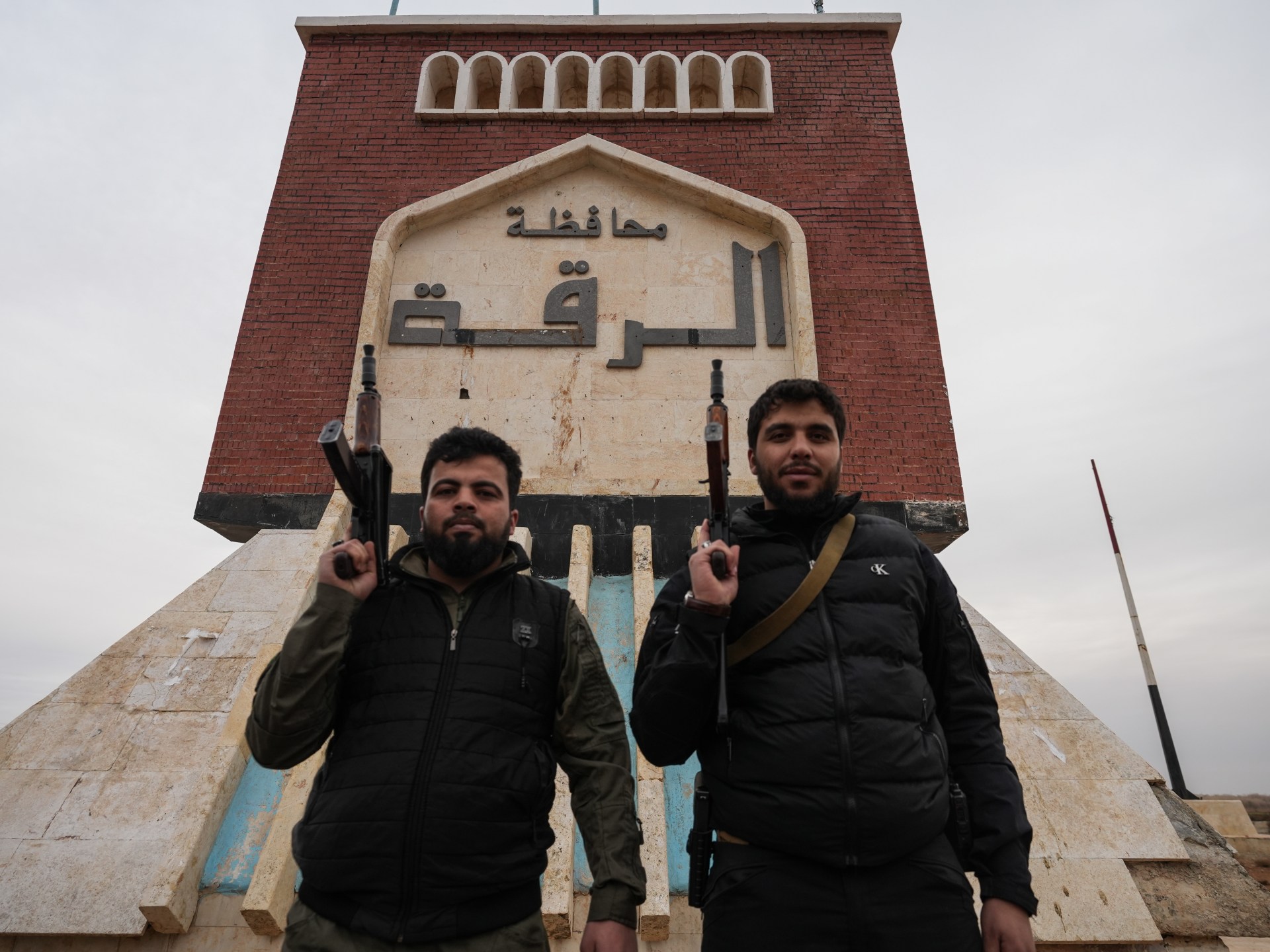

The Syrian army has taken full control of the strategic city of Tabqa and its military airport on the Euphrates River, expanding a rapid offensive in Raqqa province, state media reported.
Information Minister Hamza al-Mustafa said early on Sunday that government forces had secured Tabqa and the nearby Euphrates Dam, Syria’s largest, after expelling fighters linked to the Kurdistan Workers’ Party (PKK).
- list 1 of 3Syrian army takes control of east Aleppo towns as Kurdish fighters withdraw
- list 2 of 3US urges de-escalation as Syrian army advances on Kurdish-held territory
- list 3 of 3US says it killed al-Qaeda-affiliated leader tied to deadly Syria ambush
end of list
The Syrian government also condemned the alleged execution of prisoners and detainees in Tabqa by the Kurdish-led Syrian Democratic Forces (SDF) and PKK-affiliated groups.
The PKK has been labelled a “terrorist” group by Turkiye, the European Union and the United States.
In a statement relayed by al-Mustafa, Damascus said the killings, “especially of civilians”, amounted to “a fully-fledged crime under the Geneva Conventions” and a clear violation of international humanitarian law.
‘Rapid’ Syrian army takeover
Reporting from Aleppo, Al Jazeera’s Zein Basravi says the pace of fighting in northern Syria has accelerated sharply, with Syrian government troops rapidly shifting operations towards Raqqa.
“Rapid is the right word,” Basravi said, noting that clashes for neighbourhoods in Aleppo took place “less than two weeks ago”, while other SDF strongholds have returned to government control within the past 24 hours. “All of that feels like a history lesson overnight,” he added.
Basravi said Syrian forces have now redirected their military focus from Aleppo province towards Raqqa, advancing into territory held by the SDF. “What we are seeing now is this rapid advance of Syrian troops” from border towns towards key population centres, he said.
Advertisement
He reported unconfirmed fighting inside Tabqa, where Syrian forces appear poised to launch clearing operations similar to those carried out elsewhere.
According to Basravi, the military is moving quickly through Arab-majority towns where “there hasn’t always been organic support” for the Kurdish-led SDF.
The SDF, he said, is now facing “a massive pincer movement” stretching across Aleppo and Raqqa provinces, forcing retreats that appear increasingly defensive.
Videos circulating online showed SDF units evacuating a military hospital, while fighting intensified near the city’s southern entrance.
Raqqa was the self-declared capital of ISIL (ISIS) from January 2014 until its liberation in October 2017 by the US-backed SDF. The city was left in ruins and suffered atrocities and mass death under ISIL rule.
SDF fighters surrender
Local authorities said Raqqa’s water supply was cut after an explosion damaged main pipelines near the old bridge. State news agency Syrian Arab News Agency reported that the SDF blew up the bridge over the Euphrates.
The army’s operations command said its troops had earlier taken control of the Mansoura Dam and several nearby towns, placing them less than 5km (3 miles) from Raqqa’s western gate. It later reported that 64 SDF fighters surrendered in the Mansoura area after being encircled.
In a separate statement, the army said its units entered Tabqa “from several axes” while surrounding PKK fighters inside the military airport.
The advance followed the capture of multiple villages around al-Rasafa and a demand that SDF leaders withdraw east of the Euphrates.
Fighting also spread to eastern Deir Az Zor, where tribal forces said they were battling SDF units across several eastern towns in coordination with the Syrian army. A tribal military source said they had seized multiple positions and urged tribesmen within the SDF to lay down their arms.
The SDF, for its part, said government forces attacked its positions in several Deir Az Zor towns, as artillery shelling targeted areas east of the Euphrates. The army said it was sending reinforcements to the province as operations expanded across northeast Syria.
SDF losing territory
Speaking to Al Jazeera, William Lawrence, a former US diplomat in the region and now professor at the American University, said the current developments diverge from what was agreed in March last year.
“I am surprised by the speed,” Lawrence said, explaining that the March 10 agreement envisaged a phased withdrawal. “This was supposed to be a phased withdrawal under the March 10th agreement. The SDF is supposed to withdraw from the same areas, and the Syrian army is supposed to come in and replace it.”
Advertisement
Instead, he said, “the Syrian army’s moving in much more quickly than they were supposed to”, leaving the SDF caught “between a tactical retreat and a phased retreat that’s supposed to be under the agreement”.
Lawrence warned that both sides were now undermining the deal. “What’s happening is both sides are sort of violating the spirit, if not the exact terms of the agreement, and we’re having a chaotic change of the guard rather than a phased change of the guard,” he said.
He cautioned Washington against focusing narrowly on security. “The US needs to really focus on politics as much as on security,” Lawrence said, warning that the tendency to prioritise counterterrorism risks undermining any lasting settlement.
Talks between US envoy Tom Barrack and the commander of the SDF, Mazloum Abdi, also known as Mazloum Kobani, were held in Erbil, Iraq, though no details of the outcome were disclosed.
Related News
US seizes sixth tanker as Venezuela’s interim leader vows oil sector reform
Swiss launch criminal investigation over deadly fire at ski resort bar
China’s trade surplus hits new heights in 2025 despite US tariff war