
Yaounde, Cameroon – A dispute over roadworks in Yaounde in March, ahead of Pope Leo XIV’s visit to Cameroon the following month, highlighted tensions between central government and municipal authorities.
The disagreement involved Housing and Urban Development Minister Celestine Ketcha Courtes and Yaounde City Mayor Luc Messi Atangana over the rehabilitation of a road along the papal visit route, according to local media reports.
The episode raised a broader question about competing centres of authority in Cameroon: Who exercises power when President Paul Biya is absent?
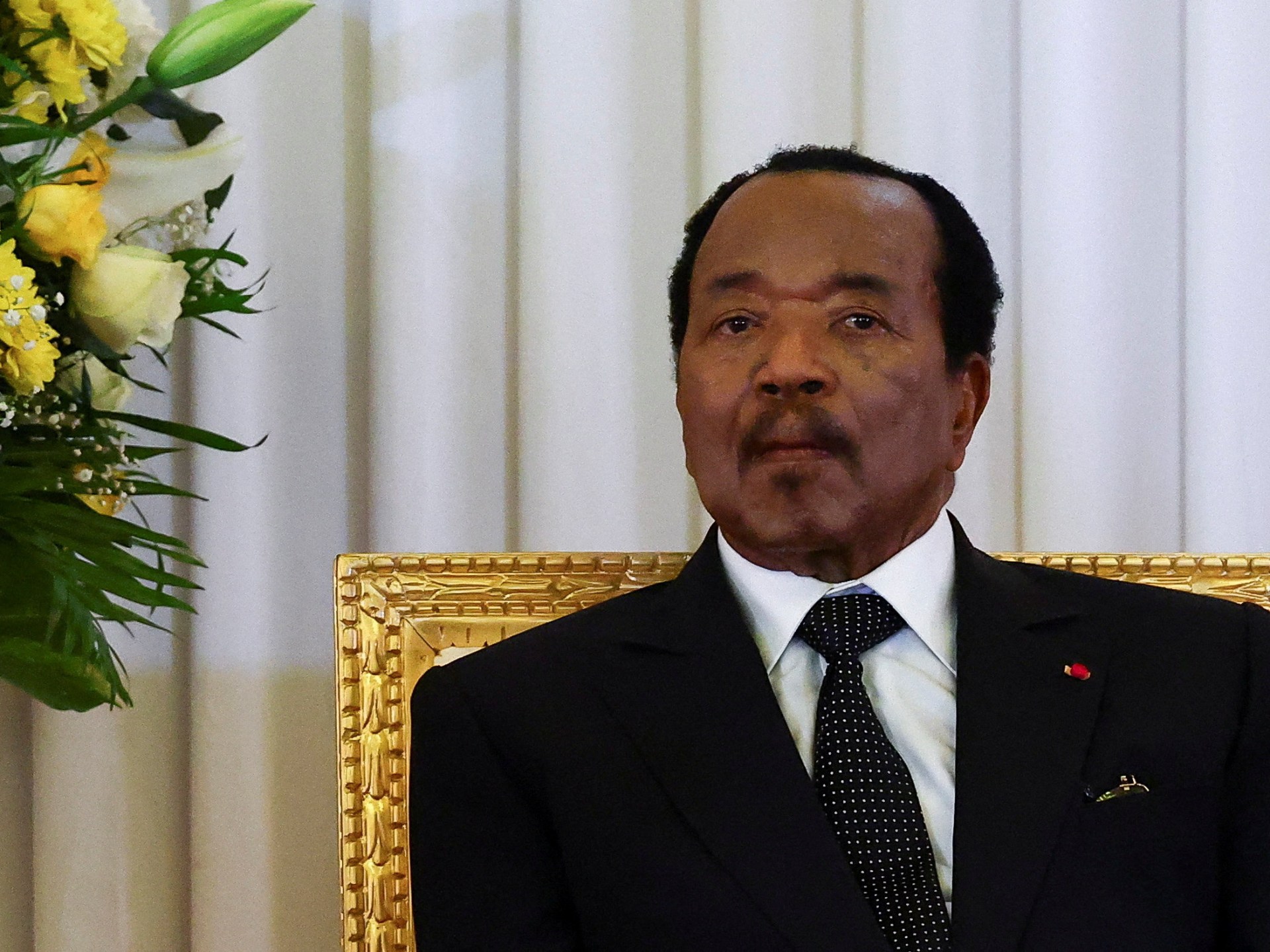
Biya, 93, has governed Cameroon since 1982. His prolonged absences from public view have intensified scrutiny on how decisions are made, who has access to him and how much authority is exercised by those around him.
Biya returned to Yaounde on August 20 after more than 10 weeks abroad, following a stay in Europe that began on June 7 . His return did little to dispel questions about the management of power.
The issue is not simply whether the state continues to function. It is whether the institutions and informal networks built around one president can manage power coherently when he is not visibly directing government.
Cameroon’s constitution gives the president extensive executive authority. He defines national policy, appoints the prime minister and, based on the latter’s proposal, other members of government.
He is also commander-in-chief of the armed forces. The prime minister heads the government and directs its activities within the framework of the president’s policy.
Advertisement
Under Section 10 of the constitution, the president may delegate some of his powers to the prime minister, other members of government and senior administrative officials, within the scope of their respective responsibilities.
Where the president is temporarily unable to perform his duties, he must expressly delegate some of his functions to the prime minister or, if the prime minister is also unavailable, another member of government.
An absence abroad does not, in itself, establish that the president is temporarily unable to perform his duties or automatically transfer his constitutional powers to the prime minister.
The government has not provided a detailed public account of whether a clear delegation of presidential functions is in effect during Biya’s prolonged absences.
Research by the Organised Crime and Corruption Reporting Project (OCCRP) found that Biya spent at least four and a half years abroad on private visits over a period of more than three decades.
The investigation, which examined records of his travels from 1982 onwards, renewed questions about how much government business depends on his direct involvement.
One figure central to that debate is Ferdinand Ngoh Ngoh, the secretary-general at the presidency.
According to the official biography published by the Prime Minister’s Office, his responsibilities include receiving the president’s instructions, monitoring the implementation of presidential decisions and coordinating administrations attached to the presidency.
On February 5, 2019, Biya signed Decree No. 2019/043, granting Ngoh Ngoh a permanent delegation of signature. The measure gave him authority to sign certain official documents on the president’s behalf.
A delegation of signature, however, is not a transfer of presidential powers. Ngoh Ngoh is not constitutionally the president’s successor, and his formal responsibilities should not be confused with the informal political influence attributed to him.
The influence of the inner circle
Other figures regularly mentioned in discussions about the presidency include First Lady Chantal Biya and the president’s son, Franck Biya. Neither holds a constitutional executive office. Claims about their influence and about rival networks around the president are difficult to establish independently.
Ryan Cummings, an Africa-focused security analyst, has argued that individuals close to the president may be playing increasingly tangible roles as questions grow about the management of power.
Advertisement
His assessment points to the importance of the presidential circle but does not establish who makes particular decisions or on whose authority.
Access to the president does not, in itself, establish that those around him exercise executive powers.
An uncertain succession
The succession question has become more pressing following a constitutional amendment approved on April 14 this year. The amendment reintroduced the office of vice president, with the president given the authority to appoint and dismiss its holder.
Under the revised Article 6, the vice president would assume the presidency if the office became vacant through the president’s death, resignation or permanent incapacity established by the Constitutional Council.
The vice president would complete the remainder of the presidential term.
The law also provides for circumstances in which there is no vice president or the vice president is unable to perform the duties of the office. In either case, a presidential election must be held between 20 and 120 days after the post officially becomes vacant.
The Senate president would serve as interim president until a new president is elected. If the Senate president is unable to perform the role, the responsibility passes to the Senate vice president, according to the order of precedence in the Senate.
The amendment establishes a formal succession mechanism but leaves the appointment of the vice president in Biya’s hands. As of November 10 , no appointment had been publicly announced.
The absence of a designated vice president means the new succession arrangement has yet to be tested. If the presidency became vacant before an appointment, the constitution provides for an interim presidency under the Senate president and a new presidential election. Accounts of competing factions and efforts to position potential successors should therefore be treated as assessments, not evidence of an agreed succession plan.
Military reshuffles and wider risks
Military appointments during Biya’s absence have added another dimension to the debate.
On August 4 , the Reuters news agency reported that three presidential decrees had reshuffled the senior military leadership. The changes included replacing commanders in four of Cameroon’s five joint military regions, promoting the head of the Presidential Guard from colonel to brigadier general and appointing a new commander of the Rapid Intervention Brigade.
Robert Besseling, CEO of intelligence advisory firm Pangea-Risk, interprets the changes partly through the lens of loyalty and the management of potential threats to the presidency. The decrees do not explain the reasons for the appointments, making their political significance difficult to establish independently.
The stakes extend beyond the presidential palace. Cameroon faces a separatist conflict in its English-speaking regions and attacks by armed groups linked to Boko Haram in the Far North.
Uncertainty over political authority at the centre could complicate the government’s response to these challenges, even as state institutions continue to operate.
Advertisement
Opposition criticism has focused on the concentration of executive authority. Social Democratic Front leader Joshua Osih criticised the constitutional amendment during the parliamentary debate in April. In remarks reported by Focus Media Afrique on April 3 , he argued that the reform weakened democratic legitimacy and reinforced the centralisation of power.
The government, meanwhile, has defended the president’s authority to make appointments. Communication Minister and government spokesman Rene Emmanuel Sadi told French broadcaster RFI in August that Biya was entitled to decide when to form a new government. The presidency did not respond to Al Jazeera’s request for comment.
Not all observers see an immediate breakdown in state administration. Paul Anchang, a Yaounde-based political analyst, argues that institutions continue to perform their functions. Besseling, however, offers a more critical assessment of the political situation.
The distinction between a functioning state and an accountable centre of political authority remains at the heart of Cameroon’s predicament.
Government business may continue, but the concentration of power around one individual leaves unresolved questions about who exercises authority in his absence and how it will eventually be transferred.
As Robert Besseling puts it: “The political scene suffers from distinct institutional paralysis.”
Related News
Tigray resumes daily life amid fears of wider war
Algeria’s military deployment to Niger: What’s behind the move?
At least 18 killed in Houthi attack on military camp in Yemen’s Shabwa