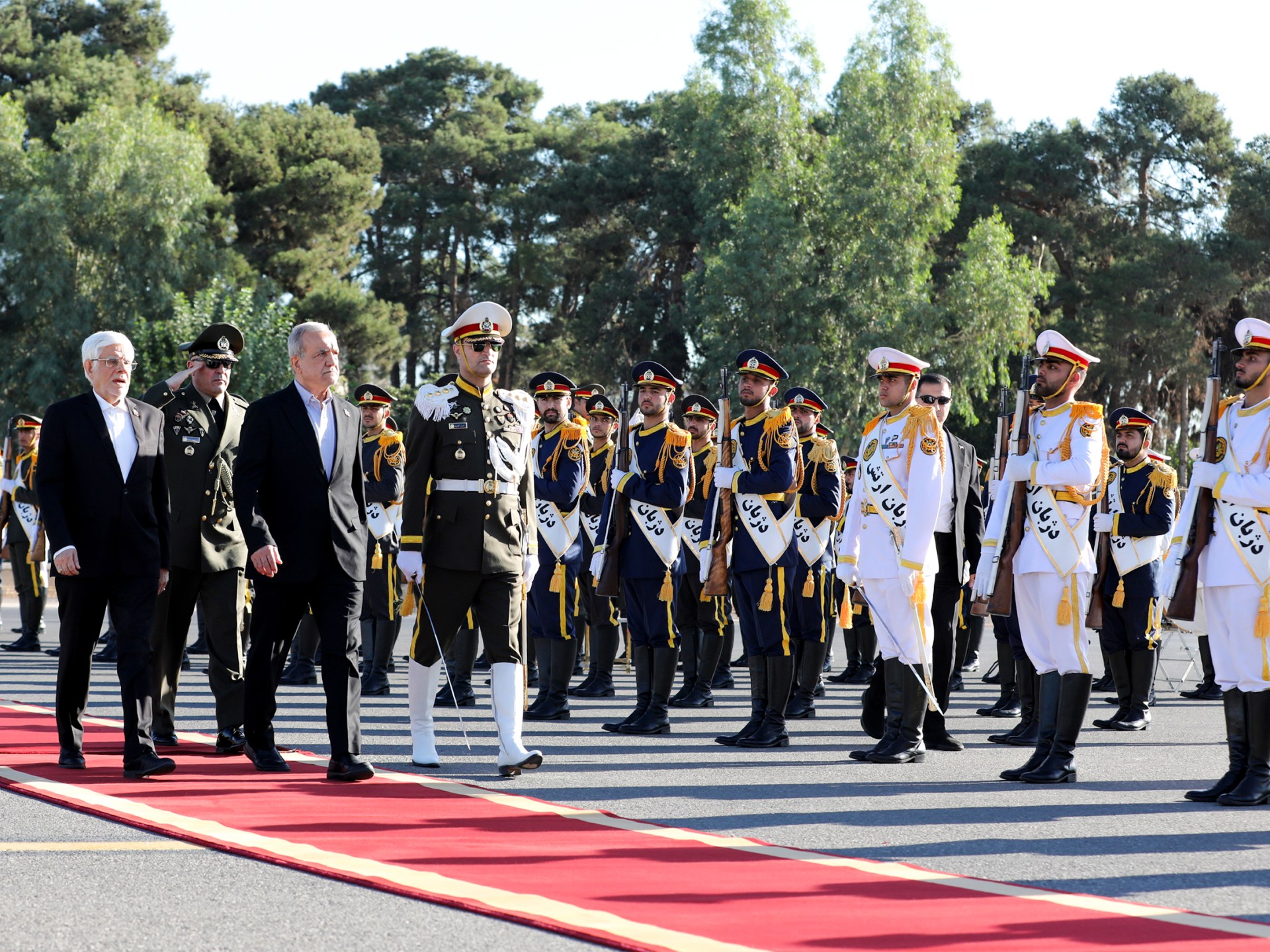

Tehran, Iran – Iranian President Masoud Pezeshkian and his team are heading to New York for the United Nations General Assembly (UNGA), where they are expected to express grievances about the United States’ war on Iran, but also look at ways of resolving it.
Pezeshkian, who departed Tehran on Tuesday morning local time, is joined by Foreign Minister Abbas Araghchi and other officials, and is scheduled to address the 193-member assembly on Wednesday.
- list 1 of 4Russian strikes on Ukraine kill three as Zelenskyy arrives for UN summit
- list 2 of 4Why United Nations says US boat strikes may be ‘crimes against humanity’
- list 3 of 4Can the US ban Iranian airlines worldwide – and what would it mean?
- list 4 of 4Trump-GCC Summit in New York: What does each side want?
end of list
“The issues we will raise at the UN concern expressing the plight of the Iranian nation, the crimes that have been committed against it, and the distrust that has been created,” Pezeshkian told reporters before boarding a flight out of Tehran.
He also warned that the renewed use of force by Iran’s foes would be counterproductive.
“We will make the enemies disappointed,” he said.
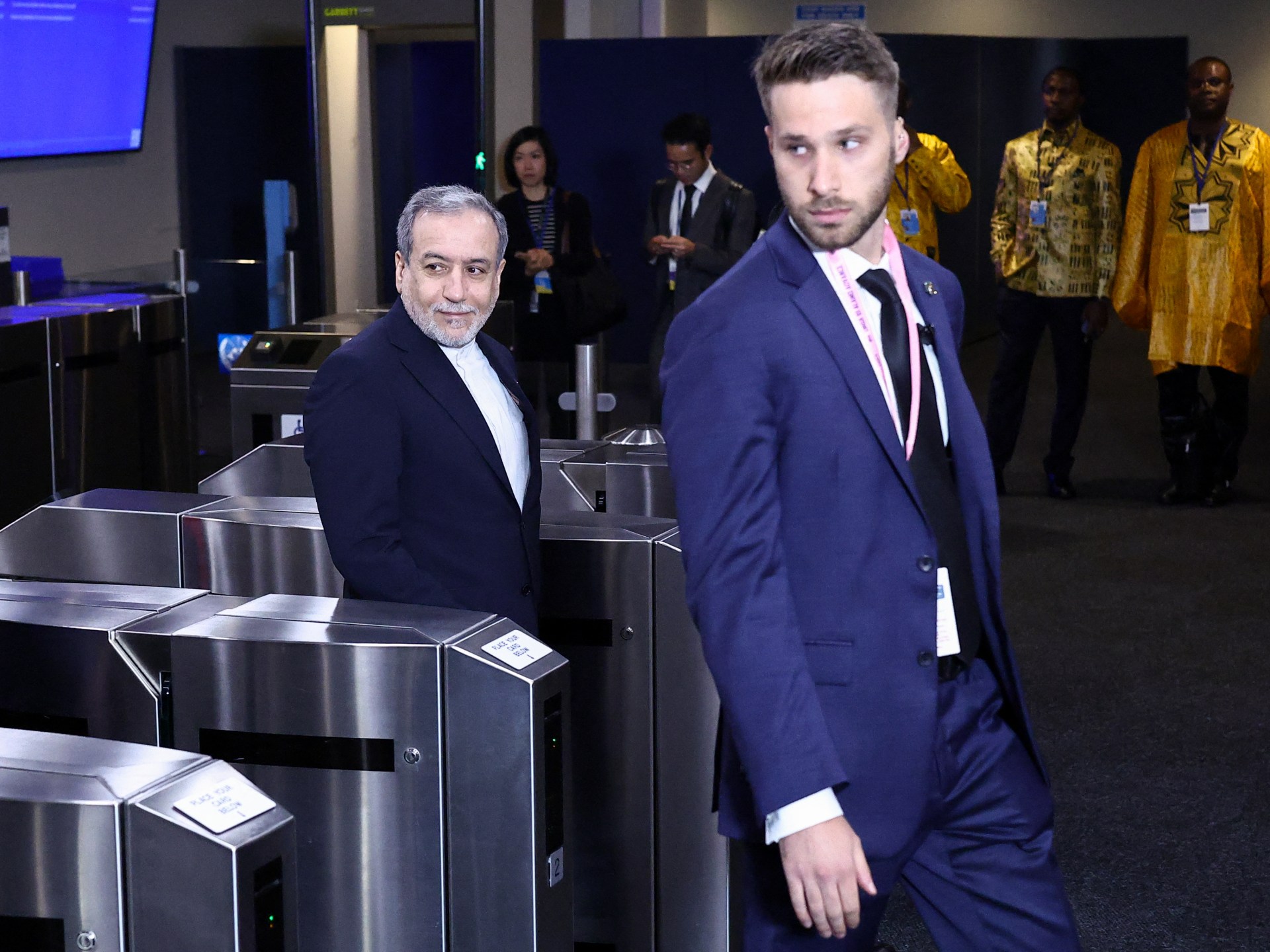
Araghchi, who had arrived in New York earlier, said his main goals during meetings on the sidelines will be to “defend the rights and interest of the Iranian people”.
The war started by the US and Israel on Iran on February 28 continues, with disruptions to shipping in the Strait of Hormuz that have affected global energy prices.
In the backdrop, Araghchi slammed the UN’s lacklustre performance in establishing peace and security.
“Trust in this organisation has been lost, and this is unfortunately because of its ineffectiveness in establishing international peace and security,” he said.
He said the Minab school bombing by the US and the assassination of Supreme Leader Ayatollah Ali Khamenei on the opening day of the war would be among the issues Iran will raise at the UN.

The Iranian delegation will be in New York for five days and is scheduled to return to Tehran on Saturday.
Advertisement
The US has denied visas to Pezeshkian’s accompanying media team and imposed tight restrictions on their movement in the country, according to the president’s office. Iranian delegates will also be barred from buying luxury goods during their stay.
Still, Pezeshkian plans to hold discussions with Iranian expatriates, intellectuals, think tanks and media in the coming days.
The UNGA brings together representatives of nearly 130 countries at the body’s headquarters in New York.
This year’s assembly, which begins on Tuesday, comes as the US tightens economic pressure through sanctions and a naval blockade on southern Iranian ports in the Strait of Hormuz.
US President Donald Trump said earlier this week that he was considering a new major military assault on Iran, but wanted to hear from the Arab leaders of the region first. He is set to meet with representatives from Saudi Arabia, the United Arab Emirates, Qatar, Oman, Kuwait and Bahrain in the coming days to discuss the war on Iran.
This and a military escalation in Yemen, where Saudi-backed Yemeni government forces are fighting the Iran-aligned Ansar Allah, also known as the Houthis, are other concerns for the assembly.
The Houthis have expanded control over the strait of Bab al-Mandeb in recent weeks after making rapid military advances in western Yemen and the Red Sea coast.
Regional mediators – including Pakistan, Qatar, Oman and Turkiye – have pushed for a diplomatic end to the crisis amid prospects of escalated conflict.
As Iran demands a return to the memorandum of understanding signed with the US in June to reopen the Strait of Hormuz, its diplomats are expected to sit down with mediators in New York as well.
Mohsen Rezaei, secretary of Iran’s Supreme National Security Council, told Al Jazeera earlier this week that Tehran has communicated seven conditions to the US to reopen the strategic waterway.
These included an end to war on all fronts, the release of Iran’s frozen assets, the lifting of the blockade on Iranian ports, an end to military attacks on Iranian territory, and noninterference in the country’s internal affairs. But he also said Iran remains prepared for escalated fighting, and could potentially abandon the nuclear Non-Proliferation Treaty (NPT) depending on future US actions.
There are conflicting views in Iran about how to end the war with the US, with some parties open to a peaceful resolution and more hardline factions seeking to continue or intensify the war until all Tehran’s demands are met.
Advertisement
Hossein Mohebbi, the spokesman of the Islamic Revolutionary Guard Corps (IRGC), told local media on Tuesday that Iran was prepared to use new weapons systems against the US if necessary, and pointed to its recent attacks on US warships.
But he added that the country was open to peace. “If our national interests call for it to conduct some negotiations alongside war, we must negotiate,” he said.
Mohammad Bagher Ghalibaf, Iran’s parliament speaker and chief negotiator, had already said both options remain on the table, but said hardline factions have no end date for the war of attrition. Other factions underestimate Iran’s capabilities and believe it must surrender, he said.
“The first keeps the country in a state of perpetual crisis and the other offers national resources and dignity to the enemy on a platter,” Ghalibaf said. “Both approaches realise the enemy’s wish for disturbing the country’s cohesion and unity.”
Trump said on Sunday he would “probably be open” to meeting Pezeshkian in New York, although the Iranian government’s IRNA news service dismissed this as a “new propaganda game”.
The government’s daily Iran newspaper said New York could offer a “platform for the Iranian narrative”. The hardline Kayhan newspaper wanted Pezeshkian to turn the UN into “a courtroom for American crimes”.
Public expectations in Iran are sceptical that the UN meetings will produce any political breakthrough to end the war, which has deepened the average Iranian citizen’s economic woes.
“I think Pezeshkian going [to New York] is better than him not going, but there is no hope that anything comes of it,” one Iranian told Al Jazeera in western Tehran, on condition of anonymity due to security concerns.
Another resident of the capital also said she harboured no hopes of a diplomatic resolution.
“I think if [the politicians] want to, then yes, there can be an opening, but they don’t want to,” she said.
Related News
Iraq seizes drone-launching platform used for targeting Saudi oil pipeline
North Korea fires ballistic missile towards the sea, South Korea says
Can flurry of New York diplomacy lead to US-Iran diplomatic breakthrough?