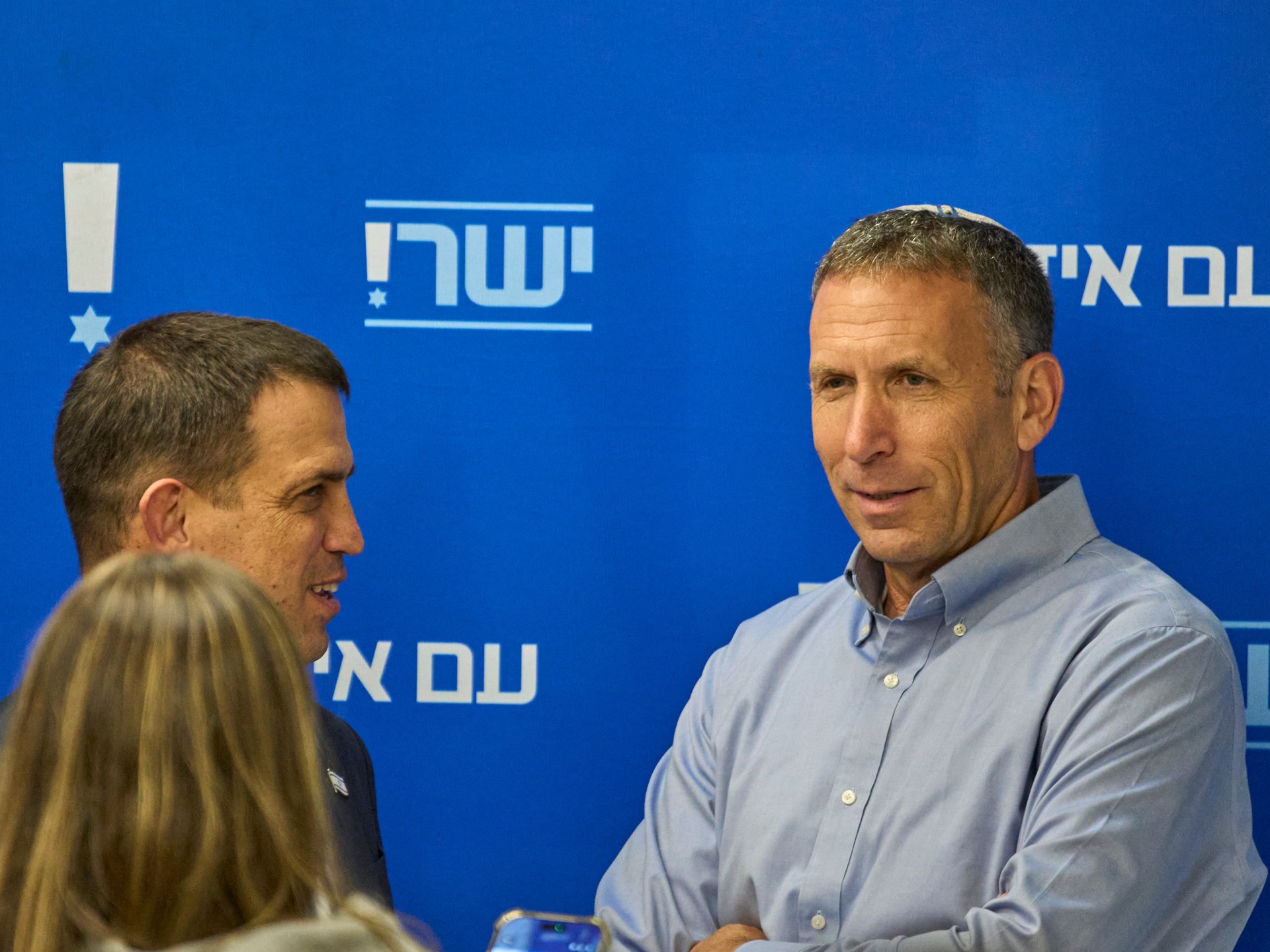

Israeli lawmakers have elected Matan Kahana as the new parliament speaker, marking a step towards reversing domestic policies from the outgoing government led by Benjamin Netanyahu.
Kahana, an ally of Gadi Eisenkot – the party leader currently working to form the next government and replace Netanyahu – was voted in on Tuesday, receiving 66 votes in the 120-member chamber.
- list 1 of 3Is Israel’s Eisenkot bloc less right wing than Netanyahu?
- list 2 of 3Will Netanyahu lose this time?
- list 3 of 3As Knesset readies for new speaker, Israeli opposition holds powerful role
end of list
Netanyahu’s Likud party had put forward Ofir Katz as its own candidate. He received 52 votes following a stormy debate that stretched over seven hours.
The Israel parliament speaker is an important office given that it sets the timetable for parliamentary business and can therefore speed up or delay debates or votes on proposed legislation.
“I will be a Knesset speaker for everyone, irrespective of race, religion or gender,” said Kahana during his inauguration speech immediately after the vote.
Kahana, a 54-year-old former special forces soldier, is expected as soon as Wednesday to start the process of undoing much of Netanyahu’s domestic agenda, especially regarding contentious reforms to the judiciary.
Netanyahu is Israel’s longest-serving prime minister, having been in and out of office for three decades.
The vote took place weeks after October 27 parliamentary elections in which neither Eisenkot nor Netanyahu won a majority in the Knesset, with the two blocs trading barbs since then.
Eisenkot’s wide-ranging bloc secured 48 seats, while Netanyahu’s finished with 53. Two Arab-majority slates won an unprecedented 19 seats on the back of anger over Netanyahu’s hard-right government.
Advertisement
On Tuesday, the two lists voted for Eisenkot’s candidate Kahana as parliament speaker, with one Arab Knesset member absent.
Netanyahu’s and Eisenkot’s parties met on Sunday to discuss the possibility of joining a unity government but the meeting appeared to be largely a formality, with both men saying they should be prime minister.
Netanyahu, who has reportedly been urging US President Donald Trump to resume the war on Iran, has talked up the threat from Tehran as he insists on the need for a unity government.
With Kahana at the helm and if Eisenkot retains the backing of the Arab-Israeli parties, he has an opportunity to deal serious blows to Netanyahu’s legislative agenda even before a possible government is formed.
Eisenkot has said he wants to rescind sweeping reforms to reduce the independence of the judiciary that were advanced by Netanyahu, who has been enraged over corruption charges against him that could land him in prison if he loses power.
Eisenkot has also vowed to quickly set up a state commission of inquiry to investigate security failures that led to Hamas’s October 7, 2023 attack.
Netanyahu, who has built his brand on saying he will ensure Israel’s security, has refused an independent probe, instead proposing one whose members would be chosen by politicians.
Kahana, who is now a member of Eisenkot’s Yashar party, served in a short-lived non-Netanyahu government in 2021 and 2022 as minister for religious services, during which he clashed with ultra-Orthodox Jews by seeking to reduce the power of the Chief Rabbinate.
Kahana himself is an observant Jew, part of Eisenkot’s efforts to form a broad coalition that ranges from secular liberals to religious conservatives.
As parliament speaker, Kahana succeeds Amir Ohana, a Netanyahu ally who has held the position since 2022.
Related News

Flavio Bolsonaro lands in Miami after losing Brazil’s presidential election

Why Jordan has struck Syria: What we know

US senators demand FAA pause upgrades linked to nationwide ground stop