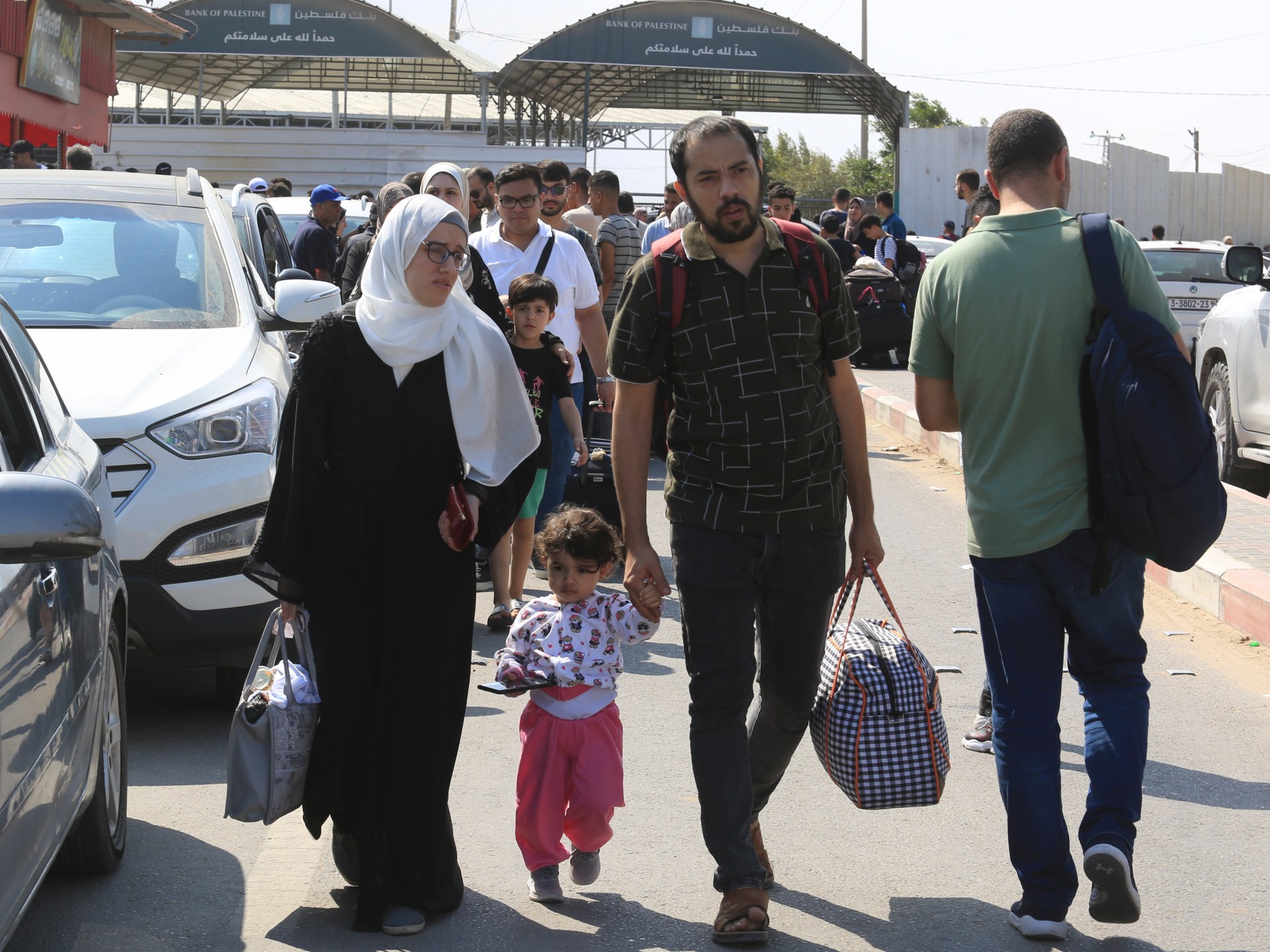

As preparations accelerate for the partial Israeli reopening of Gaza’s Rafah border crossing, tentatively scheduled for Sunday, a simmering dispute has erupted between Egypt and Israel regarding which and how many Palestinians may leave and return.
Many are seeking urgent medical attention that cannot be found in a healthcare system decimated by Israel in its more than two-year genocidal war. Others want to reunite with family or pursue an education, all put on hold because of the war.
According to a report by Israel’s public broadcaster Kan on Wednesday, Israeli negotiators have presented a condition regarding the flow of travellers: that the number of Palestinians leaving Gaza and entering Egypt through the crossing must exceed the number of those permitted to enter.
The broadcaster reported that Egyptian officials rejected this asymmetric formula, insisting on an “equal ratio” of entries and exits. Cairo reportedly fears that Tel Aviv’s position is a calculated attempt to engineer emigration and permanently reduce Gaza’s population.
While North Sinai Governor Khaled Megawer affirmed to local media Egypt’s operational readiness “for all scenarios”, the technological mechanisms being imposed on the ground suggest a system designed to filter the population.
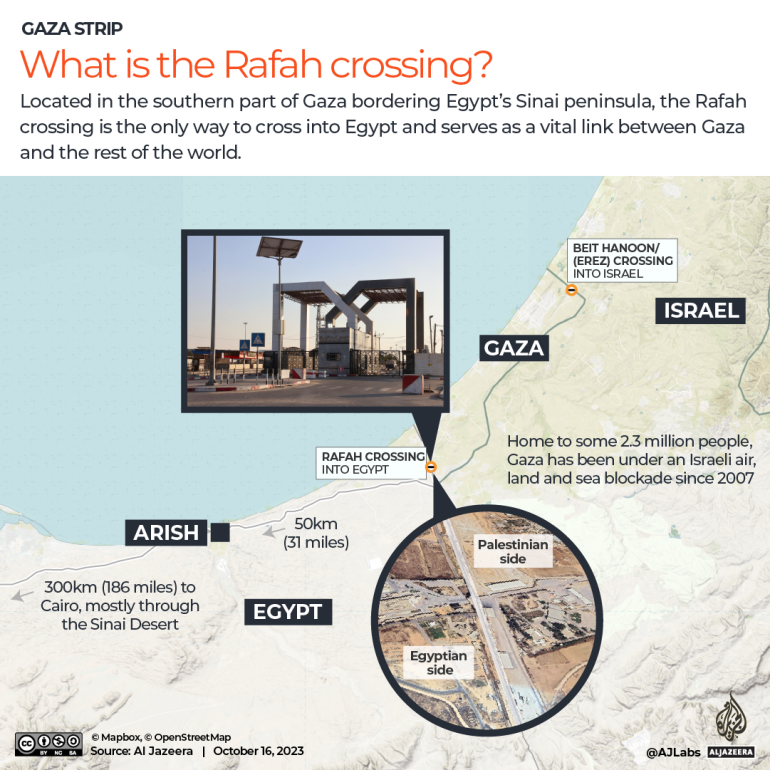
‘Remote’ screenings for exit, physical screenings for entry
While Kan reported on the dispute over numbers, the Israeli news site Ynet revealed the technical details of the proposed operation, which suggest a crossing that operates on a double standard.
Advertisement
According to the website and security sources, all travellers must be vetted by Israel’s Shin Bet security service 24 hours in advance. But the actual crossing process differs sharply by direction. A European Union monitoring mission is also expected to be on hand, but its role is unclear. Here is the reported plan:
- Leaving Gaza: For Palestinians exiting to Egypt, Ynet reported, there will be no physical Israeli presence inside the terminal. Instead, Israel will operate a “remote control” system. Facial recognition cameras will transmit live feeds to an Israeli command centre where officers will have the capability to remotely lock the electronic gates instantly if a “suspect” is identified.
- Entering Gaza: For Palestinians trying to return home, the process is far more invasive. Returnees will be funnelled into an Israeli military checkpoint established just past the border. There, they will be subjected to body searches, X-ray scanning and biometric verification by Israeli soldiers before crossing the “yellow line”, which marks the 58 percent of Gaza that Israeli forces still occupy, and leaving Israel’s self-proclaimed buffer zone.
‘Rafah 2’: A one-way ticket?
This structural disparity has raised alarm among observers. Major General Samir Farag, former head of the Egyptian army’s Morale Affairs Department, told Al Jazeera that Israeli Prime Minister Benjamin Netanyahu is trying to bypass the 2005 Agreement on Movement and Access concerning the Rafah crossing.
Farag said the Israeli proposal involves opening Rafah “in one direction” for exit only as part of a “displacement” agenda – a move he said Egypt has “categorically rejected”.
Ibrahim Al-Madhoun, director of the Palestinian Institution for Media, argued that this setup, often referred to as “Rafah 2”, is not a border crossing in the traditional sense but a “sorting platform managed with a mentality of forced displacement”.
“Israel is making exit relatively easier via remote monitoring while making entry a humiliating, physical ordeal at a military post,” Al-Madhoun told Al Jazeera. “They are engineering a system where people are encouraged to leave but are too terrified – or simply denied permission – to return.”
The proposed system marks a departure from the 2005 agreement, which designated Rafah as a Palestinian-Egyptian crossing under EU supervision, specifically to guarantee Palestinian sovereignty.
Security expert Osama Khaled warned that the implications of the new mechanism go beyond logistics. By inserting itself into the minutiae of the crossing, Israel would secure a permanent chokehold on this Gaza lifeline.
Advertisement
“This is comprehensive electronic surveillance designed to ensure a mandatory Israeli presence,” Khaled said. “It transforms the crossing from a sovereign gateway into a tool for political blackmail.”
The sharp focus on the Rafah crossing also has a darker side. According to comments by retired Israeli General Amir Avivi, who still advises the military, Israel has cleared land in Rafah to construct an enormous facility to entrench its military control and presence in Gaza for the long term.
Avivi on Tuesday described the project as a “big, organised camp” capable of holding hundreds of thousands of people. He said it would be equipped with “ID checks, including facial recognition”, to track every Palestinian entering and leaving.
Related News
Hong Kong begins national security trial for organisers of Tiananmen vigils
Israel carries out raids and demolitions, arrests dozens across West Bank
Suicide bombing at wedding in northwest Pakistan kills seven