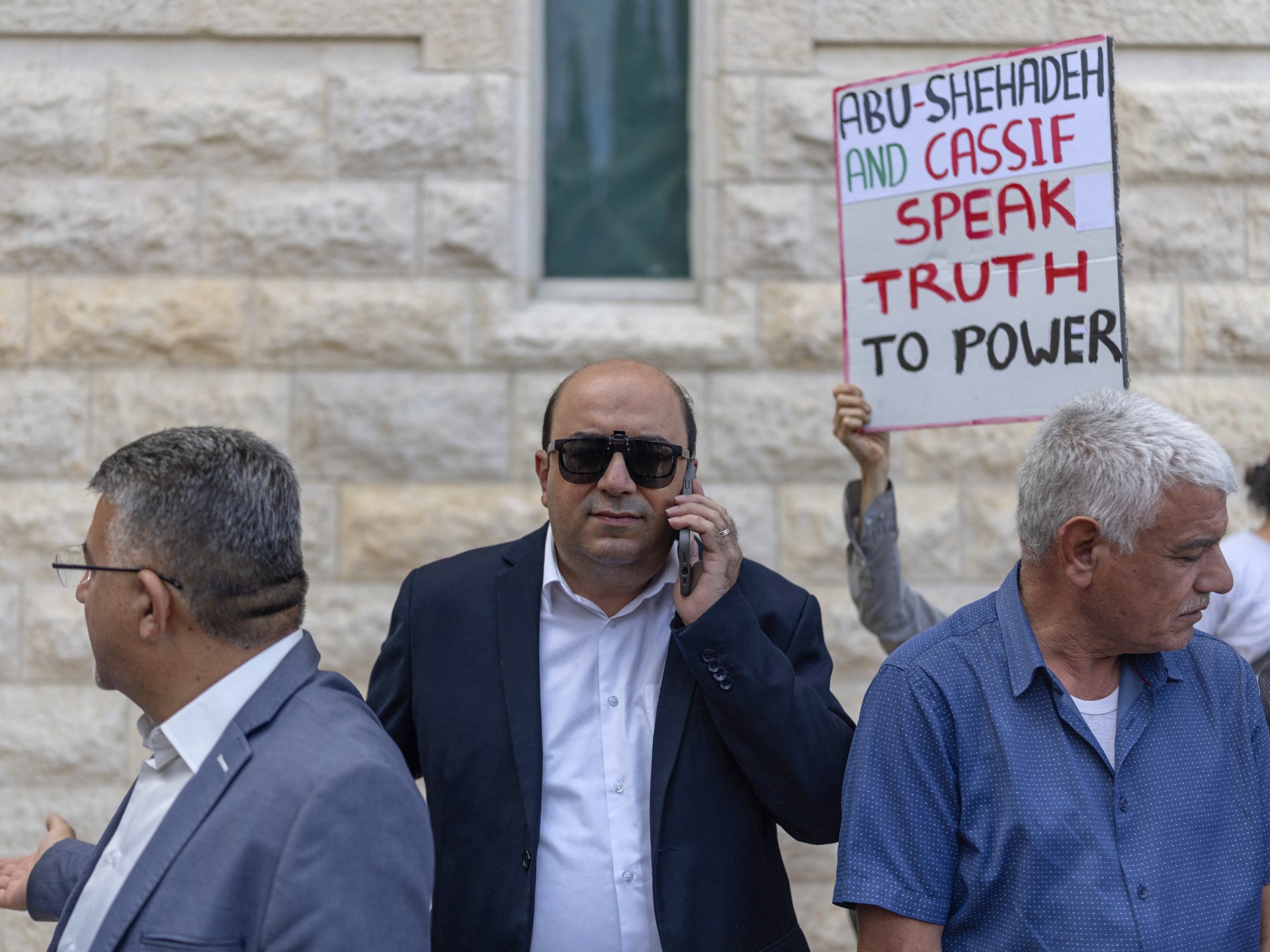

Israel’s Supreme Court has advised Balad party leader Sami Abu Shehadeh to withdraw from the October 27 Knesset election, warning that it could otherwise issue a ruling disqualifying him.
The development came as the court on Thursday began hearing appeals against decisions by Israel’s Central Elections Committee to disqualify Arab electoral lists and candidates from the parliamentary election.
- list 1 of 3Why Israel is interfering in Palestinian education
- list 2 of 3Palestinians bury remains of 105 people killed in Israeli attack on Gaza
- list 3 of 3‘I’m rather proud’: Barrister, 94, arrested for supporting Palestine Action
end of list
Last week, the elections committee voted to disqualify the country’s two main Arab-majority political lists – Ra’am and the Joint List, which is an alliance of Hadash, Ta’al and Balad. Separately, it moved to disqualify Abu Shehadeh and parliament member Ofer Cassif, a Jewish politician from the Arab-Jewish Hadash party.
Abu Shehadeh is a historian from Jaffa who served in the Knesset on the Joint List from September 2019 until November 2022; Balad was voted out of the Knesset in 2022. Hadash legislator Cassif first appeared on the joint Hadash-Ta’al list in April 2019, in the slot reserved for a Jewish candidate.
On Thursday, the panel of nine justices heard arguments from Abu Shehadeh and his legal team, headed by Hassan Jabareen, according to the Israeli Public Broadcasting Corporation.
Supreme Court President Yitzhak Amit told Abu Shehadeh that a majority of the judges favoured disqualifying his candidacy and gave him until Friday to withdraw, according to the broadcaster. If he does not withdraw, the judges would have to issue a ruling disqualifying his candidacy, according to the report.
Advertisement
National Security Minister Itamar Ben-Gvir, whose Otzma Yehudit party petitioned to disqualify Abu Shehadeh, appeared in court wearing a lawyer’s robe. “Sami Abu Shehadeh cannot be a member of Knesset. A supporter of terrorism belongs in prison, not in the Knesset,” he said.
Abu Shehadeh was accused of sympathising with Hamas and of failing to condemn the October 7, 2023 attacks. He denied this at the hearing, saying his words “may have been taken out of context” and that he is “completely opposed to acts of violence”.
Attorney General Gali Baharav-Miara backed his disqualification over an article he published a day after October 7, which she said expressed support for armed struggle. She opposed disqualifying Cassif and the Joint List, saying the evidence did not meet the stringent legal threshold.
Mairav Zonszein, a senior Israel analyst with the International Crisis Group, told Al Jazeera that the banning of Ra’am was particularly “striking”.
“The banning of the Joint List and Balad has almost become a tradition in Israeli politics. However … Ra’am have been part of past coalitions and that its leader, Mansour Abbas, was [a minister without portfolio] in the Bennett-Lapid government. Additionally, it also now has [Yoav Segalovitz] a former police official and a Jewish Israeli politician in its ranks, which makes the attempt more remarkable,” she said.
Israeli affairs expert Shadi al-Sharafa told Al Jazeera that this is “a dangerous precedent that did not exist before”, saying it is the first call to disqualify all Arab representation rather than a single candidate or list.
Al-Sharafa said Arab votes could be decisive in a society “sharply divided between the camp that supports Netanyahu and the camp that opposes him”, and that the petitioners want Abu Shehadeh not only barred from the Knesset, but also put on trial.
The move to ban major Arab parties leaves Palestinian citizens of Israel without major Knesset representation options.
Walid al-Omari, Al Jazeera Arabic’s bureau chief in Ramallah, said that if the court upholds the disqualifications, approximately 20 percent of Arab citizens could be left without representation in the next Knesset.
Israel’s Central Elections Committee is primarily a political body composed of representatives of parliamentary blocs in the outgoing Knesset. In the past, the Supreme Court overturned decisions by the Central Elections Committee to disqualify Arab lists and lawmakers.
Related News

Iran war live: Riyadh airport hit again; Tehran says US reply ‘inadequate’

‘Atrocious’ crime: Cuban official decries possibility of US military action
Catalan separatist Puigdemont to return to Spain after warrant lifted