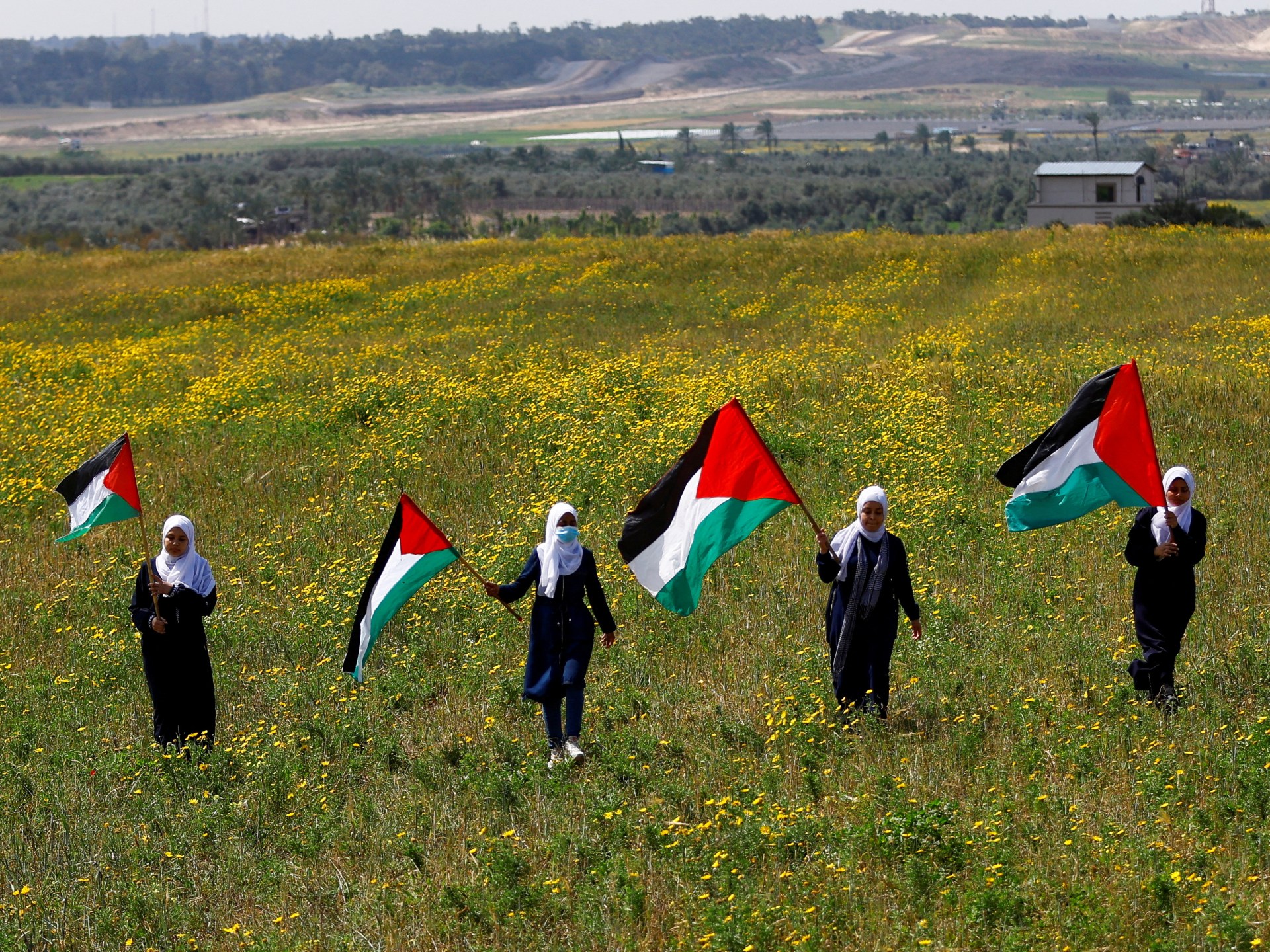

Every year on March 30, Palestinians observe Land Day, or Yom al-Ard, recalling the events of 50 years ago when on March 30, 1976, six unarmed Palestinians were killed by Israeli forces, and more than 100 were injured during protests against Israel’s confiscation of Palestinian land.
Israel ordered the confiscation of 2,000 hectares (4,942 acres) of land belonging to Palestinian citizens of Israel in the Galilee. These plans were part of Israeli state policy to Judaise Galilee following the creation of the State of Israel.
While the land confiscations affected the entire Galilee, the heart of the 1976 protests was in the Palestinian towns of Sakhnin, Arrabeh and Deir Hanna.
The confiscated land is roughly the size of 3,000 football pitches or the area from the southern tip of Manhattan to the start of Central Park in New York, United States.

What do Palestinians do on Land Day?
Palestinians, both in Israel and across the occupied Palestinian territory — the Gaza Strip and the West Bank, including East Jerusalem — mark this day by holding protests and vigils and planting olive trees to reaffirm their connection to the land. The protests are often met with brutal use of force by Israel.
Protest marches are also planned in cities around the world on Monday to mark the 50th anniversary.

Is Israel still seizing land?
Yes, Israel has continued to seize large swaths of Palestinian land, designating them as military zones, state land and other labels.
Advertisement
Most recently, on February 8, 2026, Israel’s security cabinet approved a series of sweeping measures to expand its powers across the occupied West Bank, including easing the sale of Palestinian land to Israeli settlers and expanding the powers of Israeli authorities in areas under Palestinian control.
Rights groups and several countries condemned Israel’s land grab, calling it “de facto annexation” and a “deliberate and direct attack” on the viability of a Palestinian state.

Since October 7, 2023, Israel has ramped up both formal settlement approvals and informal outpost establishments.
According to Peace Now, an Israeli anti-settlement group, Israel approved 12,349 housing units in 2023, 9,884 in 2024 and a record 27,941 in 2025.
In December, Israel’s security cabinet approved plans to formalise 19 illegal settlements across the occupied West Bank. Israeli settlements are Jewish communities built illegally on Palestinian land. Many of the newly approved settlements will be in densely populated Palestinian areas, further limiting Palestinian movement and threatening the viability of a future Palestinian state.

At the same time, Israeli army raids, house demolitions and arrests in the occupied territory are at unprecedented levels, while settlers attack and kill Palestinians and rampage through their property with impunity, backed by the military and the state.
The number of settler attacks has risen sharply in recent years, with 852 recorded in 2022, 1,291 in 2023, 1,449 in 2024 and 1,828 in 2025 – an average of five attacks per day.
At least 1,094 Palestinians have been killed by Israeli troops and settlers in the West Bank since October 2023, according to the latest United Nations figures.
Smotrich urges Israel to annex southern Lebanon
On March 23, Israel’s far-right minister of finance and head of the settlement administration, Bezalel Smotrich, called for annexation of southern Lebanon, saying its bombardment “needs to end with a different reality entirely”, which includes a “change of Israel’s borders”.
“I say here definitively … in every room and in every discussion, too: The new Israeli border must be the Litani,” he said, referring to the Litani River, a critical waterway that cuts through southern Lebanon, about 30km (19 miles) from the border with Israel.
More than a million Lebanese, or one in five people, have been displaced from their homes, with Israeli Defence Minister Israel Katz saying he would not allow the return of people to the country’s south until the safety of Israelis is guaranteed.

Related News
Will the Houthis join Iran in war against Israel and the US?
Israeli opposition leader rails against ‘multi-front war without strategy’

Spain closes airspace to US planes involved in war on Iran