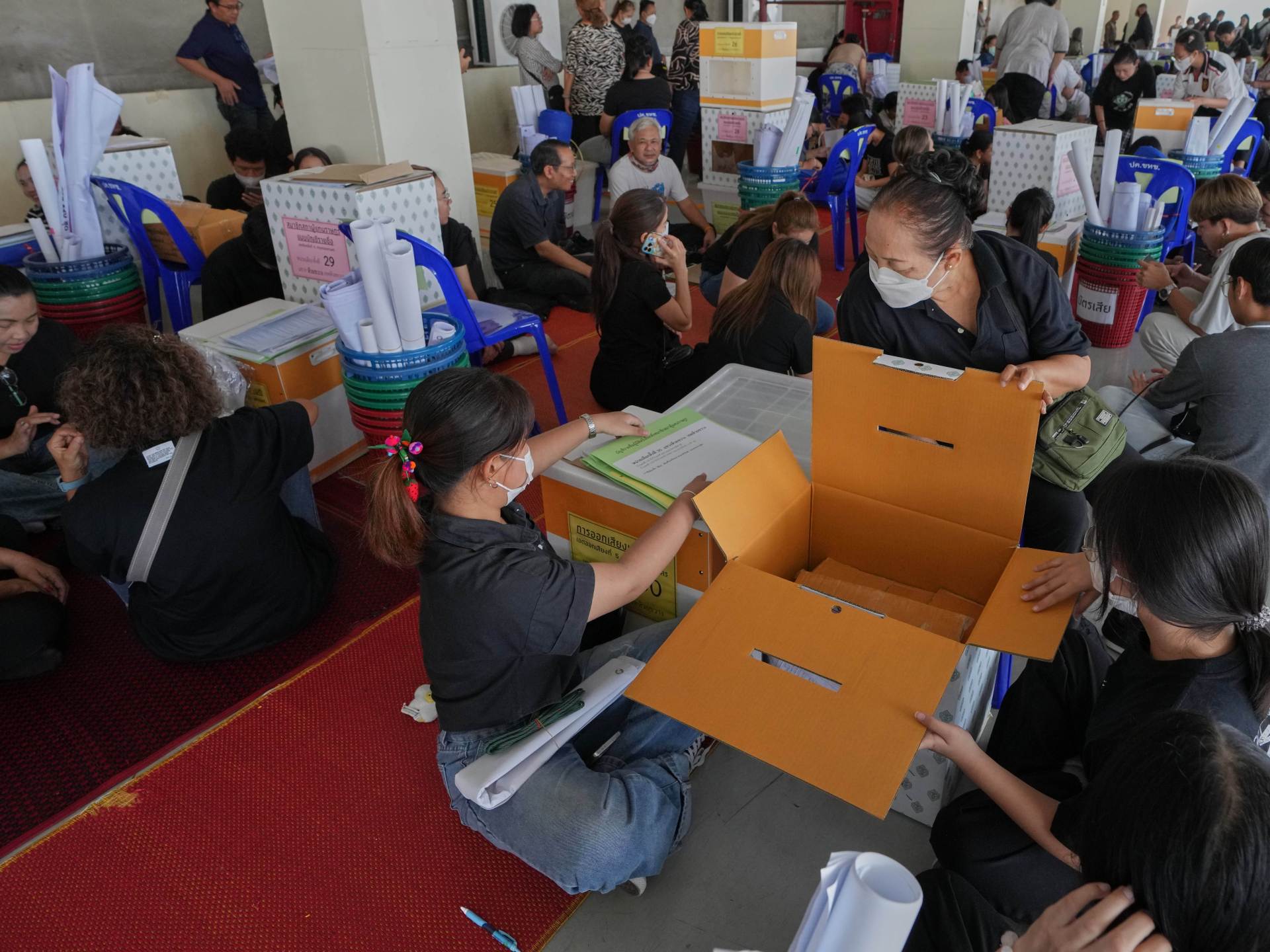

Polls have opened in Thailand in a closely watched general election, with progressive reformers, military-backed conservatives and populist forces vying for control.
Polling stations opened at 8am local time (01:00 GMT) on Sunday and were set to close at 5pm (10:00 GMT).
- list 1 of 4Thai parliament elects Anutin Charnvirakul as prime minister
- list 2 of 4Thailand, Cambodia agree to build on ceasefire in talks in China’s Yunnan
- list 3 of 4Another crane collapses in Thailand, killing two, after 32 die previous day
- list 4 of 4Ancient Khmer temples scarred by Thailand-Cambodia conflict
end of list
More than 2.2 million voters had already cast ballots during an early voting period that began February 1, according to the Election Commission.
The battle for support from Thailand’s 53 million registered voters comes against a backdrop of slow economic growth and heightened nationalist sentiment.
While more than 50 parties are contesting the polls, only three — the People’s Party, Bhumjaithai, and Pheu Thai — have the nationwide organisation and popularity to gain a winning mandate.
With 500 parliamentary seats at stake and surveys consistently showing no party likely to win an outright majority, coalition negotiations appear inevitable. A simple majority of elected lawmakers will select the next prime minister.
The progressive People’s Party, led by Natthaphong Ruengpanyawut, is favoured to win the most seats. But the party’s reformist platform – which include promises to curb the influence of the military and the courts and breaking up economic polices – remain unpalatable to its rivals, who may freeze it out by joining forces to form a government.
The party is the successor to the Move Forward Party, which won the most House seats in 2023, but was blocked from power by a military appointed Senate and later dissolved by the Constitutional Court over its call to reform Thailand’s strict royal insult laws.
The Bhumjaithai, headed by caretaker Prime Minister Anutin Charnvirakul, is seen as the main defender and preferred choice of the royalist-military establishment.
Advertisement
Anutin has been prime minister only since last September, after serving in the Cabinet of former Prime Minister Paetongtarn Shinawatra, who was forced out of office for an ethics violation regarding mishandling relations with Cambodia. He dissolved parliament in December to call a new election after he was threatened with a no-confidence vote.
Anutin has centred his campaign on economic stimulus and national security, tapping into nationalist fervour stroked by deadly border clashes with neighbouring Cambodia.
The third major contender, Pheu Thai, represents the latest incarnation of political movements backed by jailed former Prime Minister Thaksin Shinawatra, and trades on the populist parties of the Thai Rak Thai party, which held power from 2001 until 2006, when it was ousted by a military coup.
The party has campaigned on economic revival and populist pledges like cash handouts, nominating Thaksin’s nephew, Yodchanan Wongsawat, as its lead candidate for prime minister.
Sunday’s voting also includes a referendum asking voters whether Thailand should replace its 2017 military-drafted constitution.
Pro-democracy groups view a new charter as a critical step toward reducing the influence of unelected institutions such as the military and judiciary, while conservatives warn that it could cause instability.
Related News

Russia ready to respond to any US weapons deployment in Greenland: Ryabkov
Why is there a mixed reaction in India to the US trade deal?
Lebanon files UN complaint against Israel’s daily ceasefire violations