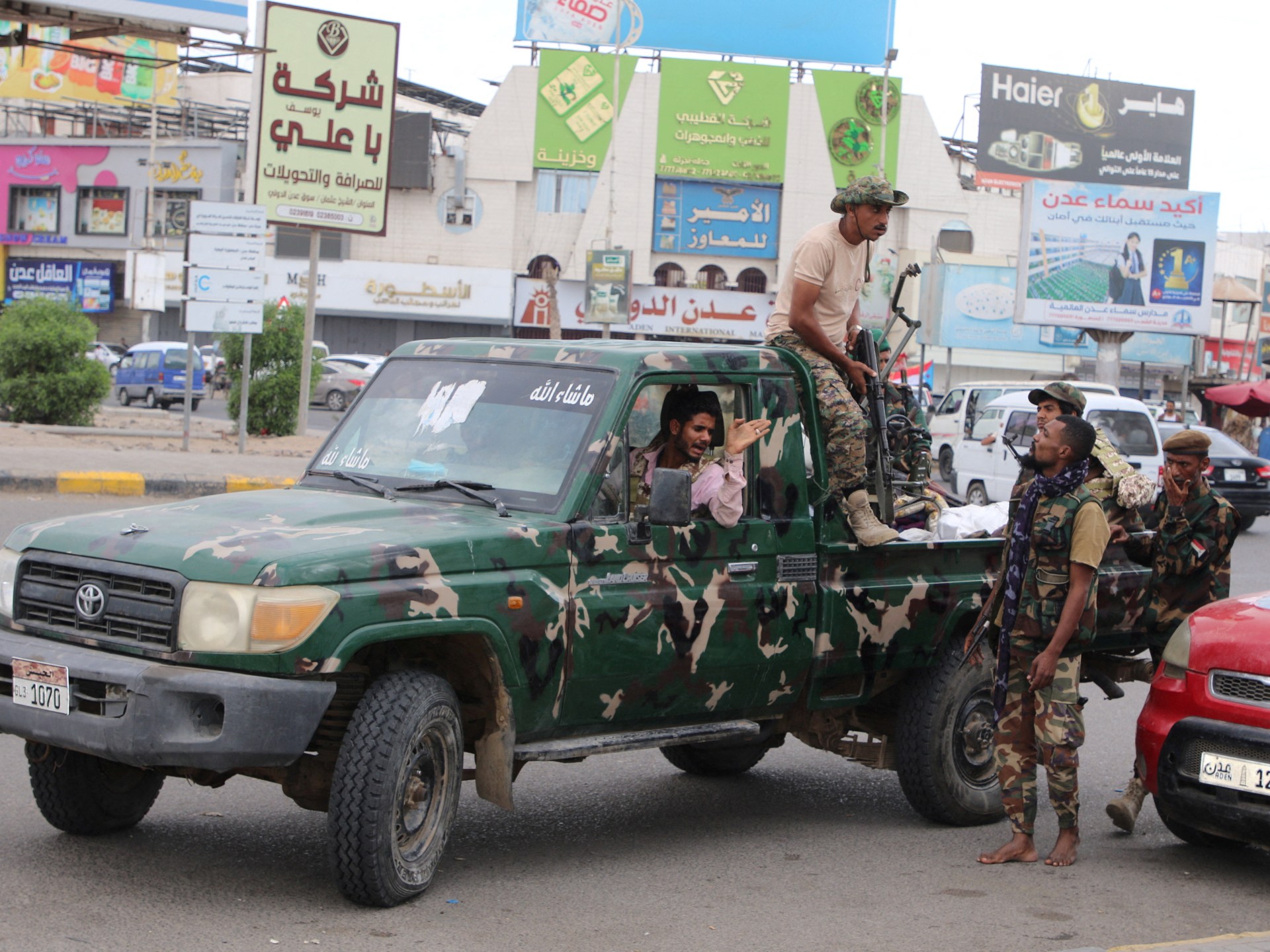

Sanaa, Yemen – Naef has been a government soldier in southern Yemen for nine years. When he joined the government army in 2016 – aged only 19 – he thought that the Yemeni government’s war against the Houthi rebel group would be brief. A decade has elapsed, and the conflict remains unsettled, with the Houthis remaining in Sanaa.
Naef was clear as to the reason for the government’s failure – a lack of unity and clear command structure. For years, government soldiers and other anti-Houthi fighters have adhered to conflicting agendas across the country, with many of the fighters in the south supporting the separatist Southern Transitional Council (STC). A solution to that division, Naef thought, was far-fetched.
- list 1 of 3Trump suspends immigrant visas for 75 countries: Who’s affected?
- list 2 of 3Trump administration to suspend immigrant visa processing for 75 countries
- list 3 of 3Mapping who controls what in Yemen in 2026
end of list
However, more recently, things have changed. The STC’s decision to attempt to seize all of southern and eastern Yemen backfired, and Saudi Arabia backed pro-government troops in pushing the group back. The STC is now divided, with one leader on the run, and others declaring that the group had been dissolved.
The Presidential Leadership Council (PLC), Yemen’s UN-recognised authority led by President Rashad al-Alimi, has seized the initiative and, on January 10, established the Supreme Military Committee (SMC), with the goal of overseeing all anti-Houthi military units, and integrating them into the official Yemeni military, under one command.
Al-Alimi said that the SMC would ultimately be a vehicle to defeat the Houthis, and reclaim all of Yemen.
The SMC announcement marks a dramatic twist in the decade-long war, and Naef is now – finally – hopeful.
Advertisement
“I am optimistic today as the government has revived some of its power in southern Yemen,” he told Al Jazeera. “The formation of an inclusive military committee is a boost to our morale and a prelude to a powerful government comeback.”
The soldier believes that, after years of inertia, the tide has finally turned for the government. After nine years of experience on multiple frontlines, Naef now thinks that the government – with the backing of Saudi Arabia – is capable of pushing into Houthi-controlled northwestern Yemen, should negotiations fail.
“The PLC has achieved remarkable success in the south over the past few weeks with support from the Saudi leadership. It has once again proven to be an indispensable party to the conflict. Whether this success will be short-lived or lasting remains to be seen,” said Naef.

Concerns and defiance
The formation of the SMC has unleashed a sense of concern among Houthi supporters in northern Yemen.
Hamza Abdu, a 24-year-old Houthi supporter in Sanaa, describes the new military committee as an “attempt to organise the proxies in the south”.
“This committee may end the friction between the militant groups in the south, but it will deepen the south’s subjugation to Saudi Arabia,” Hamza said. The Houthis have often framed their opponents as being proxies controlled by foreign powers, including Saudi Arabia and the United Arab Emirates. They themselves are backed by Iran.
In light of the developments, Hamza shared a concern: the resumption of the war between the Houthis and their opponents, which has largely been frozen since 2022.
“If this military committee succeeded in uniting the forces in the south, that might entice them to attack the north,” he said. “A new destructive war will begin, and the humanitarian ordeal will magnify.”
Like many ordinary citizens, Hamza is now fearful that the war will restart. But Houthi leaders – while warning that their forces should stay alert – are still confident, saying that the formation of the SMC will not affect their power or weaken their control.
Aziz Rashid, a pro-Houthi military expert, believes that the SMC will not alter the status quo, arguing that any future confrontation with the Houthis “will only serve the agendas and plans of the United States-supported Zionist entity [Israel]”.
Rashid indicated that Houthi forces in Sanaa “confronted international and powerful military forces, including the United States, Britain and Israel, and stood firm against the [Saudi-led Arab] coalition during the past 10 years”.
Advertisement
The only solution for Yemen, Rashid said, was a political settlement.
The Iran-backed Houthis took over Sanaa in September 2014 and toppled the UN-recognised government in February 2015. They insist they are the only legitimate authority governing Yemen.
The Houthis have faced attacks from the US, the United Kingdom, and Israel since 2023, when the Yemeni group began attacking shipping in the Red Sea and Israel itself, in what the Houthis declared was solidarity with Palestinians in Gaza.
A terrifying message
Defeating the Houthis will be easier said than done, considering the Saudi-backed coalition’s failure to do so with overwhelming air power in the early years of the war, and the group’s now extensive combat experience and possession of advanced weapons, including drones and missiles.
But if the Yemeni military does truly reorganise itself and integrate the different anti-Houthi forces on the ground, the opportunity may be there.
Adel Dashela, a Yemeni researcher and non-resident fellow at MESA Global Academy, said that if the SMC is able to provide security and stability in territory under its control, it may also be able to improve the lives of Yemenis living there – and put itself in a stronger position in any negotiations with the Houthis.
“The next stage is the start of a political process to reach an agreement with the Houthi group. If the peaceful option fails, the military action becomes necessary,” Dashela told Al Jazeera.
Abdulsalam Mohammed, the head of the Yemeni Abaad Studies and Research Center, believes that recent events – both inside and outside Yemen – provide the government with a perfect opportunity to confront the Houthis.
“A limited military operation routed the UAE-backed STC within a few days,” Mohammed said. “What happened to the STC in the south carried a terrifying message to the Houthis in the north. The Houthis are not invincible.”
According to Mohammed, some factors have magnified the vulnerability of the Houthis at present.
He explained, “Iran is undergoing a massive crisis, and this can weaken Tehran’s Houthi proxy. The popular silent rage against the group keeps growing, given the economic and governance issues in areas under their control. Moreover, the exit of the UAE from the south will enable the Yemeni government to shift the battle to the Houthis in the north.”
Desperate for order
Armed groups in Yemen have proliferated over the last decade. The outcome has been a weakened government and a prolonged war. Amid the chaos, the population has borne the brunt.
Fawaz Ahmed, a 33-year-old resident of the southern city of Aden, is hopeful that the establishment of a military committee will end the presence of armed groups in Aden and other southern cities.
Fawaz expects Aden to get two immediate benefits from the formation of the SMC: an end to unlawful money collection by fighters and the disappearance of infighting between competing armed units.
He recalled an incident last August in Aden’s Khormaksar district, when two military units clashed at the headquarters of the Immigration and Passports Authority, leading to the closure of the facility for days.
Advertisement
“The commanders of the armed groups issued conflicting directions, and soldiers opened fire on each other. This clearly points to the absence of a united leadership. So, the declared military committee will prevent such face-offs,” said Fawaz.
“We are desperate for law and order,” Fawaz said. “Desperate for a city free from an unneeded military presence. This is a collective dream in Aden. Only united military leadership can achieve this.”
Related News
How strong are Latin America’s military forces, as they face US threats?
Conservative lawmaker in Honduras injured after being hit with explosive
Countries demand Israel lift Gaza aid restrictions as Palestinians suffer