
Since launching their military offensive on Iran on February 28, the United States and Israel have carried out thousands of strikes across the Middle East nation of about 90 million people, targeting military as well as civilian infrastructure, including hospitals, schools and residential buildings.
Iran says more than 2,000 people have been killed in US-Israeli strikes on roughly 90,000 civilian sites, including the attack on a school in the city of Minab on the first day of the war, which has spread to Lebanon, where Israel has been accused of extending its “Gaza playbook”. Israeli forces have killed more than 72,000 Palestinians in the Gaza Strip, including hundreds of medics and aid workers, during their genocidal war.
- list 1 of 3Iranian academic describes US-Israeli attacks on Iran’s universities
- list 2 of 3IAEA says Iran’s Khondab heavy water reactor no longer operational
- list 3 of 3Trump says Iran’s ‘had regime change’ as he describes ‘boatloads of oil’
end of list
Iran has also carried out retaliatory strikes on military, industrial, civilian and energy facilities in Israel, killing at least 19 people and wounding thousands. Tehran has also carried out attacks on Gulf nations that host the US bases, where at least 25 people have been killed. At least 13 US soldiers have also been killed in Iranian attacks.
Israeli and US strikes have expanded to include civilian facilities such as power and water desalination plants, drawing an Iranian response. On Sunday, Iran also targeted a desalination plant in Kuwait, raising concerns in the Gulf nations, which overwhelmingly depend on desalinated water.
We break down some of the key civilian targets the US, Israel and Iran have hit so far:

Education
Advertisement
School in Iran
The war on Iran began on February 28 with a strike on an elementary girls’ school, Shajareh Tayyebeh (The Good Tree), in the city of Minab in southern Iran. At least 170 people, most of them girls aged between seven and 12 years, were killed when the missiles struck the school.
President Donald Trump denied that the US had attacked the school.
However, several independent investigations by media organisations, including Al Jazeera, and rights groups, including Amnesty International, have said the attack was likely deliberate and that a US-manufactured Tomahawk missile was likely used in the attack.
In retaliation, on March 1, Iran struck Israel, killing at least nine people in the Israeli town of Beit Shemesh.
Universities in Iran
On March 28, the Iran University of Science and Technology was hit by what Iranian media said were targeted Israeli-US strikes. It remains unclear what the damage and casualties from the strike look like.
A day later, a university in Iran’s central city of Isfahan said it was hit by US-Israeli air strikes for the second time since the war erupted, leaving four university staff members wounded.
After these strikes, according to Iranian state media, the Islamic Revolutionary Guard Corps (IRGC) said it would attack universities tied to the US and Israel across the Middle East in retaliation.
On Sunday, in a post on X, the US Embassy in Baghdad warned that Iran and its proxies “may intend to target US universities in Baghdad, Sulaymaniyah, and Dohuk, as well as other universities perceived as connected to the United States” and advised US citizens to leave Iraq immediately.
Energy facilities
In retaliation for the US and Israel’s strikes, Iran has blocked the Strait of Hormuz, which has led to a disruption in global oil and gas supplies, and many countries have begun tapping into their strategic oil reserves to avoid an economic crisis.
While the world’s focus has been on this strait, and negotiations on how to reopen it are ongoing, attacks on energy infrastructure in Iran and across the Gulf region are also continuing, further upending global energy supply.
Iran
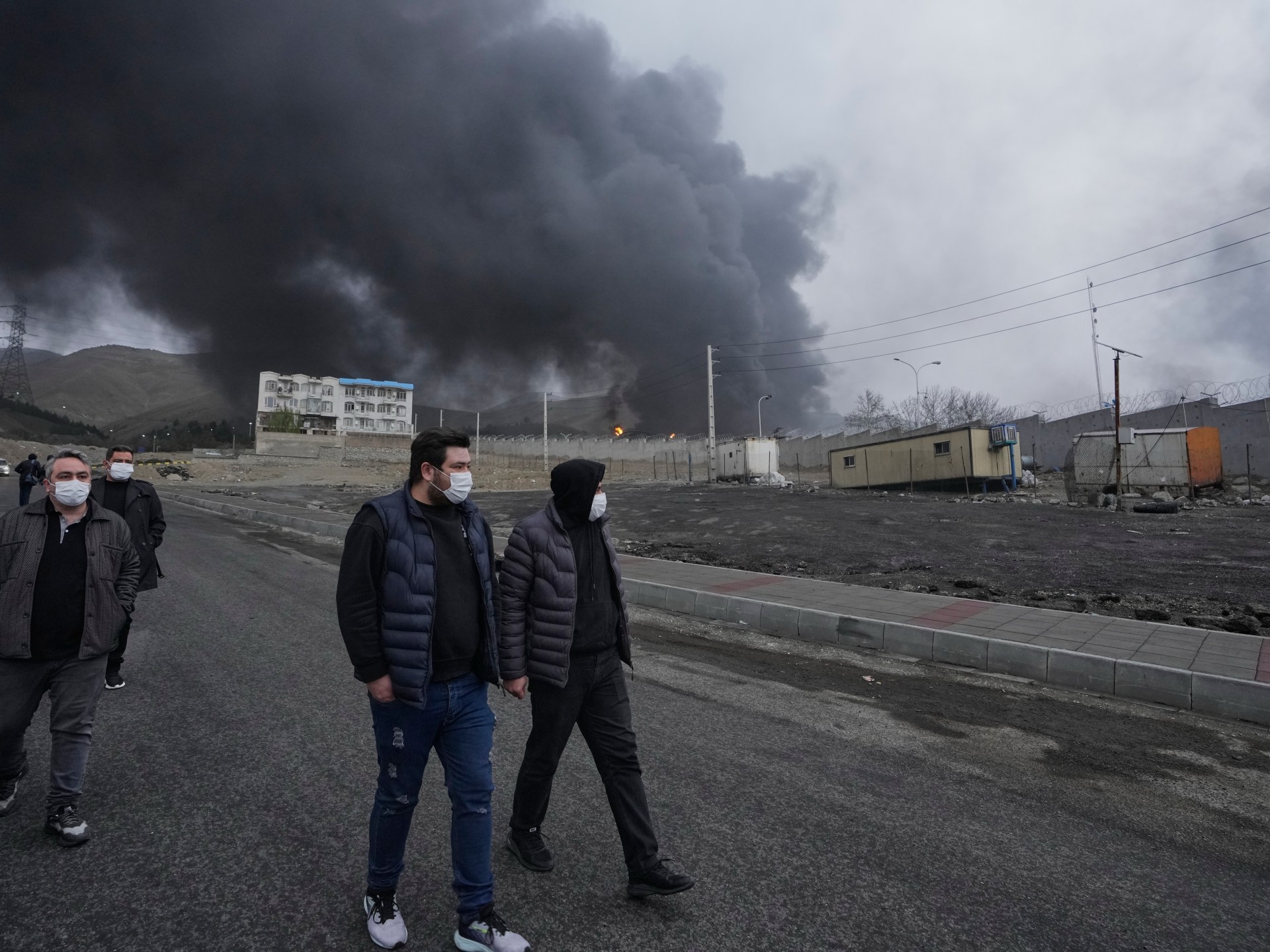
On March 8, Israel hit Iran’s oil facilities for the first time since the war started, killing at least four people. The Aghdasieh oil warehouse in northeast Tehran, Tehran oil refinery in the south, Shahran oil depot in the west of Tehran, and an oil depot in Karaj city were the key facilities targeted. Witnesses said oil from the Shahran depot also leaked into the streets. Reporting from Tehran, Al Jazeera’s Tohid Asadi also described seeing black raindrops on his windows early the next day.
Advertisement
Israel said it had struck “a number of fuel storage facilities in Tehran” that were used “to operate military infrastructure” in the March 8 attack. It provided no proof for its claims. Israel adopted similar tactics in Gaza, targeting schools and hospitals after accusing the facilities of being used by Hamas fighters. Most of their accusations later turned out to be false.
On March 18, Israel struck Iran’s critical South Pars gasfield. South Pars is part of the world’s largest natural gasfield, which spans 9,700sq km (3,745sq miles), and is shared by Iran and Qatar.
Trump has said neither the US nor Qatar had any involvement in or prior knowledge of Israel’s initial strike on the South Pars field.
Iran retaliated by launching missiles and drones at targets across the Middle East, including energy infrastructure in nearby Arab Gulf states.
Qatar
On March 2, Iranian drones struck an energy facility in Ras Laffan belonging to QatarEnergy, the world’s largest liquefied natural gas (LNG) producer.
QatarEnergy immediately announced that it had halted LNG production following the attacks. Qatar’s LNG exports represent 20 percent of the global market.
Iranian officials have, however, publicly denied targeting QatarEnergy.
On March 19, Iranian missiles again struck an LNG facility in Ras Laffan Industrial City in northern Qatar, hours after Israel had struck the South Pars gasfield. Doha reported that the attack caused “extensive damage”.
The attack wiped out about 17 percent of Qatar’s LNG export capacity, causing an estimated $20bn in lost annual revenue, QatarEnergy CEO Saad Sherida al-Kaabi told the Reuters news agency.
Saudi Arabia
On March 2, Saudi Arabia shut down operations at the Ras Tanura plant, its biggest domestic oil refinery operated by Saudi Aramco, after a fire broke out at the facility that officials said was caused by debris from the interception of two drones.
Iranian officials have publicly denied targeting Saudi Aramco.
United Arab Emirates
On March 2, a fire broke out at Mussafah fuel terminal in southwest Abu Dhabi after it was struck by a drone.
A day later, falling debris from a drone interception caused a fire at the Fujairah oil terminal along the eastern coast of the UAE. No injuries were reported.
On March 17, oil loading at the port of Fujairah was halted partly after an Iranian drone attack caused a fire at the export terminal, while operations at the Shah gasfield remained suspended after an earlier attack, officials said. Fujairah, which lies just outside the strait and is typically the outlet for more than 1 million barrels per day of the state company’s Murban crude, is still operating but at reduced capacity, according to Kpler, a data and analytics firm.
Oman
On March 3, multiple Iranian drones struck fuel tanks and a tanker at the port of Duqm, with at least one direct hit on a fuel storage tank, causing an explosion. On the same day, a drone strike was recorded at Salalah port, which handles fuel and industrial minerals.
Kuwait
On March 20, Iranian drones struck Kuwait’s largest oil refinery, Mina al-Ahmadi, for the second time. In the second attack, fires broke out across multiple units at the refinery, which processes about 730,000bpd oil.
Advertisement
Kuwait’s national oil company said several units had been shut down, though there were no casualties.
Israel
The owner of Israel’s Oil Refineries Limited said Iranian missiles struck its Haifa complex on March 19, and essential infrastructure was damaged. Energy Minister Eli Cohen said the Iranian strike had caused damage to a power grid.
Iran
On March 7, Iranian Foreign Minister Abbas Araghchi said a desalination plant on Qeshm Island in southern Iran was attacked by the US.
“Water supply in 30 villages has been impacted. Attacking Iran’s infrastructure is a dangerous move with grave consequences. The US set this precedent, not Iran,” he said on X after the attack.
Iran has since targeted desalination plants in the Gulf region.
Bahrain
On March 8, Manama said an Iranian drone attack caused material damage to a water desalination plant.
Water is scarce across the Gulf region, and groundwater, together with desalinated water, accounts for about 90 percent of the region’s water resources, according to a 2020 report by the Gulf Research Center.
The attack exposed the vulnerability of the Gulf countries, which depend on desalination plants for the majority of their water supply.
Kuwait
On March 30, an Iranian attack on a water desalination plant killed one Indian worker and damaged a building at the site, according to Kuwaiti authorities.
“A service building at a power and water desalination plant was attacked as part of the Iranian aggression against the State of Kuwait, resulting in the death of an Indian worker and significant material damage to the building,” Kuwait’s Ministry of Electricity and Water & Renewable Energy said in a statement on Monday.
Iran has yet to comment on the incident.
About 90 percent of Kuwait’s drinking water comes from desalination plants.
Power and industries
Power plants in Iran
On March 27, US and Israeli strikes hit the Bushehr Nuclear Power Plant, the Atomic Energy Organization of Iran said, adding that it was the third attack on the facility since the war began. The plant is Iran’s only operational nuclear power facility and plays a vital role in its civilian energy programme.
Power plants in Israel
On March 19, debris from intercepted missiles fell on a power generation station in the northern city of Haifa and caused electricity outages in several areas, according to Israeli media reports. Iranian media reported that Tehran struck the power plant in retaliation for the attack on the South Pars gasfield.
Steel plants in Iran
On March 27, the Israeli air force said it struck two Iranian steel plants linked to the IRGC. It provided no proof linking the plants to the IRGC.
Iran’s Fars news agency reported that the Israeli strikes hit Khuzestan Steel near Ahvaz and Mobarakeh Steel in Isfahan. A day later, according to Iranian media, the Khuzestan Steel Company had to halt production after its steelmaking units were struck.
In a post on X on March 27, Iran’s Foreign Minister Abbas Araghchi declared that Tehran would exact a “HEAVY price”.
Aluminium facilities in Bahrain, UAE
On March 29, the IRGC said it carried out missile and drone attacks on aluminium facilities in Bahrain and the UAE.
Aluminium Bahrain (Alba) said in a statement that two employees were injured in the attack on its facility, while the UAE’s Emirates Global Aluminium (EGA) said one of its sites in Abu Dhabi suffered significant damage, and six people were injured.
Finance and technology companies
Iranian bank hit
On March 11, Iran’s state broadcaster said an Israeli attack overnight had struck a state-owned Bank Sepah branch in Tehran and called it an “illegitimate and unusual act in war”. It reported that several employees were killed in the incident.
Advertisement
The IRGC has since threatened to attack “economic centres and banks” related to US and Israeli entities in the region.
The IRGC-affiliated Tasnim news agency also released a list of offices and infrastructure run by top US companies with Israeli links whose technology has been used for military applications, describing them as “Iran’s new targets”, said Al Jazeera’s Maziar Motamedi, reporting from Tehran.
The companies include Google, Microsoft, Palantir, IBM, Nvidia and Oracle, and the listed offices and infrastructure for cloud-based services are located in multiple Israeli cities, as well as in some Gulf countries, said Motamedi.
Gulf banks threatened
Following Iran’s threats, several banks across the Gulf region have evacuated their offices.
According to a March 11 report by The New York Times, Citibank asked its employees to immediately vacate its regional headquarters in the Dubai International Financial Centre. Standard Chartered told its employees to work from home.
In Qatar, HSBC temporarily shut down all three of its branches.
Data centres in the Gulf
On March 1, an Amazon data centre was struck in an Iranian drone attack on the UAE. On the same day, debris from a drone strike damaged a third Amazon data centre in Bahrain.
On March 24, an apparent Iranian drone attack disrupted Amazon Web Services (AWS) in Bahrain. Amazon did not immediately comment on whether its Bahrain facility was directly hit or if the disruption was due to nearby attacks.
The company said it was helping to migrate customers to alternate AWS regions while it recovers, though it did not provide additional details, such as the extent of the damage or how long it anticipates the disruption to last.
“As this situation evolves and, as we have advised before, we request those with workloads in the affected regions continue to migrate to other locations,” Amazon told Reuters in a statement.
AWS is Amazon’s cloud computing unit and is critical for the operation of many well-known websites and government operations. It is also the company’s main driver of profits.
Related News
Israeli attacks on Lebanon may amount to war crimes, UN rights office says
Hong Kong grants police power to demand phone and computer passwords
Iran war live: Qatar, Saudi energy sites attacked; Riyadh says trust gone