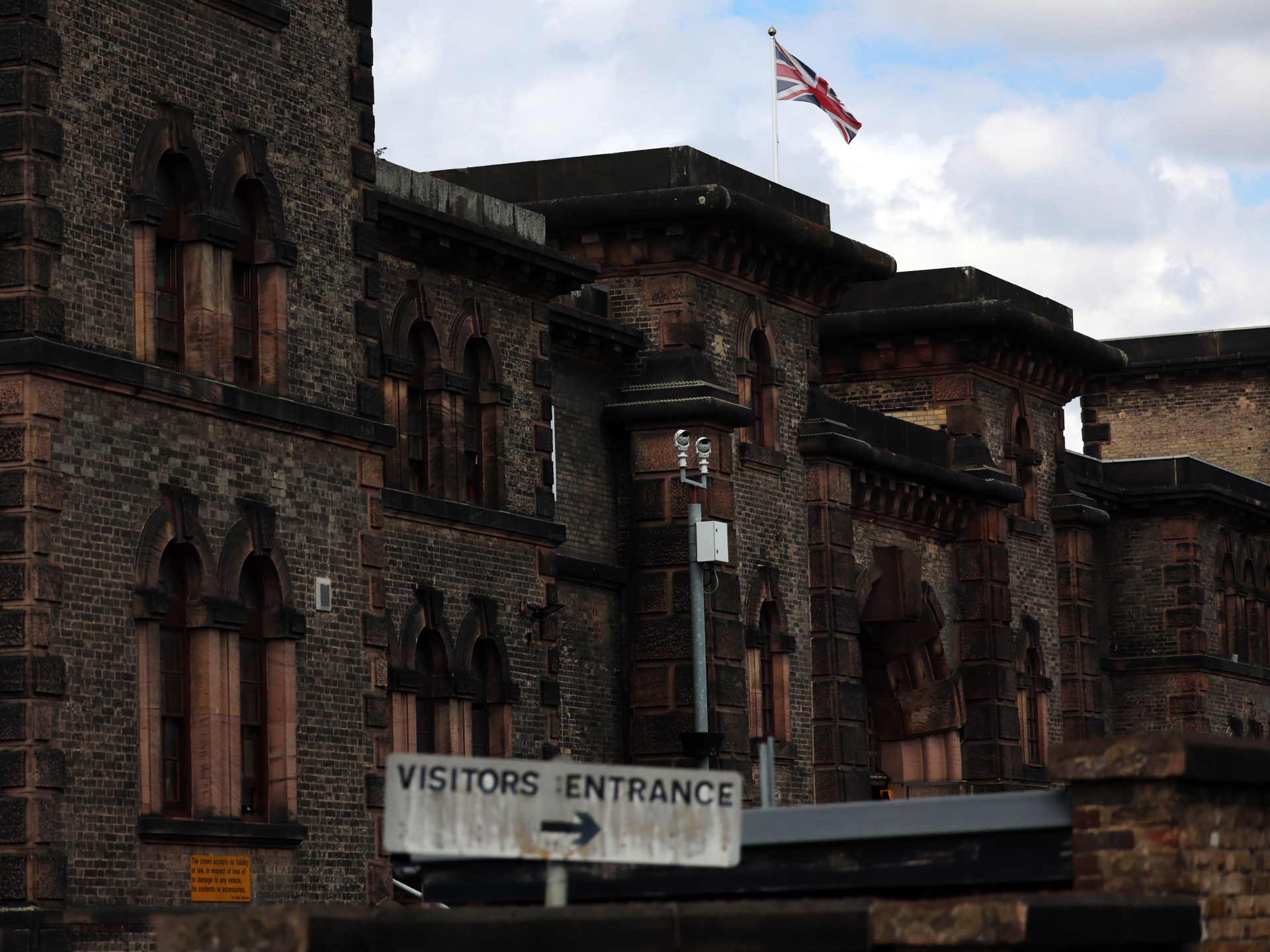

The UK’s Prime Minister Andy Burnham has become embroiled in a row about an early prison release scheme to alleviate overcrowding in England and Wales, which ignited furious public outcry when it emerged that two of the killers of Police Constable (PC) Andrew Harper could benefit from the plan.
Under the Sentencing Act 2026, which was passed under former Prime Minister Keir Starmer, prisoners in England and Wales who are serving fixed, determinate sentences will be released as early as one-third of the way through their jail time in order to free up space. The scheme is set to begin in October this year.
- list 1 of 3Infantino sets deadline for FIFA offer in Kushner-backed World Cup plan
- list 2 of 3Police arrest dozens at London rally supporting Palestine Action
- list 3 of 3UK left-wing MP Diane Abbott reinstated by Labour Party after suspension
end of list
Prison services are devolved in Scotland and Northern Ireland, but are still centrally controlled in England and Wales.
Here is what we know about the row and why England and Wales are facing a prisons crisis.
Burnham, who took over as prime minister last month after Starmer’s ousting just two years after winning a landslide election, paused the early release scheme for review following public backlash over the news that some rapists and child-grooming convicts might be freed. The family of slain PC Andrew Harper, who was killed in 2019, also protested.
Harper died after being dragged by a car driven by the two killers who were escaping from a burglary. They were convicted of manslaughter.
Following this review, Burnham said on August 4 that the Sentencing Act would no longer apply to those guilty of rape, serious child sex and other grooming offences. That brought the number of inmates eligible for early release to around 5,000, rather than the previously estimated 6,000. However, the exemptions do not include those convicted of manslaughter, as well as other charges.
Advertisement
Burnham has also moved the start date for the scheme back by one month to October, and has announced extra supervision of those released and more support for victims.
Adding the crime of manslaughter to the list of exclusions to prevent the release of PC Harper’s killers would result in blocking the early release of around 1,000 inmates, according to estimates published by British media.
While there have been calls to add manslaughter of an emergency worker as an exception, this is not a specific offence, and the government has said that such an amendment would not be legally feasible.
Experts say the British prison system is on the verge of collapse, as it has one of the highest imprisonment rates in Western Europe, and successive governments have grappled with unpopular options to solve the emergency.
Burnham has vowed to take concerns on board, but ultimately, he said he would see the policy through. “I am doing all I can,” he wrote on X. “But it is simply not possible to prevent all offenders from being released early without the prison system collapsing.”
What happened to PC Andrew Harper?
Twenty-eight-year-old PC Harper from Wallingford, Oxfordshire, was killed in 2019, just four weeks after getting married, as he responded to reports of a burglary. As three teenagers fled the scene of a quad bike theft in Berkshire, his ankle became caught in the getaway car’s tow-rope loop, and he was dragged along a country road for more than a mile (1.8km), suffering fatal injuries.
Albert Bowers and Jessie Cole, two of his killers who were convicted of manslaughter, were sentenced to 13 years for manslaughter in 2020. Under usual rules, they would have to serve at least two-thirds of their sentences before they could be considered for release.
Under the new scheme, however, they would be eligible for release in June 2027, just halfway through their sentences.
A third killer, Henry Long, was given a longer sentence, which requires his case to be seen by the Parole Board before any release can be granted.
The police officer’s widow, Lissie Harper, has pleaded for Cole and Bowers to be denied early release. Chris Bushnell, a former police dog handler who was at the scene of PC Harper’s death, told media in the United Kingdom that he was “shaking” when he was informed that the officer’s killers might be eligible under the scheme.
Harper’s mother, Debbie Adlam, told the BBC she was in “turmoil” over the conflicting reports that Cole and Bowers could be eligible for release next year.
Advertisement
Some 900,000 people have signed a petition to prevent the killers’ early release. On Wednesday, 50 police chiefs also signed a letter urging Burnham to pursue every legal option to prevent their release.
How has PM Burnham responded to this case?
Andy Burnham is under increasing pressure to block the release of the killers of PC Harper, and is reportedly actively seeking ways to be able to do this.
On social media, the prime minister said he fully appreciated the “anguish” felt by Harper’s family and said the scheme could be mitigated by expanding prison places in other ways, including removing foreign offenders more quickly and repurposing some women’s prisons for male offenders.
“However, I recognise that, even with all these changes, there will be concerns from many victims about who will still be released early for other offences,” Burnham said on Tuesday.
He added that he was “confident” that the release of the most serious offenders, including Harper’s killers, could be prevented. However, it remains unclear how he intends to do that.
Why is there a prisons crisis in the UK?
Britain’s prisons are nearing the breaking point, experts say, while the prison population is projected to keep rising.
According to the Institute for Government, an independent British think tank, the prison population has doubled over the past 30 years despite falling crime rates. This is largely due to longer sentences being passed and a growing number of people being recalled to prison following release.
As a result, men’s prisons are currently 97 percent full, according to the think tank. Building new prisons would not solve the problem in time, given that it can take an average of seven years to construct and open a new, operational facility, with projects often suffering delays. Additionally, lack of adequate staffing is a long-running problem for British jails.
The think tank said public campaigns calling for the creation of new offences or the introduction of longer sentences have also contributed to the overcrowding.
In 2020, the Conservative government led by Prime Minister Boris Johnson increased the length of sentences for certain serious offences by one-third, while in 2022, the Conservative government of PM Rishi Sunak did the same for a wider group of offences, despite there not being enough capacity in prisons to absorb the increase.
According to independent UK charity Prison Reform Trust, years of rising sentence lengths have driven the prison population close to the limits of available capacity.
“The current crisis is the result of successive governments relying increasingly on imprisonment, while population growth has outpaced the construction of new prison places,” Alex Hewson, the charity’s senior policy and communications officer, told Al Jazeera.
Research conducted by the organisation found that between 2024 and 2025, almost three-quarters of prisons (72 percent) in England and Wales were overcrowded. More than 21,600 people – one-quarter of the prison population – were being held in overcrowded accommodation.
Advertisement
The Howard League, a British charity advocating for penal reform, said overcrowding, coupled with chronic staff shortages, means prisons cannot engage everyone in activities that help rehabilitation. This means more people are locked in an overcrowded cell for 23 hours a day with nothing to do, raising the risk of self-harm, violence and reoffending.
Under the Sentencing Act 2026, up to 5,000 inmates serving a standard prison sentence will be eligible to be released earlier than their originally set date.
According to the new rules, prisoners convicted of less serious offences who would have been expected to serve 40 percent or 50 percent of their sentence in prison will be eligible to leave after having completed one-third of their sentence. A second group, currently set to be released after two-thirds of their sentence is served, will leave after half.
Being released does not end the sentence. Those convicted continue to serve the rest of their sentence in the community, under conditions set by probation, and can be recalled to prison if those conditions are breached.
Hewson, at Prison Reform Trust, said these changes are expected to provide “the single biggest reduction in demand for prison places”.
“With places projected to run out in the autumn [September through November], there are no easy alternatives waiting in the wings,” he added.
“Other options, such as tackling growth in the recall population, reducing the use of remand, or making greater use of community-based alternatives to custody, could also help, but none offers an immediate solution on the scale required,” Hewson continued.
“In the long term, the only sustainable answer is a justice system that reserves prison for the most serious cases, reverses decades of sentence inflation, and does more to reduce reoffending in the community.”
Related News
Did China steal 2020 US election data, as Trump claims?

Two Palestinians shot dead by Israeli forces as West Bank fields set ablaze

Israeli ex-generals urge Trump to push Netanyahu on ‘settler terror’