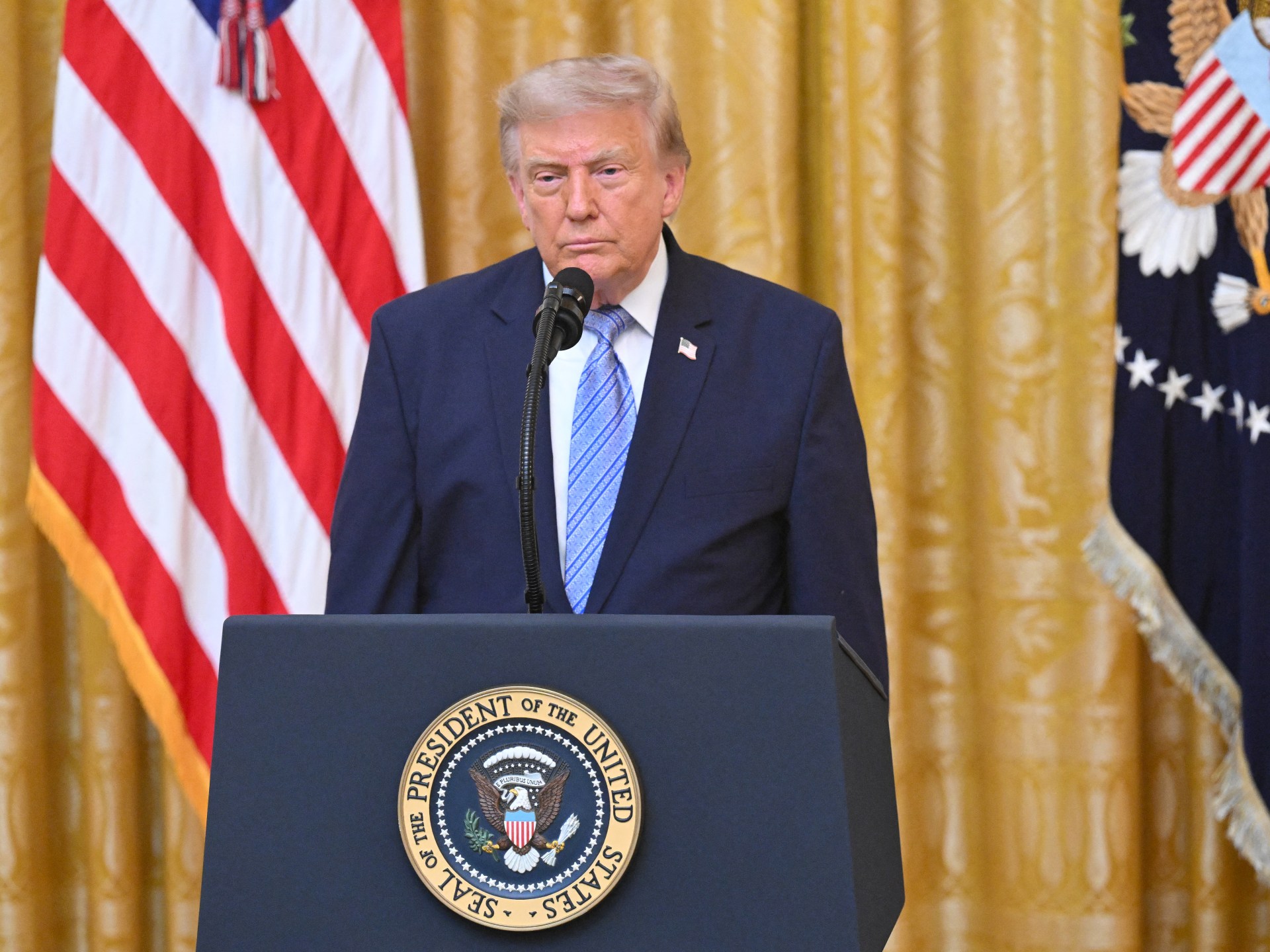

United States President Donald Trump has delivered an extraordinary primetime speech, alleging government “cover-ups” and “vulnerability” in the nation’s electoral system.
But experts were quick to point out that Trump failed to present any conclusive evidence that past presidential elections had been swayed by malfeasance.
- list 1 of 3Trump limits length of visas for students, exchange visitors, journalists
- list 2 of 3US to impose new 25 percent tariffs on some Brazilian imports
- list 3 of 3The hardest party to manage in the Iran talks isn’t Iran
end of list
In many ways, Trump’s speech on Thursday revisited themes familiar to the Republican leader.
He made broad accusations about a “deep state” conspiracy involving his Democratic predecessors, Barack Obama and Joe Biden, and he lashed out at familiar foes, including the news media and China.
For years, Trump has spread baseless claims that his loss in the 2020 presidential election was “rigged” and “stolen”.
Trump stopped short of repeating his false claim that he had, in fact, won that race. But in his remarks, he sought to raise suspicion about the election’s outcome, pointing to declassified government documents.
Those files, however, painted a more nuanced picture than Trump portrayed, and they failed to substantiate his claims of a conspiracy.
After the speech, Democrats criticised Trump for attempting to mislead the public and reduce confidence in the US electoral system, with months to go until the November midterm election.
Here are the key takeaways from his address:
Trump claims China compromised election data
One of the biggest accusations of the night was levied against China, the US’s geopolitical rival.
“Starting during the 2020 election cycle, the People’s Republic of China carried out what is believed to be the largest compromise of election data in history,” Trump said near the outset of his speech.
Advertisement
He claimed that Beijing, through “illicit” means, had acquired 220 million US voter files, including names, addresses and party preferences.
“Think of that: Tens of millions of voters’ data in 18 states have been bought, stolen or hacked by China,” Trump said.
A spokesperson for China’s embassy denied such claims, saying the country “has never and will never interfere in the presidential elections of the US”.
Trump, however, did not say that the information had been used to influence any election.
But critics pointed out that such voter information is already publicly available. Some states even sell that public data, for prices ranging from $0 to $37,000, as the US Election Assistance Commission explained in a 2020 report.
The documents declassified by the White House also appeared to indicate Beijing was, at least in part, drawing from publicly available data. It did, however, express curiosity at China’s increasing interest in such information.
“While the PRC [People’s Republic of China] government has historically demonstrated interest in US elections, this is a newly-identified interest for this individual actor,” a heavily redacted assessment said.
“The US voter registration information is available for public download, with 2021 voter registration information available for some states.”
In Thursday’s speech, Trump returned to a conspiracy theory that helped define his first successful bid for public office in 2016: that so-called “deep state” actors had sought to undermine his presidency.
He claimed there was a “shadow government” with “rogue bureaucrats” who attempted to cover up Chinese efforts to influence the 2020 vote.
They even sought to suppress information from his daily presidential brief, Trump alleged.
“These were briefings I would get almost every day. Everything was kept out that was of importance,” he said.
Experts, however, have noted that presidential briefs are usually heavily curated to contain intelligence perceived to be of high importance.
An intelligence community report compiled in January 2021 assessed with “high confidence” that China had considered launching an influence campaign in 2020 – but that it eventually decided against it.
The report was declassified in March 2021. It contained a minority opinion that indicated China “took at least some steps” to undermine Trump’s re-election chances “primarily through social media and official public statements and media”.
The publication of the report would appear to contradict Trump’s claims of a “cover-up”.
Advertisement
Still, in his speech, Trump said he had instructed his top law enforcement officials to “fire those involved in the cover-up and to file criminal charges, if appropriate, against these people”.
Critics had warned that Trump could use Thursday’s speech to undermine confidence in US elections by spreading falsehoods.
Some television news outlets, including ABC, NBC and CNN, even opted not to air the speech in full on their main broadcast channels.
The timing of the speech is significant, as it comes less than four months before the midterm elections, which decide control of Congress.
Trump did indeed spend part of his speech voicing allegations that American voters had been deceived by the same “deep state” actors he accused of targeting him.
“For many years, Americans were blatantly lied to about the security of our election infrastructure, including voting machines and ballot counting systems,” Trump said.
“They’re vulnerable, and they’re easily compromised, and people within our government knew that.”
But the declassified documents released by the White House did not appear to contain any major revelations about such claims. Potential vulnerabilities have long been known, and local and federal officials have sought to address them.
The fact that elections are administered at the state and local levels has also been cited as a barrier against any widespread tampering.
Given the decentralised nature of US election administration, the US intelligence community has long assessed that large-scale voting manipulation would be all but impossible.
After Trump’s speech, Democrats dismissed Trump’s remarks as distortions designed to disincentivise voters from participating in elections.
“President Donald Trump continues to lie, distort the truth to try to sow doubt and suppress the 2026 election,” US Representative Jason Crow said in a video statement. “He doesn’t want Americans to vote. He doesn’t want their voice to be heard.”
Trump rehashes Michigan investigation
Trump made a gesture at unity in Thursday’s speech, arguing that election security should not be a “partisan issue”.
“It should cause to unite us, not to divide us,” he said at one point.
But the Republican leader fired off dubious claims against targets big and small.
He called for broadcasters that did not air his speech to lose their licences. He berated California as “worse than any third-world country”. And he rehashed an incident in the swing state of Michigan that took place well before the 2020 election.
The case involved allegations of voter registration forms with false information. But the forms were not processed and did not have any bearing on that year’s election; they were flagged months before the vote took place.
The state Attorney General’s Office probed the incident, as did the Federal Bureau of Investigation.
Neither found evidence that fraud had been successfully committed. It is believed that the forms were not part of an election scam but rather an attempt to meet workplace quotas.
Advertisement
Still, in his speech, Trump portrayed the incident as a significant breach.
“It was pay, play, and cheat,” he alleged, proceeding to blame former President Biden for failing to pursue the case. “The Biden Department of Justice slow-walked the investigation and killed it.”
He added that he had instructed the FBI to reopen its investigation, although the declassified documents the White House released did not appear to provide new evidence in the case.
Speech sought to cast doubt, but contained few revelations
Trump’s speech had been hyped as a major moment in the president’s second term.
On Tuesday, when the primetime address was first announced, Trump said it would contain “really big news”. His press secretary, Karoline Leavitt, warned reporters earlier in the day that the speech would “shock”.
But Democrats and election experts have argued that the speech was underwhelming – and would mostly serve to fire up Trump’s Republican base.
Indeed, Trump opened his remarks on Thursday with a resume of his second-term accomplishments, from border security to efforts to combat crime.
And he closed his speech with an appeal to pass the SAVE America Act, a piece of legislation he has repeatedly championed to heighten voter requirements.
The bill would increase voter identification standards, requiring proof of citizenship in the form of documents like birth certificates and passports that some US citizens may not have.
Rights groups have argued the requirements could disenfranchise some citizens.
Speaking to Al Jazeera, political analyst Eric Ham said the speech was yet another push in Trump’s effort to bring elections under federal control.
“This is something that the president has had an ambition of doing for quite some time, and I think what we saw tonight was another shot across the bow at trying to fundamentally change elections,” Ham said.
Hakeem Jeffries, the top Democrat in the House of Representatives, also decried the speech as a distraction from Trump’s political woes before the midterms.
“Donald Trump is a feeble, unhinged conspiracy-peddling 80-year old failed President,” Jeffries wrote on social media. “The economy is a disaster under this guy and the American people know it.”
Related News

US Supreme Court clears path for Texas to enforce app age verification law

How US-Iran war may push Gulf countries to ‘diversify’ security alliances
Trump praises army, rails against communism in US 250th anniversary speech