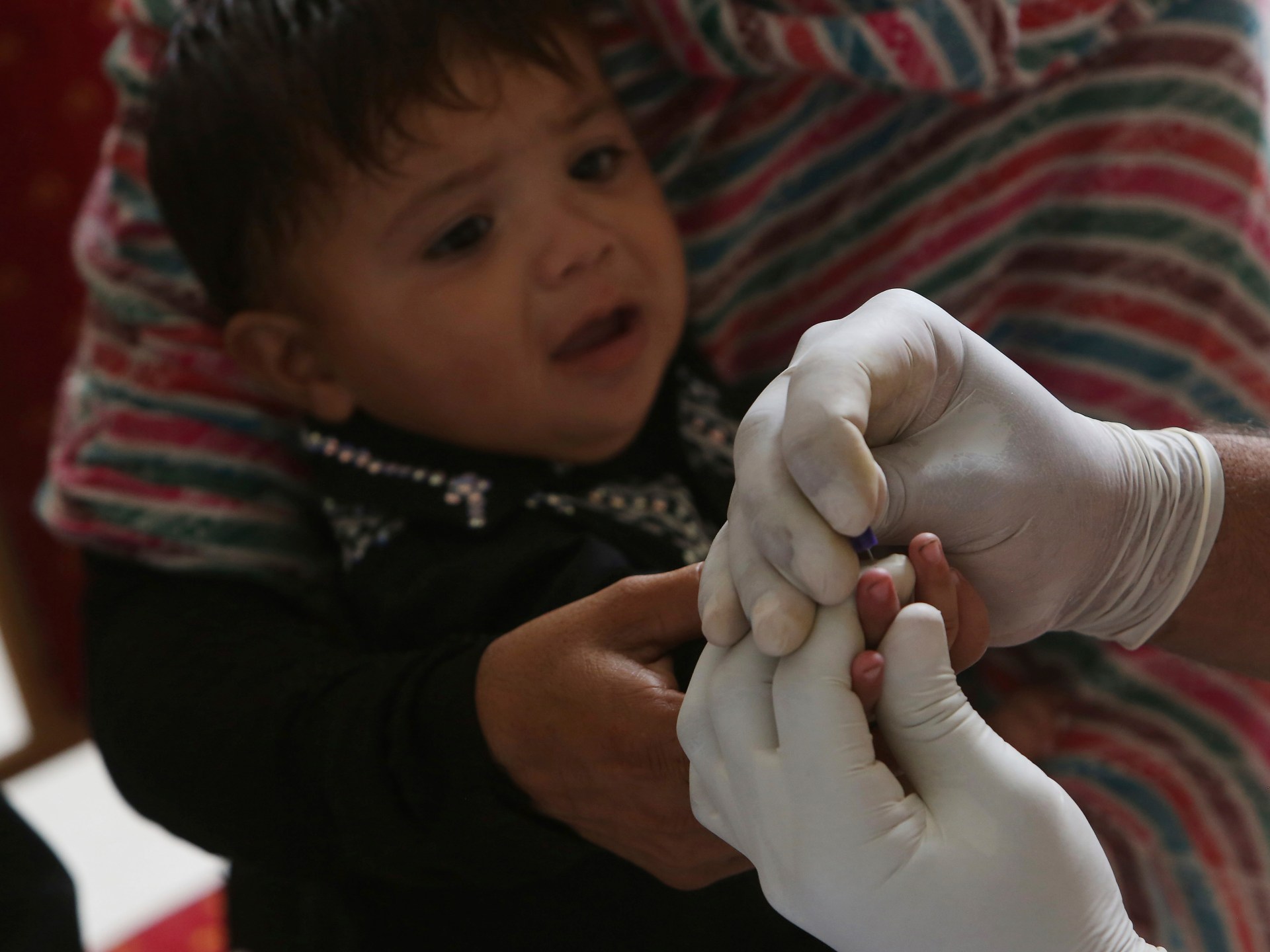

Islamabad, Pakistan – At least 130 people, most of them children, have tested HIV-positive in connection with an outbreak at a government-run hospital in Karachi, Pakistan’s largest city, with officials adding that the number has risen sharply in recent weeks.
Sindh Labour Minister Saeed Ghani said earlier this week that more than 10,500 people were screened in and around Kulsum Bai Valika (KBV) Hospital, a Sindh Employees’ Social Security Institution (SESSI) run facility, where 120 tested positive.
- list 1 of 4Pakistani doctor arrested after 90 infected by HIV syringe
- list 2 of 4Photos: Poverty worsens HIV outbreak among Pakistani children
- list 3 of 4‘They’re coming by dozens’: HIV outbreak sparks panic in Pakistan
- list 4 of 4An AIDS-free generation is within reach, but not guaranteed
end of list
A separate screening drive at another SESSI facility in Karachi’s Landhi area identified 10 additional cases.
SESSI is an autonomous provincial organisation that provides healthcare, medical facilities and financial assistance to industrial and commercial workers and their dependants across Sindh.
The crisis at KBV Hospital first came to public attention in November 2025, when residents of Karachi’s SITE Town noticed a cluster of infections among children treated there.
Officials, however, trace the outbreak to October 2025, when the first six HIV-positive cases were reported to the provincial health department.
So what happened, what caused the outbreak, and why does Sindh continue to witness such episodes?
What has happened this month?
Chief Minister Murad Ali Shah was briefed on July 14 that two internal inquiries had found serious lapses, including poor adherence to infection prevention protocols, inadequate use of protective equipment and improper handling of single-use syringes.
The first inquiry, submitted in November last year, identified 16 HIV-positive children, all linked to the KBV’s paediatrics department.
Advertisement
A second, more comprehensive inquiry, submitted to the provincial ombudsman on June 19, confirmed 78 infections and six deaths, holding named hospital staff responsible for administrative and supervisory failures.
The number has since increased, with the latest infections confirmed at the SESSI facilities.
Minister Ghani said all cases had been traced to exposure before October 2025 and that screening would continue “despite fears that additional cases may emerge”.
Thirty-seven doctors and hospital staff were issued show-cause notices on July 3 and given 14 days to respond.
Ghani said criminal cases and dismissals would follow for those found responsible. Asked about his own accountability, he said he had “accepted indirect responsibility” and would not object to resigning if it helped resolve the crisis.

Is Sindh’s outbreak an isolated case?
Responding to questions after a Sindh High Court petition alleged the outbreak stemmed from reused syringes, Ghani told reporters on July 4 that the infections were not caused by syringe reuse. He argued that KBV Hospital uses auto-disable syringes that cannot be reused.
The official inquiries, however, pointed to a broader breakdown in infection prevention, citing failures that included poor adherence to safety protocols, inadequate use of protective equipment and improper handling of single-use syringes.
The petition before the Sindh High Court alleges the number of infections is significantly higher than officially acknowledged.
This is not the first large HIV outbreak reported in Sindh.
Last December, the World Health Organization (WHO) and UNAIDS identified the crisis in Pakistan as one of the fastest-growing HIV epidemics in the WHO Eastern Mediterranean Region, comprising of 21 nations, with annual infections rising 200 percent over 15 years, from 16,000 in 2010 to 48,000 in 2024.
In a joint World AIDS Day statement issued on December 1, the agencies estimated that about 350,000 people in Pakistan are living with HIV, with nearly 80 percent unaware of their status.
The statement also noted that HIV infections among children aged 0 to 14 increased from 530 in 2010 to 1,800 in 2023.
Only 38 percent of children living with HIV are receiving treatment, while just 14 percent of pregnant women requiring therapy to prevent mother-to-child transmission receive it.
Advertisement
In June, physicians writing in British medical journal The Lancet HIV argued that Pakistan’s epidemic is now driven “in large part, by the health-care system itself”, pointing to repeated outbreaks linked to unsafe medical practices.
That assessment, however, remains inconclusive.
While repeated outbreaks have highlighted unsafe medical practices, researchers say Pakistan also lacks comprehensive surveillance to determine how many HIV infections nationwide originate in healthcare settings compared with sexual transmission, mother-to-child transmission or intravenous drug use.
Syed Faisal Mahmood, professor of infectious diseases at Aga Khan University Hospital in Karachi, urged caution.
“At this point in time, it is impossible to say which of the two are the dominant drivers of infection,” he told Al Jazeera.
For sexual transmission, mother-to-child transmission and intravenous drug use, he said, “the numbers are somewhat more reliable, because a great deal of work has been done” through established surveillance.
“There is no systematic surveillance looking at how many people have acquired HIV from visiting clinics, hospitals, or informal care providers,” he said.
The pattern extends beyond KBV Hospital.
Three other hospitals in Karachi have also reported increasing numbers of paediatric HIV patients, including one facility where admissions rose from 10 cases in 2024 to 70 in 2025.
The Pakistan Medical Association warned in April that 329 of the 894 HIV cases recorded in Sindh during the first quarter of 2026 involved children, describing the figures as “merely the tip of the iceberg”.
For Mahmood, these outbreaks point to a much broader problem.
“For many of us working in this field, this is a systemic problem,” he said. “It is not linked to any one hospital or healthcare system. Poor injection safety protocols are pervasive throughout the entire country and across all levels of healthcare.”
He added that children are not the only victims, pointing to outbreaks in dialysis centres linked to unsafe blood transfusions.
Pakistan also has one of the world’s highest hepatitis C burdens, he said, “driven by the same mechanism and the same underlying reasons” as the HIV cases now emerging.
What is being done?
The Sindh High Court has given the provincial government until July 20 to respond to a petition alleging violations of provincial laws governing the regulation and disposal of syringes.

At the federal level, Prime Minister Shehbaz Sharif ordered a nationwide ban on substandard syringes on July 3.
The Drug Regulatory Authority of Pakistan later announced that retail sales of conventional syringes that can be reused, unlike auto-disable syringes that block or break the plunger after one use, will be banned from January 2027.
Advertisement
Federal Health Minister Mustafa Kamal has also said HIV screening will become mandatory before surgery nationwide, while cautioning against describing the situation as a broader “epidemic”.
Meanwhile, the Sindh government has approved a 2 billion-rupee ($7.2m) endowment fund for the long-term care of affected children, alongside an isolation ward and a third-party audit of KBV Hospital’s procurement and infection control systems after the provincial ombudsman took notice of the case.
Al Jazeera contacted Sindh Health Department officials for comment but did not receive a response.
Mahmood, however, said measures such as banning syringes address only part of the problem.
About 60 percent of healthcare in Pakistan is delivered by the private sector, which he said is much harder to regulate.
“The private sector is considerably more difficult to regulate. It encompasses not just hospitals but also clinics, dispensaries and similar facilities, which are nominally overseen by healthcare commissions that simply do not have the manpower to inspect all of them,” he said.
Mahmood said unsafe injections remain deeply embedded in Pakistan’s healthcare culture, driven not only by weak regulation but also by patient expectations.
“Patients coming to a doctor expect an injection because they believe it will make them recover faster, and healthcare workers often feel the same way,” he said. “It is, in many ways, a perfect storm: more injections being given, those injections going largely unregulated, limited knowledge of safe injection practice, no surveillance on whether injections are being administered correctly, and no consequences for unsafe practice.”
Related News
Trump’s border czar probes possible vetting failures after ICE shooting

Israel’s Smotrich declares ‘revolution’ in West Bank settlement expansion

China warns UK over British Steel nationalisation, demands fair resolution