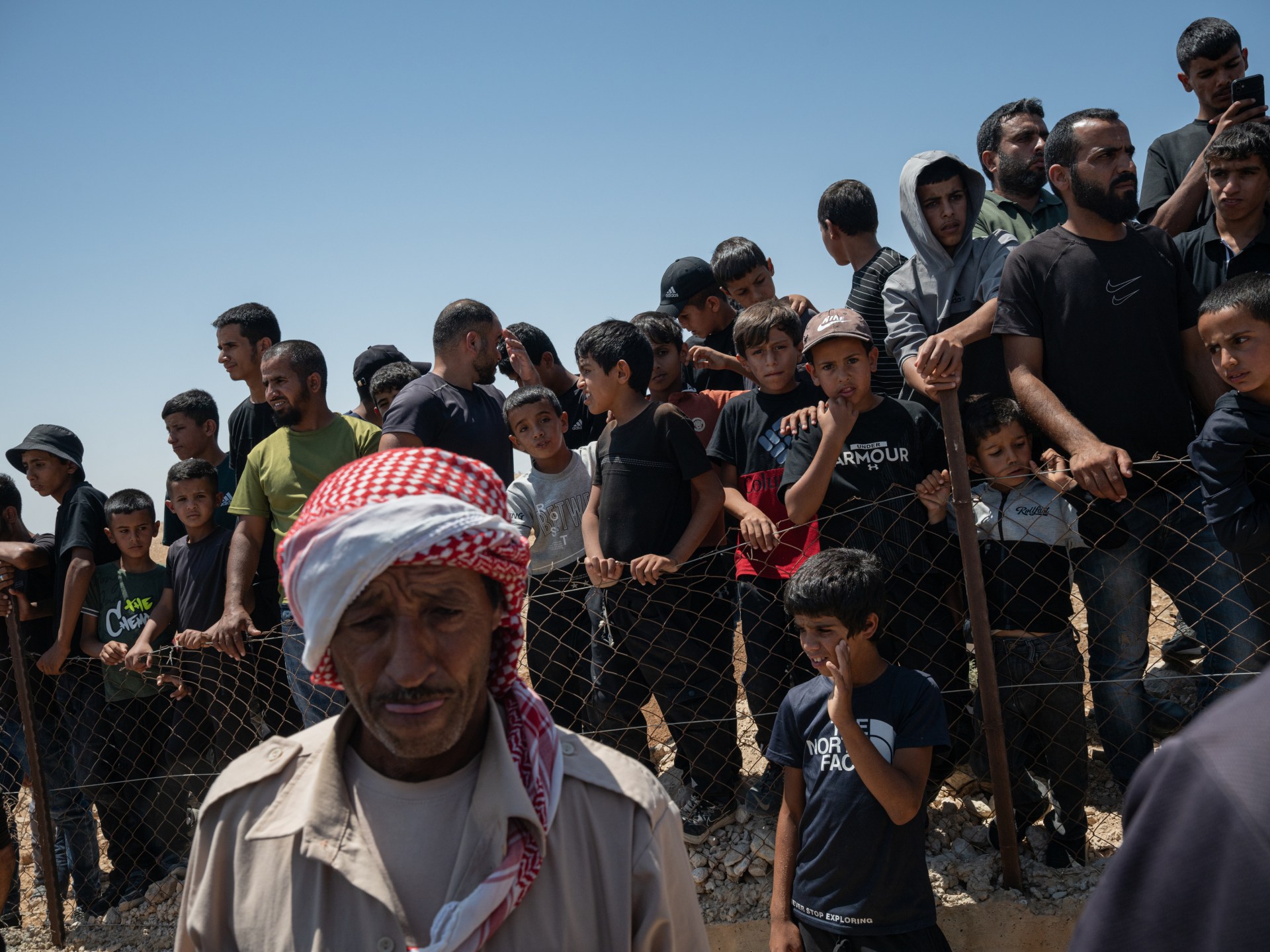

Umm al-Khair, Occupied West Bank — There were weddings in Umm al-Khair this week, but almost no one danced. The small Bedouin village, located in Masafer Yatta, was marrying off two of its sons. Cauldrons of slow-cooked lamb meat for mansaf – a large platter of traditional Arabic food – fed the whole community. But there was no dahiyya, the line dance and chant that normally opens a Bedouin wedding.
Residents said it did not feel right coming so soon after the first anniversary of the killing of Umm al-Khair activist and community leader Awdah Hathaleen, allegedly by Israeli settler Yinon Levi. The community continues to endure daily settler attacks, arrests and incursions by Israeli soldiers, and the threat of further demolitions by Israeli authorities looms.
- list 1 of 4Israel’s illegal settlements are Europe’s credibility test
- list 2 of 4Israeli raid in West Bank’s Qalandiya injures 51 Palestinians
- list 3 of 4Israel advances plan for 627 settler units in occupied West Bank
- list 4 of 4Israeli settler attacks rise as West Bank residents lose land
end of list
During celebrations, families spread out in different areas rather than gathering in one place, wary of drawing any attention that, in the past, has brought soldiers to disrupt the celebrations.
“There is a wedding, but they are not letting us celebrate quietly,” said Tariq Hathaleen, an English teacher and community leader in Umm al-Khair.
On Thursday, the first day of the wedding, Shimon Atiya – the Israeli settler behind the illegal outpost of Havat Shorashim, established roughly 800 metres from the village in 2022, and who has been under a restraining order since July 2025 for harassing Umm al-Khair families — crashed the wedding in the only style he knows. He brought his livestock to graze in a resident’s vegetable garden, escorted by Israeli soldiers who stood by as it happened.
Advertisement
When villagers told the soldiers that the plot is recognised as Umm al-Khair land, they were told the maps had changed; when they asked to see the new maps, they were refused. That night, the outpost’s fence towards the village homes was torn down – a prelude to pushing the boundary further in, residents believe.

Hathaleen says the settlers’ timing was a reaction to Levi’s indictment days earlier — one of the few times an Israeli has been charged with the killing of a Palestinian in the occupied West Bank since October 2023.
Just a couple of days before, on Thursday, Hathaleen watched as buildings and vehicles in the nearby Palestinian community of Khirbet Tuba were set ablaze by settler arsonists.
“The occupation always tried very hard to erase the Palestinian Indigenous people and their history, their legacy, their heritage,” Tariq said. “This really reminds me of the Nakba, and how the Israelis destroyed Palestinian cities and villages”, he noted, even planting cactus over the ruins to bury the evidence. “Back then it wasn’t documented. Nowadays, it’s happening, but it is documented.”
Sunday marks the United Nations’ International Day of the World’s Indigenous Peoples. In Umm al-Khair, the wedding felt symbolic of the threats to Indigenous Palestinians’ way of life and their basic presence on their own land.
‘They try to imitate us’
According to local Palestinians and watchdog NGOs, the threats facing Palestinians in the occupied West Bank, including East Jerusalem, and the Gaza Strip include detentions, killings, demolitions, restrictions on movement and evictions.
Since October 2023, Israel has killed 1,100 Palestinians in the occupied West Bank, including 242 minors, according to the Israeli NGO B’Tselem. Israel has also demolished more than 3,000 Palestinian homes since October 2023, the vast majority due to a lack of Israeli-issued permits that Palestinians in Area C are routinely denied.
According to the latest figures from the UN’s Office for the Coordination of Humanitarian Affairs (OCHA), demolitions and settler violence displaced an average of 17 people a day this year, double the rate of the previous three years.
A June report by the West Bank Protection Consortium, which includes the Norwegian Refugee Council (NRC) and monitors more than 200 communities it judges at risk of forcible transfer, said 96 percent of those who had been forcibly displaced were previously dependent on farming or herding. They have mostly lost access to these lands or pastures.
Advertisement
However, residents and watchdogs say such dispossession takes place within a system of Israeli permits, demolition orders and land policies controlled by the state alongside hundreds of millions of dollars in public funding for settlements and outposts. Israeli NGO Peace Now counts 146 illegal Israeli settlements in the occupied West Bank and 390 unauthorised outposts and farms.
In 2024, the International Court of Justice found Israel’s continued presence in the occupied Palestinian territory unlawful.

Amid dispossession of their traditional grazing lands, 13 structures in Umm al-Khair were issued demolition notices last October, following demolitions in 2024 that left a third of the village homeless. The restraining order against Atiya, residents say, has done little to stop him.
Tariq argues the erasure is not only physical, but cultural also, and that it comes paired with an attempt by settlers to claim the very Palestinian identity they are displacing.
“The settlers nowadays try to imitate that lifestyle, building tents that they probably stole from Palestinians somewhere, using tractors to bring water from far away,” he said.
Young men from the hilltop outposts can be seen grazing camels, goats and sheep. All the while, Tariq observes them wearing Palestinian scarves and even attempting the Bedouin dialect when leading their own flocks.
“They know the Indigenous people of this land are the Bedouins and other Palestinians. So, they try to imitate that – to show to themselves and to the world that they are the Indigenous people of this land,” he added. “[But] this land doesn’t relate to them, because only the Indigenous people of this land know how to live in this land.”
‘We are the Indigenous people of this land’
Many outpost settlers serve as military reservists while living on the farms themselves, Tariq noted – a status that comes with state-issued weapons.
He recalled Finance Minister Bezalel Smotrich publicly distributing all-terrain vehicles to South Hebron Hills outpost settlers. He also remembers the day Awdah was killed, when soldiers let Levi point out five community members for arrest.
“This is not only settler terrorism backed up by the state,” Tariq said. “It is the state’s plan, carried out by the settlers, well planned in rooms where officials sit around a table and tell them what to do.”
Yair Dvir, spokesperson for B’Tselem, said: “Israel is carrying out ethnic cleansing in the West Bank and an all-out assault on the Palestinian people. We see it on many levels: military violence and repression, home demolitions, and the funding and backing of settler militias.”
Shaina Low, a spokesperson for the NRC, described the same pattern as a coordinated strategy across the Israeli-occupied territories.
“For nearly 80 years, we’ve seen Israeli efforts to drive Palestinians from their land play out, starting with the Nakba and continuing to the present day,” she said. Low cited an acceleration of these actions since October 2023, when the genocidal war on Gaza began, that has seen expanding settlement infrastructure, rising West Bank demolitions alongside East Jerusalem evictions in neighbourhoods like Silwan. There has been an “astronomical increase” in settler violence documented, Low added.
Advertisement
Gaza shows the same agenda but taken to the extreme. Since the October 2025 “ceasefire”, more than 1,200 people have been killed in Gaza, on top of a cumulative death toll that has climbed past 73,000 since October 2023, according to Gaza’s Ministry of Health.
According to UN satellite analysis, roughly 81 percent of all structures in Gaza have been damaged. Even with the “ceasefire”, OCHA reports that some 59 percent of Gaza’s population faced crisis-level food shortages or worse between April and June, a share it projects will rise again by year’s end as aid funding shrinks.
Following successive campaigns of expansionism, the Israeli military now controls at least 64.9 percent of Gaza. “These policies are all working together,” Low said. “They may be different tactics, but it’s all part of the same agenda to force Palestinians from their land and increase Israeli control over the territory and expand Israeli presence.”
Still, on the eve of a day meant to mark the world’s Indigenous peoples, Tariq was resolute.
“They will try a million ways to erase the Palestinian Indigenous people, but they will fail because this land doesn’t speak their language, it doesn’t carry their colour, it doesn’t go by their ideologies,” he said.
“This is our land, and we have always been living here in harmony – with nature, the desert, the mountains, the valleys of Palestine – because we are the Indigenous people of this land, and we always will be. Their attempts are failing, and will fail. One day, we will get our freedom.”
Related News
Decades of denial: Death certificate for disappeared reopens Kashmir wounds
Russian strikes near Ukrainian capital kill three, including child
Russia says Ukraine rejects local ceasefire in dispute over Kostiantynivka