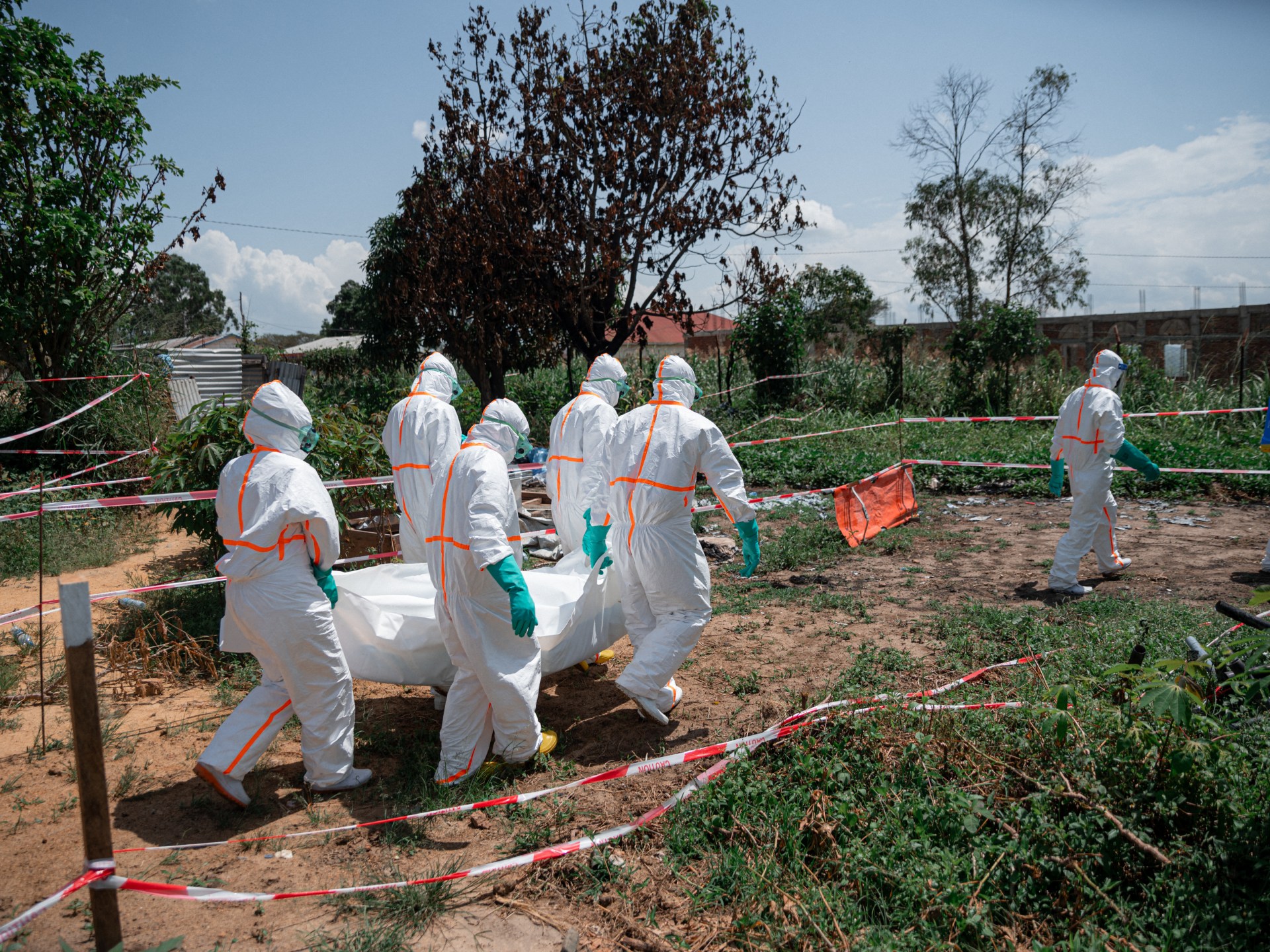

The latest Ebola outbreak in the Democratic Republic of Congo has spread to a sixth province after a death was recorded in previously unaffected Bas-Uele, said the head of the Africa Centres for Disease Control and Prevention.
Jean Kaseya said on Thursday that the man died in Buta, the capital of Bas-Uele province, after travelling from Haut-Uele province.
- list 1 of 3DR Congo Ebola outbreak set to become deadliest on record, WHO warns
- list 2 of 3Ebola outbreak caused by new ‘animal transmission’: What that means
- list 3 of 3DR Congo Ebola death toll surpasses 2,000
end of list
“If we do not stop this outbreak, it will last more than a year and will be the largest in the world,” Kaseya warned. That would also increase the risk of the outbreak spreading to other countries, he added.
The World Health Organization (WHO) says it is spreading faster than any previous one.
The latest outbreak began in the northeastern Ituri province and infections have also been recorded in North Kivu, South Kivu, Haut-Uele and Tshopo provinces.
It has killed 2,128 people out of 4,566 cases recorded, according to government figures. There are no approved vaccines or treatments for the rare Bundibugyo strain of the virus responsible for this outbreak.
WHO Director-General Tedros Adhanom Ghebreyesus said on Wednesday that “at its current pace”, the outbreak was on track to surpass the deadliest on record, which started over a decade ago and killed more than 11,000 people.
The current outbreak was formally declared on May 15 but the virus had begun circulating in February, health officials said this week.
The WHO hopes to reverse the spread of the virus within three months, but warned that the outbreak would not end by then.
Ebola is rare but highly contagious and can be contracted from bodily fluids and contaminated surfaces and materials, such as bedding and clothing. The disease it causes is severe and often fatal.
Advertisement
Clinical trials of two possible treatments for this type of Ebola began last month in Ituri.
Two vaccines developed specifically for the Bundibugyo virus are being tested in people for the first time, the WHO said on Wednesday.
The UN health agency also plans to test whether an existing Ebola vaccine could protect people against the latest virus after studies in animals showed promising results.
Related News
Republicans clear Todd Blanche for top US Justice Department role

California gets Bruce Lee Day in a first for US state’s Chinese Americans
Colombia earthquake: Hospitals adapt to save lives amid widespread damage