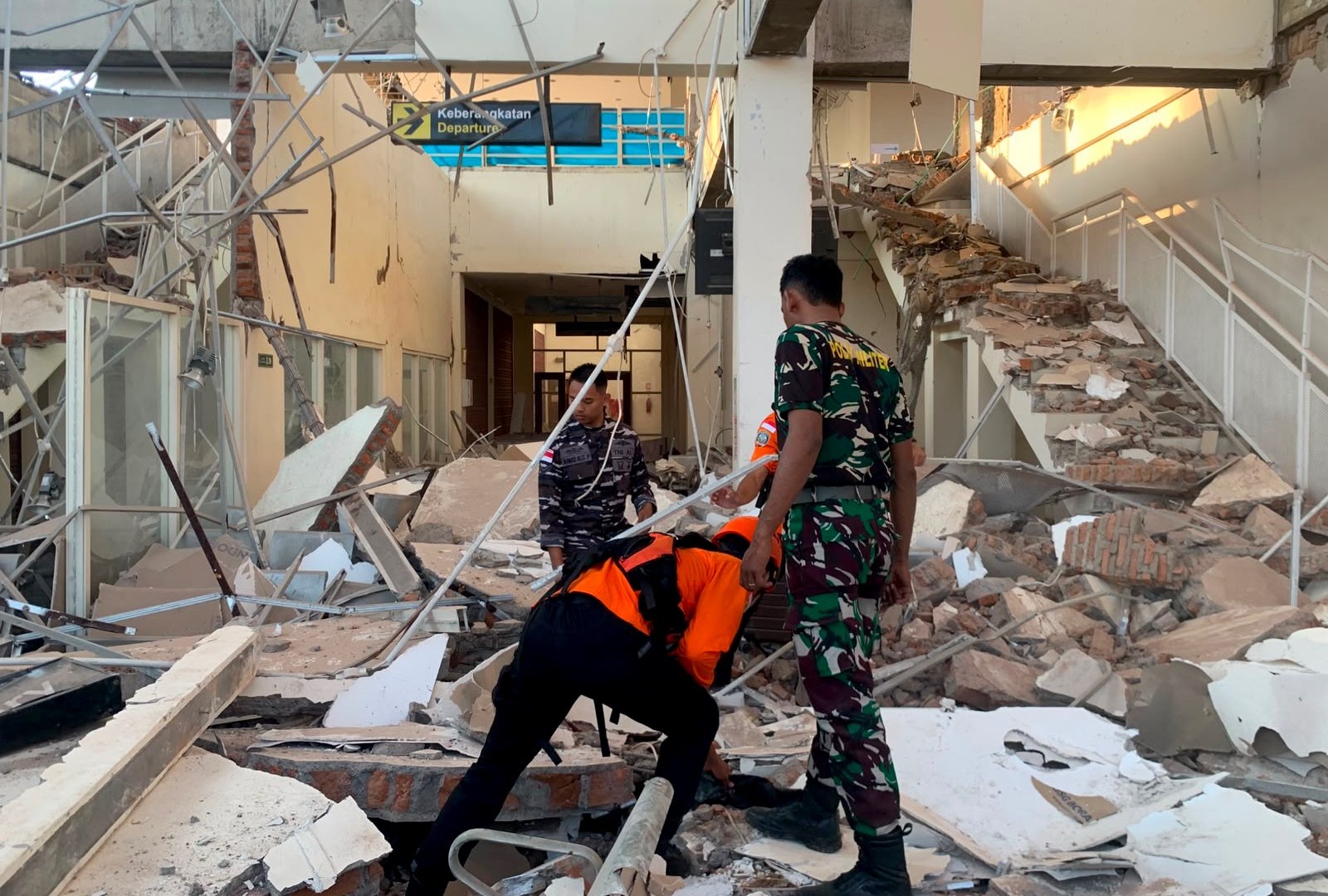

A powerful earthquake that struck eastern Indonesia has killed at least 51 people and forced about 5,000 people to evacuate, as rescue teams work to clear roads blocked by landslides and reach survivors still trapped under rubble.
The magnitude 7.7 earthquake struck at 5:58am local time on Saturday (21:58 GMT, Friday), with its epicentre about 68km (42 miles) north-northwest of the city of Ende, on Flores Island, East Nusa Tenggara province, according to the US Geological Survey, which put the depth at 10km (6.2 miles).
- list 1 of 2On the ground in Indonesia following 7.7 magnitude earthquake
- list 2 of 2Aftermath of deadly Indonesia earthquake
end of list
The earthquake, followed by some 341 aftershocks, is one of Indonesia’s deadliest in years.

A total of 36 people were seriously injured and 77 more suffered minor injuries, Deputy Health Minister Benjamin Paulus Octavianus told a televised meeting on Sunday.
More than 3,300 people in Sikka regency, one of the hard-hit areas, either fled their homes or were left stranded, taking shelter in a sports arena, according to Indonesia’s disaster mitigation agency, BNPB.
“The quake was massive, the shock was so strong, we were resting at home with family,” Nona, a 51-year-old resident of Talibura village, told the Reuters news agency. “There were 13 of us inside the house, and we all ran to save ourselves.”
In the port town of Maumere, some residents camped outside collapsed homes under tarpaulin tents, while others received treatment in a makeshift tent outside a local hospital.
Advertisement
“Almost all of Sikka’s residents didn’t dare stay indoors, so they slept on a porch or a tent outside,” Simon Sabandi, the region’s deputy chief, told news channel KompasTV.
Lieutenant General Suharyanto, the BNPB head, said the earthquake destroyed at least 157 houses and damaged nearly 200 more, forcing about 2,000 villagers in Nagekeo regency, the area closest to the epicentre, into temporary shelters.
He said three helicopters and a rescue vessel had been deployed to support the emergency response in a region where the scattered geography of small islands makes access difficult.
East Nusa Tenggara police chief Rudi Darmoko said the disaster had caused severe damage and building collapses across the province.
Rescue teams have yet to fully reach Nagekeo, where landslides have blocked roads and disrupted communications, said Fathur Rahman, head of the local search and rescue agency in Maumere, adding that a team was attempting to reach the area by ferry.
More than 3,500 military and police personnel have been deployed overall, Cabinet Secretary Teddy Indra Wijaya said. More than 1,300 homes have been damaged, and 20 petrol stations remain shut due to power outages, according to state energy firm Pertamina.
Officials are considering declaring a state of emergency for East Nusa Tenggara, which would unlock further resources and funding.
A tsunami warning issued immediately after the earthquake has since been lifted.
Reporting from Jakarta, Al Jazeera’s Jessica Washington said aftershocks could continue for “several days”, with authorities in the island’s northern areas ordering further evacuations as the true scale of the damage is still “emerging”.
She said several affected areas remain inaccessible to first responders and that local authorities have urged residents to stay away from shorelines and damaged buildings.
The same stretch of coastline was struck by a similarly powerful earthquake in December 1992, when the quake and the tsunami it triggered killed more than 2,500 people on Flores, Indonesia’s geophysics agency said.
Indonesia, a nation of some 290 million people spread across roughly 17,000 islands, sits on the Pacific “Ring of Fire”, making it one of the world’s most seismically active countries.
Related News

Why is Pakistan’s Sindh province facing a major child HIV outbreak?

Iran war live: Qatar’s PM meets US envoys, Tehran holds firm on conditions

US announces first two deaths from cyclospora outbreak