PM Dr. Friday urges end to Cuba embargo, backs Taiwan and reparatory justice at UN
 28 September 2026


By Val Matthias. Updated 6:51 a.m., Monday, September 28, 2026, Atlantic Standard Time (GMT-4).
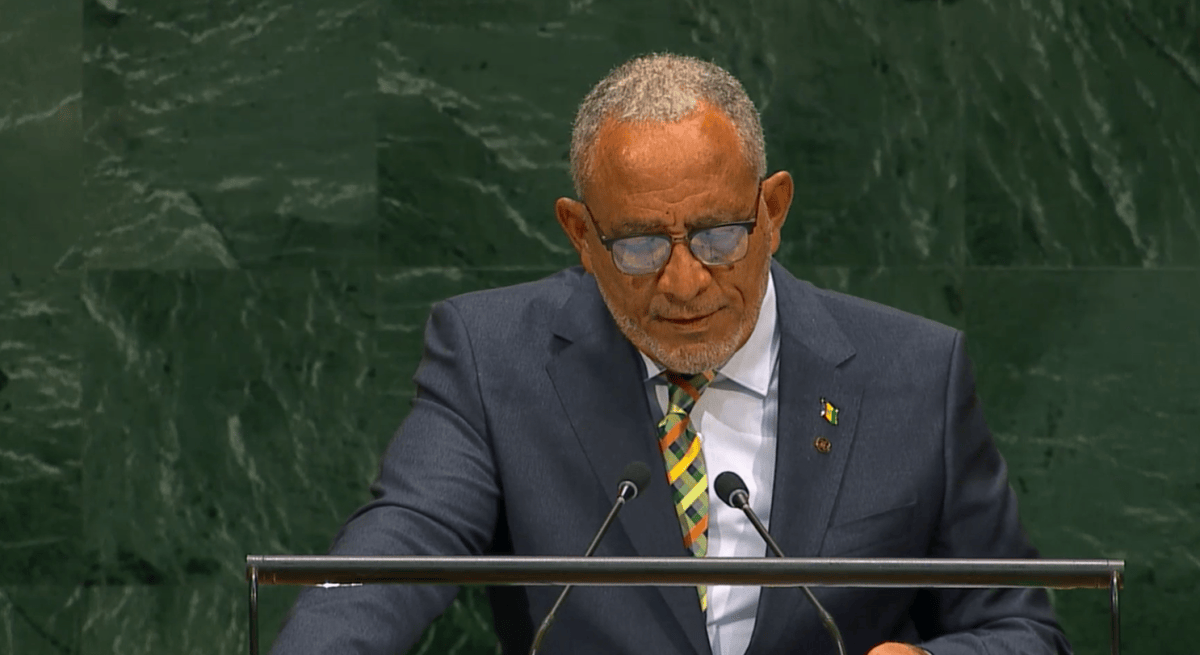
Prime Minister Dr. Godwin Friday used his inaugural address to the United Nations General Assembly to call for an end to the United States embargo on Cuba, renew support for Taiwan’s participation in the UN system, and press for reparatory justice for the Caribbean.
Addressing the General Debate of the 81st United Nations General Assembly in New York, Dr. Friday said restoring trust in the international system requires fairness, solidarity and equal treatment of small and vulnerable nations.
The Prime Minister described Cuba as “a valued member of our Caribbean family” and said the UN had repeatedly called for the decades-long economic embargo to be lifted.


“For more than three decades, this Assembly has said that the economic embargo imposed on Cuba must end,” he told delegates.
Dr. Friday argued that the collective punishment of an entire population through restrictions on medicine, trade, fuel and development could not be reconciled with the principles of the UN Charter.
“My government adds its voice to a call renewed year after year in this hall for the embargo to end,” he said.


Dr. Friday also highlighted 45 years of diplomatic relations between St. Vincent and the Grenadines and Taiwan, describing the partnership as one built on development, disaster response, education and public health.
He said Taiwan had repeatedly demonstrated that it is prepared to be a responsible member of the international community.
“We renew our call for Taiwan’s meaningful participation in the United Nations system and its specialized agencies,” the Prime Minister said.
Turning to reparatory justice, Dr. Friday said the legacy of slavery and colonialism continues to shape global inequality and cannot be treated as a matter of history alone.

“The past is not the past when its consequences still shape who is rich and who is poor in the world today,” he said.
He reaffirmed CARICOM’s long-standing 10-point plan for reparatory justice, which seeks acknowledgement, repair and genuine partnership to address the historic injustices of the enslavement of African people and the near annihilation of Indigenous populations.
Dr. Friday welcomed the UN General Assembly’s adoption of a 2026 resolution declaring the trafficking and racialized enslavement of Africans to be the gravest crime against humanity, describing it as “a hopeful and historic event”.
He said momentum generated by discussions in Accra earlier this year must now be matched by concrete action, adding that when Africa and the Caribbean spoke with one voice, “this chamber listened”.
The Prime Minister concluded that restoring trust in the United Nations depends on correcting historical wrongs, securing peace, and ensuring that the concerns of the world’s smallest nations receive equal attention.
Dr. Friday’s comments on Cuba, Taiwan and reparatory justice reflect positions that have long been supported by Caribbean governments and other small developing states.
His call for an end to the United States embargo on Cuba aligns with a position repeatedly endorsed by the United Nations General Assembly. For more than three decades, member states have overwhelmingly voted in favour of resolutions calling for the embargo to be lifted, arguing that it hinders Cuba’s economic and social development.
The Prime Minister’s support for Taiwan’s meaningful participation in the United Nations system also reflects St. Vincent and the Grenadines’ longstanding diplomatic relationship with Taiwan, which this year marks 45 years asTaiwan remains one of the country’s key development partners, providing support in areas such as education, public health, agriculture and disaster resilience. While Taiwan is not a member of the United Nations, countries that maintain diplomatic relations with Taipei have consistently advocated for its participation in specialised international agencies and technical bodies.
Dr. Friday’s remarks on reparatory justice were also in line with a longstanding Caribbean Community, or CARICOM, position. Caribbean leaders have argued that the legacy of slavery, the transatlantic trafficking and enslavement of Africans, and the displacement of Indigenous peoples continue to contribute to present-day social and economic inequalities.
CARICOM’s Ten-Point Plan for Reparatory Justice calls for acknowledgement of those historical injustices and measures aimed at addressing their long-term consequences through development partnerships, education, public health initiatives and economic cooperation.
The Prime Minister’s support for reparatory justice comes as the issue gains increasing international attention. Earlier this year, the United Nations General Assembly adopted a resolution declaring the trafficking and racialized enslavement of Africans to be the gravest crime against humanity.
Taken together, Dr. Friday’s positions on Cuba, Taiwan and reparatory justice reinforced a broader theme of his address: that smaller and more vulnerable states should be treated fairly within the international system and that historical and structural inequalities must be addressed if trust in global institutions is to be restored.
END
About the Author: This story was written and submitted by freelance journalist Mr. Val Matthias, a trained communicator with more than two decades in the media sector. He holds a Bachelor of Arts in Media and Communication (UWI Mona), a Master of Science in Tourism and Hospitality Management (UWI Cave Hill), a Certificate in Digital Marketing, and has years of broadcast journalism experience rising to ranks of a programme manager. All supporting materials for this story have been presented, vetted, and verified. Mr Matthias can be reached at [email protected]

Related News
3 Vincentians get university education funding from Mustique Charitable Trust
Government Says Probe Continues into ‘Wiped’ Consulate Computers

Police investigate officer-involved shooting after reported gunfire in Ottley Hall