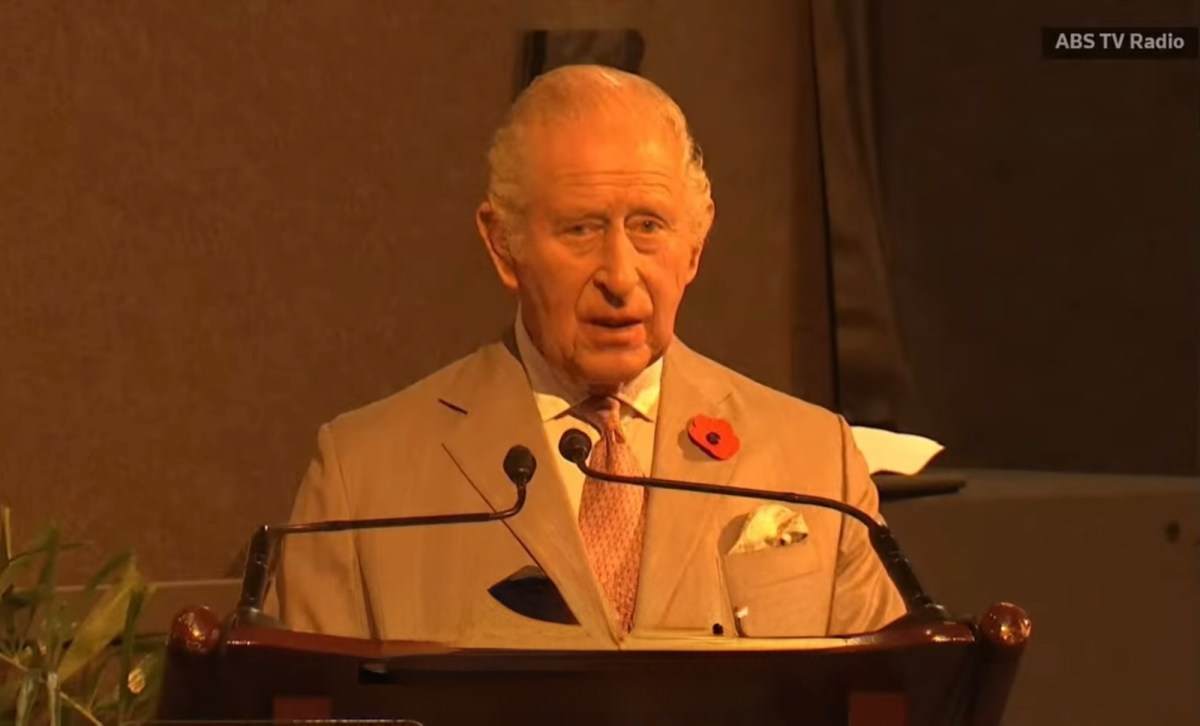



His Majesty King Charles III.
By Admin. Updated 5:07 p.m., Tuesday, November 3, 2026, Atlantic Standard Time (GMT-4).
An apology from Britain for the transatlantic slave trade must actually use the word, and must admit that the harm continues today. That is the test set by former Prime Minister Dr. Ralph Gonsalves as British Prime Minister Andy Burnham prepares to open talks with Caribbean leaders.
Dr. Gonsalves, Senior Advisor and Elder of The Repair Campaign, was asked by One News SVG on Monday, November 2, what would suffice as a proper apology. He was speaking from Antigua and Barbuda, host of this week’s Commonwealth Heads of Government Meeting (CHOGM).
“A full formal apology is what it says it is,” he said. Britain, he explained, must formally apologise, using that word, for its part in directing the transatlantic slave trade and the racialised chattel enslavement of Africans. It must also recognise the continuing harms that flowed from that trade.


His answer lines up with the first point of the CARICOM Ten Point Plan for Reparatory Justice. The plan calls for an apology from the Monarch or the Head of Government that acknowledges the harm done, names the victims and the perpetrators, apologises formally to victims and their descendants, and commits to reparatory justice.
Mr. Burnham set out his thinking in a Guardian article last week. He expressed his personal sorrow and regret over the slave trade and ruled out reparations in the form of financial compensation, but said Britain was prepared to help poorer countries restructure their debt on better terms.
On Monday, Downing Street said he would use the summit, which opens today, to launch a “structured dialogue” with affected countries on what form a formal apology might take, the Guardian reported. The Foreign Office is to lead those talks. Chancellor John Healey has said that considering an apology does not mean the British people accepting financial liability for the past.
Dr. Gonsalves said that sorrow and regret fall short.


“He has expressed personal sorrow and regret, but that’s not an apology,” he said.
Downing Street has drawn the same line.
According to the Guardian, the prime minister’s spokesperson said that sorrow and regret were “distinct from a formal apology”, and that any apology should be shaped with the countries and communities most affected. Dr. Gonsalves noted that Mr. Burnham appears to accept this, having tied the question of a full apology to the structured dialogue.
While London insists it is not talking about reparations, Dr. Gonsalves said Britain wants to discuss several items that fall within CARICOM’s ten-point plan. He expects a framework and set of procedures for the talks to come out of the summit.
He summed up Britain’s position in one line.
“The British government is coming to the table kicking and screaming, but they’re coming nevertheless,” he said.

He noted that Barbados Prime Minister Mia Mottley, Antigua and Barbuda’s Gaston Browne, Philip Davis of The Bahamas, the Prime Minister of Jamaica, and Saint Lucia’s Prime Minister Philip J. Pierre, whom he described as CARICOM chairman, have all acknowledged that Mr. Burnham’s move represents progress.
Dr. Gonsalves recalled that at CHOGM in Samoa in 2024, then Prime Minister Keir Starmer agreed to an outcome document that spoke of an honest conversation on reparatory justice. “But nothing happened,” he said. Mr. Burnham, in his view, is now taking that further.
What encourages him most is the choice of former British Prime Minister Gordon Brown to lead work on debt relief and financial restructuring. Britain does not call this reparations, he said, but the appointment tells him Mr. Burnham intends to be serious.
That seriousness, he added, must be matched on the Caribbean side.
“We equally on the CARICOM side have to have a serious team to begin at least the exploratory dimensions of the structured dialogue,” he said.
Dr. Gonsalves stressed that the Caribbean is not seeking a fight. Neither the region nor Africa has nuclear weapons or aircraft carriers, he said, so the task is to persuade Britain through reason. He also noted that Jamaica has taken three legal questions to the Privy Council, but said the struggle continues whatever the outcome.
He argued that an agreement could serve Britain well. At a time when Britain faces tensions over multiculturalism and race, he said, embracing reparatory justice could act as a kind of cleansing that brings people closer together. It could also lift Britain’s standing in the world.
The CARICOM plan places a full and formal apology first and debt cancellation and monetary compensation tenth. In between are demands on health, education, an Indigenous peoples’ development programme, cultural restitution, psychological rehabilitation and repatriation, among others.
Dr. Gonsalves said one fitting outcome could be a memorial on Balliceaux, where Garifuna people were held after their deportation from St. Vincent in the 1790s.
END


Related News
Arnos Vale Set for 47th Independence Parade This Evening (October 27)
PM Dr. Friday demands results as SVG signs GPH cruise deal
GHS student Pemberton crowned 2026 Lions/FLOW public speaking champion