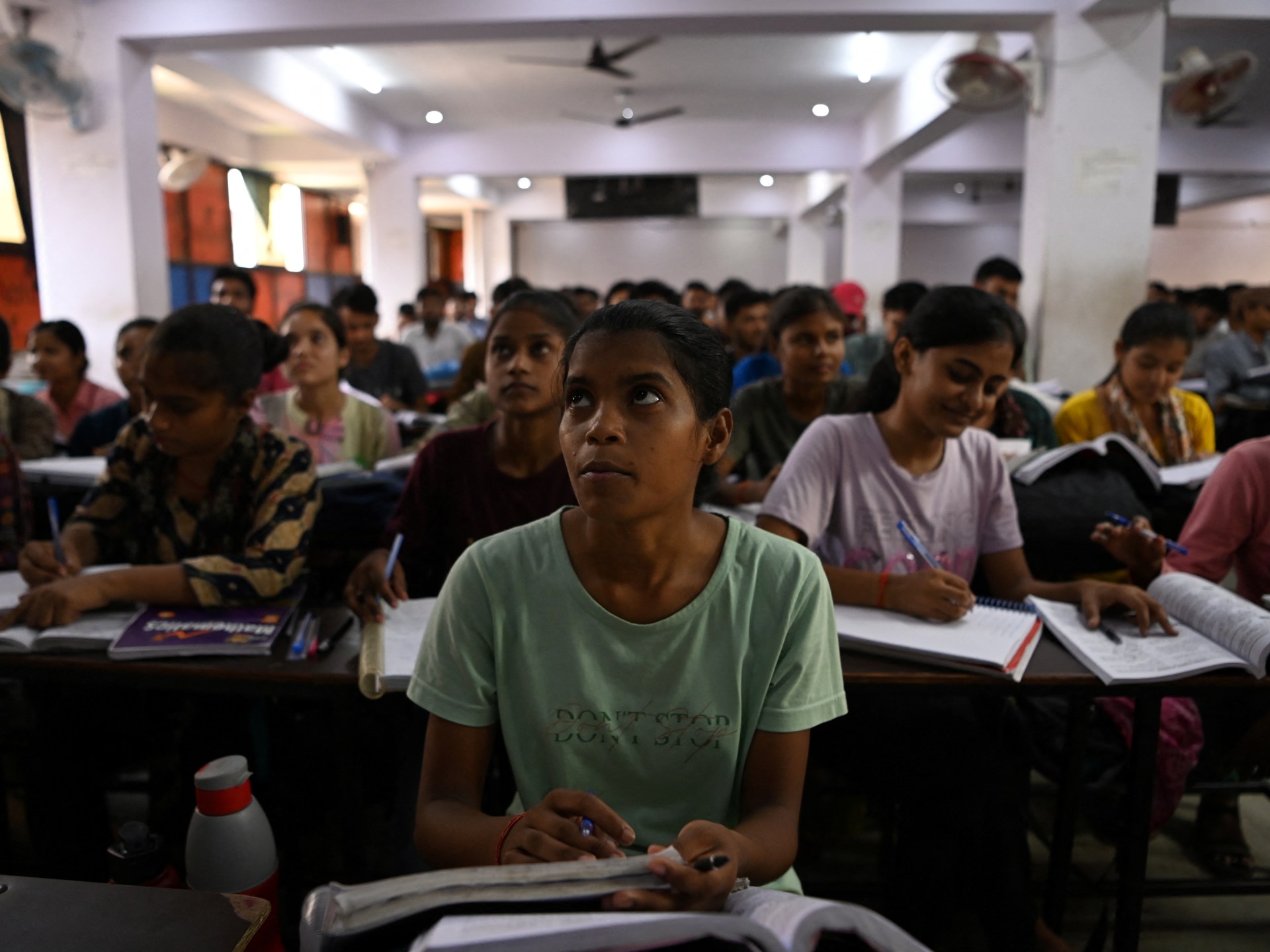

New Delhi, India – Nandini Singh had been waiting for weeks for her high school examination results, her scores in different subjects being the pathway to the colleges of her choice.
She was surprised and disappointed when she saw that her chemistry score was much lower than she had expected. Singh was torn over whether to seek a review of her answer scripts or accept the results – and the window to apply for a review lapsed.
Now, though, she is convinced that she’s been cheated of the score she deserved, and her faith in the body conducting one of the world’s largest school-leaving examinations has been shattered by a spate of controversies over the tests conducted from February 17 to April 10. The results came out on May 13.
“They are liars and a corrupt bunch of people taking our lives, our future hostage,” Singh told Al Jazeera, speaking from her home in Dehradun.
Singh is far from the only student furious with India’s Central Board of Secondary Education (CBSE), the largest of India’s multiple school boards. More than 1.7 million students like her sat the CBSE exams this year. Now many of them are in a state of limbo after the results of the exams have come under a cloud of suspicion following a series of revelations about a digitised answer-sheet evaluation process that the board rushed through this year.
Student-led disclosures have snowballed into outrage against Indian Prime Minister Narendra Modi’s government and its handling of the crisis amid growing calls for Education Minister Dharmendra Pradhan to resign.
Advertisement
So what’s the exam scandal all about, and why is it turning into a political crisis for Modi?

What’s happening at CBSE?
The CBSE, which is affiliated with more than 30,000 schools, introduced the On-Screen Marking system this year to evaluate millions of answer sheets.
After students finish writing their papers, the answer sheets are scanned into digital images and uploaded to an integrated platform for evaluation. An evaluator can sign in on a computer and mark copies electronically.
But the system has been hit with criticism of blurry scans, technical glitches, server outages and delayed resolution – casting a shadow over the results, which impact the futures of millions of students.
While On-Screen Marking is not a novel idea, its implementation by the CBSE across its schools has drawn widespread ire.
The board went out to look for bids from private companies to implement the system. It could not land any bidder in the first two rounds. In August with six months until the exams, the CBSE cut down major technical requirements, like image quality and fines over errors, and finally gave the deal to Coempt Edu Teck, a Hyderabad-based company in southern India.
That company has been mired in similar controversies earlier. In April 2019, at least 20 students died by suicide after about 40 percent of students who appeared in an exam in the southern Telangana state failed. The answer sheets in that case were digitised by a company named Globarena Technologies Private Limited – which changed its name to Coempt Edu Teck after the public backlash and won the bid for the annual CBSE exams.

Who is exposing CBSE lapses?
Teenagers – high-school students – are speaking out about the test scores.
Academicians and teachers had come forward with worries about the On-Screen Marking rollout. But a post on X by a student took the Indian internet by storm.
Vedant Srivastava, who requested that the CBSE allow him to review his answer sheets, posted photos on social media, showing that the scanned copy shared by the CBSE board was not his. He shared his other answer sheets to show a different handwriting.
Advertisement
“I studied for an entire year. I sacrificed sleep, peace of mind, outings, everything for these exams. And now I don’t even know whether MY actual Physics paper was checked,” he wrote in the post, reshared over 13,000 times.
“Do students really deserve this?” Srivastava asked.
The CBSE acknowledged the lapse, resent the student’s original copy – manually checked this time – and updated the result.
But Srivastava’s post triggered a wave of similar complaints, with many students posting snaps and videos of alleged incorrect marking.
The government’s dubious appointment of the tainted company to conduct the national-scale examination was also first dug out by a recent high school graduate, Sarthak Sidhant, an 18-year-old in Ranchi, central India.
The teenager published the details in a blog, breaking down his investigation. He wrote: “This is a story of how a massive public institution deliberately played with students’ futures by rewriting its own rulebook.”
Another teenager, Nisarga Adhikary, based in southern India’s Bengaluru, exposed several vulnerabilities in the CBSE’s On-Screen Marking portal and claimed that he was able to enter the system as an examiner and edit markings.
Adhikary reported the issues in detail to the CBSE in February, but decided to post them on social media after most of them remained unresolved after the results were declared last month. The 19-year-old also outlined his findings in a blog, including how the master password could be compromised to secure unrestricted access to the website.
What is the core issue here?
The issue at the core here, critics say, is the design of the system at large.
Pranesh Prakash, the co-founder of the Delhi-based Centre for Internet and Society, a nonprofit that engages in policy research, said that India does not incentivise vulnerability reporting.
Prakash noted that international companies and other countries’ governments run bounty programmes for researchers to expose vulnerabilities. Otherwise, he told Al Jazeera, “vulnerabilities may end up in the black market, where people are willing to pay for it.”
“The blame lies squarely with this dysfunctional system,” he said.
Apoorvanand, who teaches Hindi at the University of Delhi and goes by a single name, pointed out that the government’s “incompetence” is not a one-time affair.
The National Testing Agency, an autonomous body under India’s Ministry of Education that is responsible for holding the nationwide examinations, has been at the centre of controversies over the integrity of national competitive examinations and frequent paper leaks.
“This fiasco is not a one-time affair,” Apoorvanand told Al Jazeera. “The government has been indifferent towards people, and that is not just limited to examinations. It extends to all aspects of life.”
The professor said that students have “lost trust in the institutions” in recent years. “They know that they are being cheated. But they take it as their fate because any form of dissent is criminalised,” he said.
A TV anchor from the government-run broadcaster Doordarshan accused one of the students who pointed out discrepancies in his answer sheets of being a “Pakistani” – before half-heartedly apologising after the CBSE acknowledged it had made a mistake.

How are politicians reacting to this?
The opposition is circling Pradhan, the education minister in Modi’s government, over repeated controversies.
Advertisement
After the outrage, the government transferred the chairman and secretary of the CBSE to other departments on Tuesday.
The leader of the opposition, Rahul Gandhi, described the government’s action as a “cover-up” and alleged that “the real culprit”, the education minister, was “spared”.
“Our demand remains the same today: Dismiss the education minister and conduct an independent inquiry,” Gandhi said in a social media post.
The spokesperson for Gandhi’s Congress Party, Jairam Ramesh, alleged that the transfer of the CBSE officials was “an attempt to deflect attention by holding bureaucrats accountable instead of the political leadership”.
Aam Aadmi Party chief Arvind Kejriwal said that the transfers had “sprinkled salt on the wounds of millions of children and their parents”. He alleged that the government was effectively sending the message that “the education minister will not be changed, do whatever you have to”.
For Prateek Singh, also a recent high school graduate from Raebareli in northern India, anger over the fiasco is increasingly competing with a feeling of helplessness.
“We are just students. What can we even do to make things right for us now?” Singh asked.
For days after the results were published, the CBSE’s website for reevaluation remained inaccessible – and Singh, dissatisfied with his marking, could not apply for one.
“This result will linger behind me like a shadow for the rest of my life,” he told Al Jazeera. “It would dictate my college admission, then a job, if ever. And I will always think that maybe the examiner did not even read my answers.”
Related News
Hajj pilgrims gather at Mount Arafat under scorching desert sun
Why is Israel attacking Lebanon’s Nabatieh, the major southern city?

‘Fjord’ by Romania’s Cristian Mungiu wins Cannes top film prize