
The United States-Israeli war with Iran continues to rage, as Washington pledges to send more troops and military assets to the Middle East and Tehran widens its retaliatory strikes across the region.
But on Thursday, top officials under US President Donald Trump shifted focus to another military front: Latin America.
- list 1 of 3‘Remote coercion’: What has US approach been since abduction of Maduro?
- list 2 of 3Another US boat strike in Caribbean Sea kills three, Pentagon says
- list 3 of 3What US military actions has Trump taken since returning to office?
end of list
Since taking office for a second term, Trump has indicated he plans to exert US dominance over the entire Western Hemisphere. His push for control has coincided with military operations against alleged criminal networks across the region.
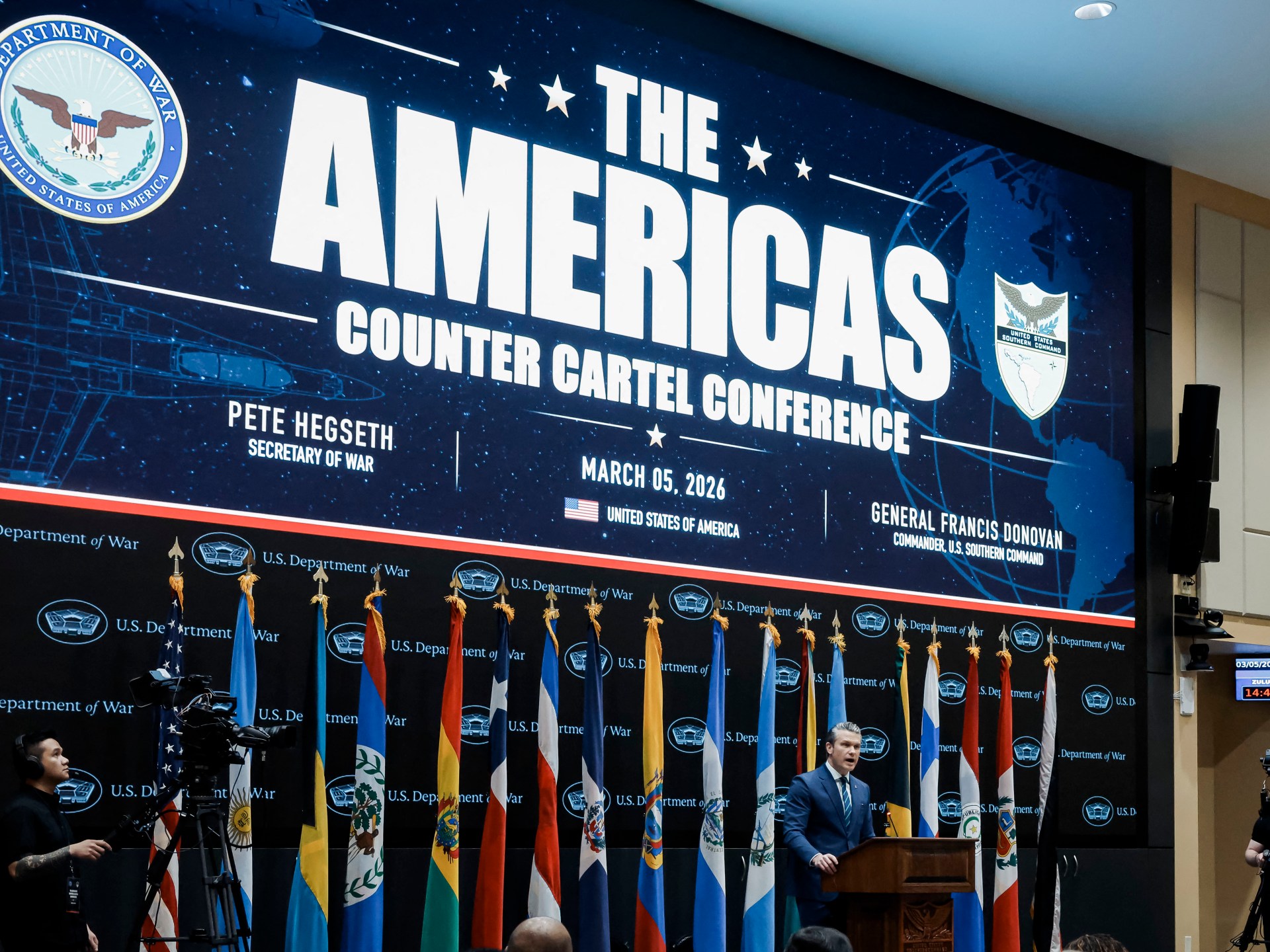
At Thursday’s inaugural “Americas Counter Cartel Conference”, speakers such as White House security adviser Stephen Miller assured reporters that Latin America would remain a top military priority for the US, regardless of events in the Middle East.
“We are not going to cede an inch of territory in this hemisphere to our enemies or adversaries,” Miller said, adding the US was “using hard power, military power, lethal force, to protect and defend the American homeland”.
Miller further maintained there is no “criminal justice solution” to drug cartels, which he likened to armed groups like al-Qaeda and ISIL (ISIS).
Organised crime, he concluded, “can only be defeated with military power”.
Since Trump took office last year, his administration has applied what experts describe as a “global war on terror” approach to Latin America, including by labelling drug cartels “foreign terrorist organisations”.
Figures like Miller, a key architect behind Trump’s hardline immigration policies, have championed the president’s militaristic approach, even as critics warn it raises human rights and legal concerns.
Advertisement
Last September, for instance, the administration began striking alleged drug-smuggling boats in the Caribbean and eastern Pacific Ocean, in what rights groups have decried as extrajudicial killings.
And in early January, the US launched an extraordinary operation to abduct Venezuelan leader Nicolas Maduro. It has since pursued a pressure campaign against Cuba designed to weaken its communist government.
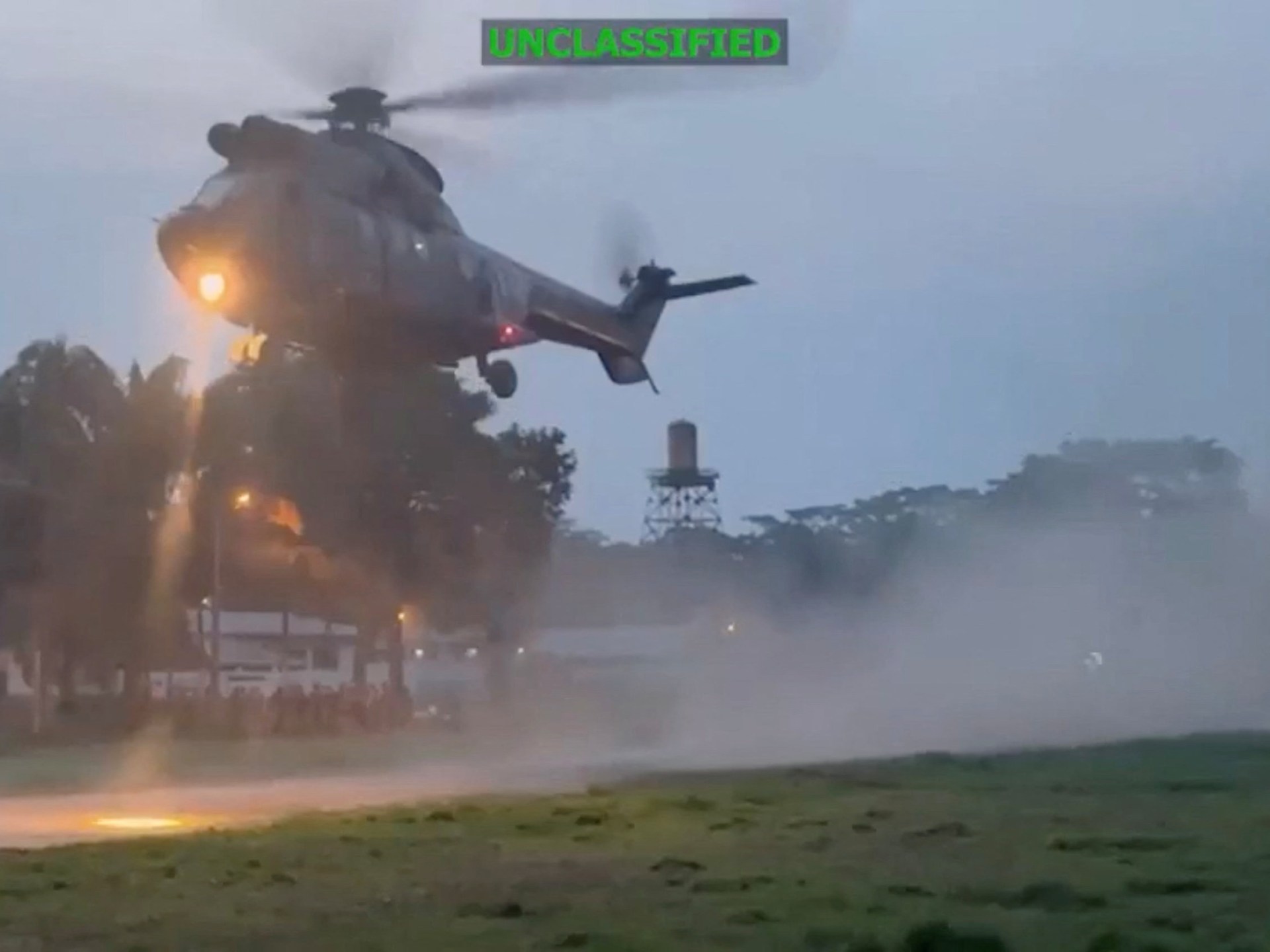
Just this week, on Wednesday, the Pentagon announced it had launched joint operations with Ecuador’s military “against Designated Terrorist Organizations” in the South American country.
The announcement indicated a new front for US military actions in the region, which officials have said could include land operations.
But the broadening scope of Trump’s military involvement in Latin America, combined with the nascent war with Iran, has raised questions about the US’s ability to sustain such intense military activity.
Prepared to ‘go on offence alone’
The “Americas Counter Cartel Conference” came as Latin American leaders arrived in South Florida to attend a regional summit hosted by Trump at his Mar-a-Lago estate.
Attendees included officials from the Trump-allied conservative governments in Argentina, Honduras and the Dominican Republic.
But despite support from several regional governments, Secretary of Defence Pete Hegseth nevertheless told the audience that the US was “prepared to take on” Latin America’s cartels and “go on the offence alone, if necessary”.
“However, it is our preference — and it is the goal of this conference — that, in the interest of this neighbourhood, we all do it together,” Hegseth added.
The secretary also praised Trump’s take on the 1823 Monroe Doctrine, which sought to establish a US sphere of influence, separate from Europe, in the Western Hemisphere. Administration officials have dubbed Trump’s parallel approach the “Donroe doctrine”.
Hegseth framed the administration’s attacks on alleged drug-smuggling boats as a keystone of Trump’s effort to maintain regional influence.
The US military has carried out at least 44 aerial strikes on vessels in the Caribbean Sea and eastern Pacific Ocean, resulting in an estimated 150 known deaths.
The identities of the victims have not been released, with several family members saying fishermen and informal workers were among those targeted.
The Pentagon chief said the approach was meant to “establish deterrence”.
“If the consequence was simply to be arrested and then released, well, that’s a consequence they’d already priced in a long time ago,” Hegseth said.
Advertisement
He then pointed to a “few weeks” in February in which there were no strikes on alleged drug boats.
The pause in attacks, he said, was evidence of the strategy’s success. But that break notably came as the US surged assets to the Middle East.
Emphasis on ‘heritage’
Neither Hegseth nor Miller specifically referred to the war with Iran, but the pair touched on themes that have been present in the administration’s messaging on the war.
Trump, for example, said Iran’s government “waged war against civilisation itself”. There have been reports, meanwhile, that US military officials have referenced the biblical “end times” as a religious underpinning for the war.
Those remarks have reflected what critics consider Trump’s embrace of Christian nationalism and his view of the Americas as a European-derived “civilisation” threatened by outside forces.
At Thursday’s conference, Miller himself referenced violence in European history as justification for the modern-day military actions in Latin America.
There were periods in European history throughout the 18th and 19th centuries during which “ruthless means were used to get rid of the people who were raping and murdering and defying established systems of order and justice,” Miller said.
He also echoed Trump’s allegation that Europe was facing “civilisational erasure” as a result of left-wing leadership and immigration.
“The reason why many Western countries are struggling today is they’ve forgotten the eternal truth and wisdoms they once followed,” Miller said.
Hegseth, meanwhile, described all the countries at Thursday’s meeting as “offsprings of Western civilisation”.
Representatives in attendance, he said, faced a test “whether our nations will be and remain Western nations with distinct characteristics, Christian nations under God, proud of our shared heritage with strong borders and prosperous people ruled not by violence and chaos but by law”.
He added that foreign “incursions” represent “existential questions” for the region, seemingly referencing the growing influence of China as an economic and political partner in the Americas.
Related News
UK weighs removing ex-Prince Andrew from succession line amid Epstein probe
Thousands in Iran mourn Khamenei’s killing
Trump administration launches US military operation in Ecuador