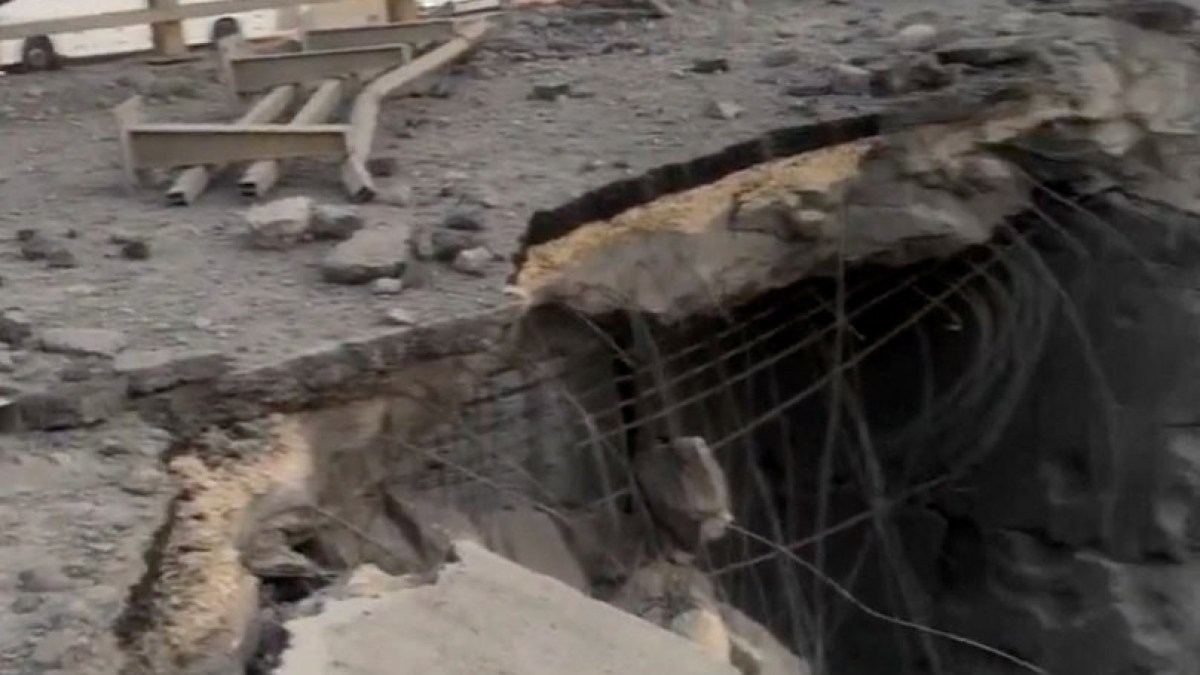

The United States has expanded its military campaign against Iran, with Tehran accusing Washington of striking civilian infrastructure as US forces carried out a sixth consecutive night of attacks.
Iranian officials say a railway station and residential neighbourhoods have been hit, while elsewhere, bridges, water facilities, food silos and other civilian infrastructure have reportedly come under attack. The latest strikes come after US President Donald Trump said Washington would eventually target Iran’s energy sector, telling Fox News he would “save the energy targets for last”.
- list 1 of 4Key takeaways from Donald Trump’s controversial speech on election security
- list 2 of 4Texas floods ravage through southwestern areas of state
- list 3 of 4Why is Pakistan’s Sindh province facing a major child HIV outbreak?
- list 4 of 4VIDEO: Argentina arrives in New Jersey ahead of Spain final on Sunday
end of list
As tensions escalate, Iran’s military said on Friday it had hit US aircraft at a military base in Bahrain, Kuwait says it is responding to missile and drone attacks, and air defence systems have again been activated this week across Bahrain, Kuwait, Oman, Qatar, the United Arab Emirates and Jordan.
The renewed fighting comes a month after Washington and Tehran signed a memorandum of understanding extending an April ceasefire and setting out a framework for negotiations aimed at ending the war, which began on February 28 with Israeli and US strikes on Iran. Since then, Tehran and Washington have accused the other of violating the agreement.
The latest attacks also coincide with a growing confrontation over the Strait of Hormuz. Iran has said it will block marine traffic entering the strategic waterway after Oman announced a new shipping transit corridor, while the US has resumed a naval blockade of vessels travelling to and from Iranian ports and coastal areas.
Advertisement
As the attacks increasingly hit infrastructure used by civilians, questions are mounting over Washington’s objectives. Are the attacks aimed at degrading Iran’s military capabilities and forcing Tehran back to the negotiating table, clearing out vital transport networks to prepare for a ground invasion, or increasing economic and political pressure by disrupting the infrastructure on which daily life depends?
The attacks have also spurred debate over whether the attacks comply with international law and whether the conflict risks spiralling into an all-out war. Here’s what we know.
What’s been hit?
Southern Iran’s coastline has come under repeated attack as US strikes increasingly hit infrastructure stretching across Hormozgan province and neighbouring regions.
Explosions have been reported in Ahvaz, Qeshm, Bushehr, Dashti, Bostan, Sirik and Bandar-e Lengeh, with Iranian officials reporting more extensive damage to infrastructure than during previous rounds of attacks.
Bandar Abbas, Iran’s main naval hub overlooking the Strait of Hormuz, has been among the hardest-hit cities.
Iranian media report that two people were killed and eight wounded after US strikes hit the Kahurestan Bridge and a residential area in the city. Local reports also say a railway facility was damaged. Tasnim news agency reported that a communications tower overlooking the city was struck, causing a power outage in surrounding areas.
Officials in Hormozgan province, where Bandar Abbas is the capital, say six bridges were hit in the latest attacks, along key transport routes linking Bandar Abbas with surrounding towns.
Those included the Gariyeh Bridge on the Bandar Abbas-Khamir-Lar route, a bridge near Latidan village, two bridges on the Kahurestan-Lar road, a partially constructed bridge on the Bandar Khamir-Keshar-Bandar Abbas axis and a bridge in Maroo village.
Elsewhere, officials say Iranshahr Airport in southeastern Iran sustained damage after coming under attack, resulting in power outages, while authorities in Semnan reported that the main building of a civilian airport had suffered what they described as minor damage following US strikes at 9pm ET on Wednesday (01:00 GMT Thursday).
US strikes have also reportedly hit a bottled water facility in Dehloran in western Ilam province and the area around Khondab in central Markazi province, home to one of Iran’s heavy-water facilities, which has been targeted previously.
Health facilities have also been affected. More than 200 patients were evacuated from Baghaei Specialised Hospital after strikes in Ahvaz reportedly rendered the hospital inoperable, according to hospital Director Reza Bazar. Iranian media reported no casualties at the facility.
Advertisement
The latest attacks come against the backdrop of one of the deadliest attacks since the conflict began. On February 28, a double-tap missile strike destroyed the Shajareh Tayyebeh girls’ elementary school in Minab, killing at least 150 people, most of them children and school staff, according to Iranian authorities. A subsequent investigation by The New York Times reported that the US was responsible for the strikes.
What international law says
Iran has accused the US of committing war crimes following the recent spate of attacks, with Iranian Foreign Minister Abbas Araghchi saying the strikes on what he described as the country’s “vital infrastructure”, alongside repeated US threats to target bridges and energy facilities, demonstrated “the criminal intent of the US ruling body to commit heinous crimes”.
In a statement published on Telegram, Araghchi said the attacks constituted “a flagrant violation of the United Nations Charter and the fundamental principles of international law”.
He said they amounted to “serious international crimes” under international humanitarian law, including the four Geneva Conventions of 1949, adding that “all governments are obligated to prosecute and punish those who commit such crimes.”
Whether the strikes violate international humanitarian law, however, depends on factors that are often difficult to determine while a conflict is ongoing.
Under the Geneva Conventions, civilian objects are protected from attack unless they contribute to military action.
This can create a legal grey zone where militaries often try to justify attacks in real time, even though these are frequently found later to be war crimes. Joel Rayburn, a retired US Army colonel and senior fellow at the Hudson Institute, told Al Jazeera that military lawyers at US Central Command (CENTCOM) and elsewhere might have cleared these targets as “dual-use” – civilian infrastructure also potentially used for military purposes.
Iran, meanwhile, points to the human toll as evidence that civilians are bearing the brunt of the US campaign. Iranian authorities say 3,468 people were killed between February 28 and June 7 during the first phase of the war. Since fighting resumed after Tehran and Washington met in Switzerland on June 22, Iran says a further 38 civilians have been killed and more than 400 injured in US attacks.
The Trump administration says the strikes are aimed at degrading Iran’s ability to threaten shipping through the Strait of Hormuz, one of the world’s most important maritime trade routes.
CENTCOM has repeatedly said its operations are targeting “Iranian command centres, air defence sites, missile and drone capabilities, and coastal surveillance facilities” used to threaten vessels transiting the strategic waterway.
But the latest strikes have increasingly focused on civilian infrastructure, raising questions over whether Washington is pursuing a broader strategy to increase pressure on Tehran beyond degrading its armed forces.
Advertisement
Mark Hilborne, a senior lecturer in the School of Security Studies at King’s College London, told Al Jazeera that while the US will defend its strikes by arguing that many of the targets have a military utility as well, “they would certainly affect civilians” and “do stray beyond purely military targets”.
Hilborne added that bridges have become a particular focus because they underpin Iran’s military logistics in the country’s south.
“The bridges in particular are important for military logistics and operations, and enable Iran to move equipment to [the] south. Attacking bridges would then undermine Iran’s ability to interfere with shipping in the strait and sustain operations there.”
He said another bridge struck in northeastern Iran earlier this month forms part of a key trade corridor linked to China’s Belt and Road Initiative.
“It [the bridge] therefore has real economic value, and enables Iran to avoid some of the sanctions, trading oil for instance, but also it is claimed that critical parts of its weapons programme come via this route. The US has claimed traffic on this route had tripled after the naval blockade.
“In terms of the strategic rationale, I would say these are mostly concerned with enforcing the naval blockade, undermining military logistics and broadly pressuring Iran towards a settlement.”
Why the south matters
Many of the latest strikes have centred on Bandar Abbas, home to both Iran’s conventional navy and the naval arm of the Islamic Revolutionary Guard Corps (IRGC).
Overlooking the Strait of Hormuz, the port occupies one of the most strategically important positions in the Gulf. More than 90 percent of Iran’s crude oil exports used to pass through the strait, making Bandar Abbas central both militarily and economically in growing its revenue from trade.
Alex Alfirraz Scheers, a London-based military analyst, told Al Jazeera that the expansion of attacks beyond conventional military facilities could point to a broader shift in US strategy.
“Because the United States is growing increasingly frustrated, particularly President Trump, and therefore becoming more desperate, we could see the early stages of a preparation for something like a limited ground invasion on those strategic outposts, but also into territorial Iran proper.”
The attacks have extended beyond bridges and transport routes to water facilities, food storage sites and power infrastructure – assets that could become critical if the US were preparing for a ground operation in southern Iran.
Simon Mabon, a professor of international relations at Lancaster University, told Al Jazeera the pattern of strikes could be interpreted as “perhaps a precursor to a ground invasion”, pointing to growing rhetoric in the US suggesting that securing the Strait of Hormuz and Iran’s southern coastline may require forces on the ground.
“But I don’t think that is the likely scenario, in the sense that it would be hugely catastrophic and a misreading of the situation by the US,” he added. At this stage, Mabon said, the attacks were more likely intended to intensify pressure on Tehran and “get them to the negotiating table”, noting that previous rounds of escalation had eventually been followed by renewed diplomacy.
But he warned that striking civilian infrastructure would not necessarily turn the Iranian population against its government. Instead, he said, such attacks could reinforce Tehran’s narrative that Washington is deliberately inflicting suffering on Iranian civilians.
Advertisement
“US attacks on civilian infrastructure would not be seen as a negative for the regime,” Mabon said. “It would be seen as the US engaging in its usual practice of targeting civilians, as far as Iranians are concerned.”
He also warned that the confrontation could become significantly more destructive. “We have seen rhetoric from Trump that perhaps points to a darker turn of events, where targets could move from military sites to ones having a more catastrophic impact on the Iranian people.”
Related News
Mapping Israeli settler violence in the West Bank
Iran war live: US demands Iran publicly state Strait of Hormuz open for all
Saudi Arabia seeks international coalition against Houthis in Red Sea