
By Val Matthias and Admin. Updated 6:00 a.m., Wednesday, June 10, 2026, Atlantic Standard Time (GMT-4).
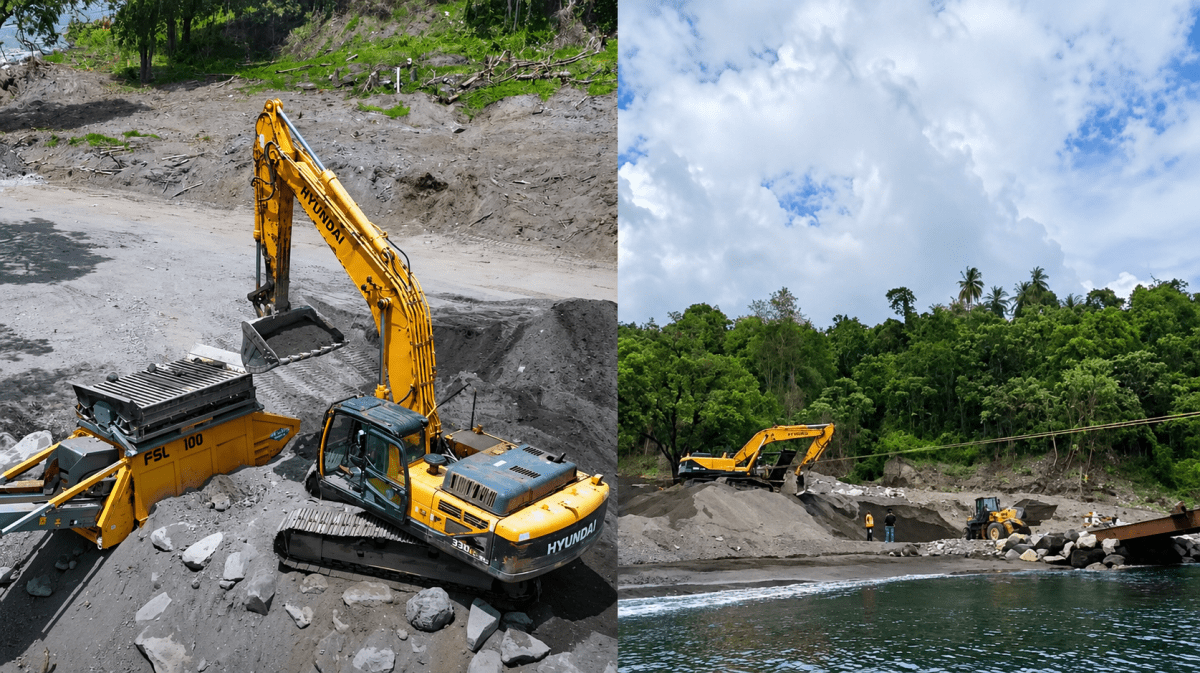
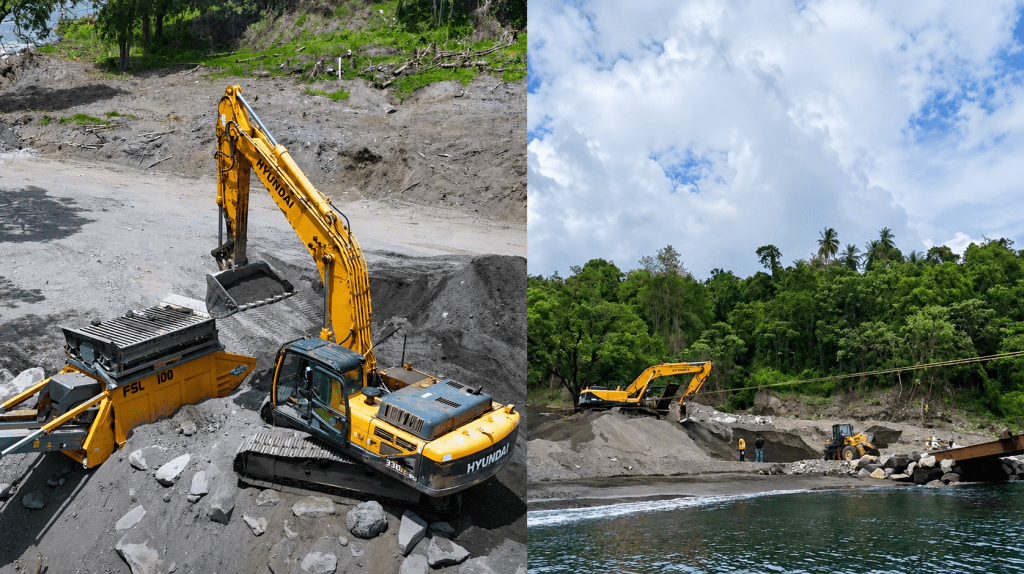
The state-owned Roads, Buildings and General Services Authority (BRAGSA) has defended its decision to establish a sand harvesting operation at the mouth of the Roseau Dry River in North Leeward, stating that environmental studies found the site could be developed with limited impact on surrounding communities.
Chief Executive Officer Kem Bartholomew said the project was approved only after environmental and social assessments were completed and consultations held with residents, many of whom raised concerns about potential effects on fishing activity, dust and noise.
Speaking during a community consultation in Chateaubelair on Tuesday (June 9) and also in a video via BRAGSA’s official Facebook page, Mr Bartholomew said BRAGSA first secured approval in principle from the Physical Planning Unit before undertaking the required surveys, designs and an Environmental and Social Impact Assessment (ESIA). Community consultations were also held on 8 April at the Golden Grove Learning Resource Centre as part of the assessment process.
According to Mr Bartholomew, residents identified fishers, livestock farmers and nearby communities as the groups most likely to be affected by the operation.
However, he said the assessment concluded that livestock farmers would not be significantly impacted because the site is located within a dry riverbed rather than an active watercourse.

“It was identified that there’s no impact on the farmers because there’s no water here. There’s not a flowing stream, it’s a dry river,” he said.
Concerns were also raised about the potential impact on fishing activities.
Mr Bartholomew said BRAGSA altered the design of a temporary ramp extending into the sea after concerns were raised during consultations.
“The temporary ramp that we created was adjusted, the distance into the sea, the alignment, so that we do not affect that fishing as far as possible,” he said.
The assessment also highlighted the possibility of increased dust and noise from the operation.
Mr Bartholomew said the Environmental and Social Impact Assessment produced an Environmental Management Plan containing guidelines for managing those impacts and that BRAGSA would be required to follow those measures throughout the project.
The BRAGSA chief said the location was chosen as part of a broader five-year strategic plan aimed at identifying revenue-generating investments for the agency.
The material being harvested at Roseau is volcanic sediment deposited following eruptions of La Soufrière and is being processed through a harvesting and sifting operation.
Mr Bartholomew said surveys indicate that approximately 4.2 million cubic metres of material are located within a roughly three-kilometre section of the Roseau River area.
He described the operation as the harvesting and processing of material already deposited in the riverbed.
“We are simply harvesting the material. We take the material, we sift it into the sizes that we want, and we take it by barge,” he said.
According to Mr Bartholomew, the current extraction programme is linked to the sale of 110,000 tonnes of material for a development project at Glossy Bay in Canouan. Developers were considering purchasing material from Guyana, but BRAGSA capitalised on the opportunity for the sale, according to Bartholomew.

He said the sale generated approximately EC$3.8 million, $500,000 of which has already been paid in the form of a deposit on cash and equipment. The deposit, he said, enabled BRAGSA to get equipment needed for the operation, including heavy machinery and screening equipment.
“We ourselves do not have the resources to buy the front-end loader and the sifter and so forth. That came from this initial sale,” he said.
BRAGSA also extracts material from Rabacca on the Windward side, in an area that measures about one kilometer, but due to the Atlantic Ocean’s impact on the eastern coast, barges cannot be docked there. The material is transported using trucks.
Mr Bartholomew said supplies from the Roseau River site on the western coast (the calm Caribbean Sea side) are also intended for Canouan, Union Island, Bequia and Kingstown, where access to construction material would be improved.
Mr Bartholomew said BRAGSA hopes to capitalise on the estimated volume of material available at the Roseau River site. He told residents that, based on the authority’s calculations, extracting up to 75 per cent of the available material could potentially generate more than EC$70 million in revenue over time. He did not indicate a timeframe for such extraction or revenue projections.
Mr Bartholomew described the project as the “responsible use of natural material that we inherited from the eruption of La Soufrière volcano”.

Mr Bartholomew said the project is expected to reduce the cost of construction materials in the Grenadines, strengthen BRAGSA’s finances and contribute to national development.
He also pledged that the authority would work with residents and community representatives to identify projects that could benefit North Leeward directly.
“The community of North Leeward will benefit. The cost of material in the Grenadines will be reduced. BRAGSA financially will be more sustainable, and it will contribute significantly to national development,” he said.
END