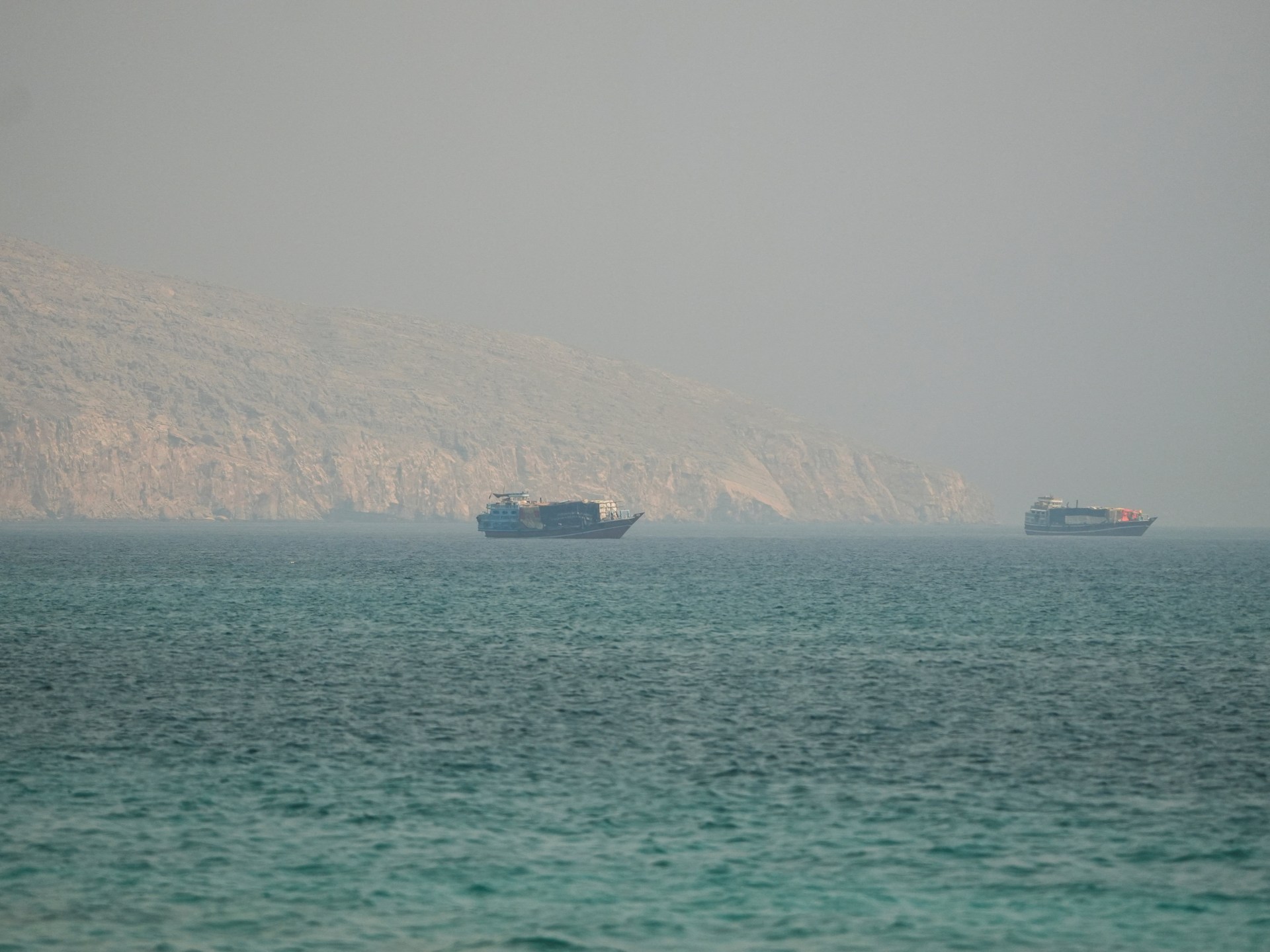

Tehran, Iran – Iran and the United States have offered clashing narratives over the fate of ships passing through the Strait of Hormuz as they continue to trade threats, even as they maintain contact through mediators.
Iranian state media on Saturday released the latest statement attributed to Mojtaba Khamenei, who has not been seen or heard from since being selected as the new supreme leader by a clerical body in March.
- list 1 of 4Trump hints at further Iran negotiations after exchange of fire over Hormuz
- list 2 of 4Can the agreement between Iran and the US be rescued?
- list 3 of 4Are the US and Iran at war again?
- list 4 of 4What is going on in Yemen?
end of list
“We pledge to avenge your pure blood, and the blood of all the martyrs of these two wars, upon the criminal and disgraced killers. This revenge is the demand of our nation, and it must certainly be carried out,” Khamenei said about his father, Ayatollah Ali Khamenei, who was assassinated on the first day of the war launched by the US and Israel on February 28.
He emphasised that this was state policy and did not hinge on any single official. “Soon, individuals among the free people of the world will each carry out a part of this divine mission,” he said.

Khamenei’s comments echoed calls for vengeance by hardline religious-backed factions during this week’s funeral ceremonies for Ali Khamenei.
In Mashhad, where Ali Khamenei was buried on Friday, chief negotiator Mohammad Bagher Ghalibaf and other officials in favour of talks with the US sat in attendance as crowded shouted, “Negotiations with the enemy is betraying the homeland”. In an animated televised speech, Ali Khomeini, a grandson of Ruhollah Khomeini, who established the Islamic Republic after a 1979 revolution, said that “anyone who wishes to negotiate to reach peace with America is a traitor.”
Advertisement
Meanwhile, US President Donald Trump said, without elaborating, that he believes he is first on the “kill list for Iran” and that he has left instructions to retaliate if an attempt on his life was made.
A thousand “Missiles are Locked and Loaded and aimed at the Islamic Republic of Iran”, he wrote on his Truth Social platform. “Orders have already been given, and the U.S. Military is ready, willing, and able, for a one year period of time, subject to extension, to completely decimate and destroy all areas of Iran,” he said.
Trump said he considers the repeatedly breached “ceasefire” to be over following the latest exchange of attacks between the two sides earlier this week, but that mediated talks could continue. On Friday, Qatari mediators visited Iran for meetings aimed at de-escalating tension with the US, while on Saturday Iranian Foreign Minister travelled to Oman for talks.
Ali Vaez, the Washington-based Crisis Group’s Iran Project director, said revenge rhetoric is for domestic consumption while diplomacy is aimed at preventing another punishing round of war.
“Trump’s declaration that the ceasefire is over raises the costs of talks, but not necessarily their utility. Both sides appear to recognise that the alternative is an escalation neither can afford or reliably control,” he said.
On Friday, unnamed senior officials in the Trump administration claimed during a briefing with US media outlets that Iranian officials privately told Washington that an “errant” faction of hardliners were trying to undermine negotiations through launching attacks in the Strait of Hormuz.
US reporting also suggested that the Trump team expected Araghchi, after his meetings in Oman, to either publicly admit or implicitly acknowledge that hitting the tankers and commercial ships earlier this week was a mistake.
Vaez said the claim about Iran’s private messaging is implausible but convenient for the US as blaming the hardline faction leaves the door to diplomacy ajar.
“The real test is not what Iranian officials reportedly said in private, but whether both sides can find a way to stop exchanging fire and return to exchanging words,” he added.
While Washington’s narrative leaves a diplomatic off-ramp open and attempts to build pressure on Tehran, the official account from Iranian authorities has emphasised that they intend to exercise a degree of control over transit through the strait.
Tehran also considers any movement through a US-backed southern route crossing near Oman – as well as rescinding of oil sanction waivers – to have run counter to the memorandum of understanding (MoU) reached between the two sides last month. It has further insisted on control over the full reopening or demining of the strait through which one-fifth of global oil and liquefied natural gas passes in peacetime.
Advertisement
Iran’s Ambassador to the United Nations Amir Saeid Iravani told reporters outside the Security Council in New York on Friday that any attempt by external actors to “interfere with or establish a power arrangement” would violate the MoU and delay the full restoration of maritime traffic.

In a statement on Thursday, the Islamic Revolutionary Guard Corps (IRGC) Navy said traffic in the Strait of Hormuz had gradually recovered to about 50 percent of pre-war levels through Iran’s cooperation before the latest strikes, but that ships must only pass through designated routes while foreigners “will have no share” in managing the strait.
The central command of armed forces also pledged a day earlier that “under no circumstances” would it permit US or foreign interference in the management of the strait.
To implement this policy and coordinate authorised transit, Iran has established the Persian Gulf Strait Authority.
But the governing council of the UN’s shipping agency, the London-based International Maritime Organization (IMO), on Friday “strongly condemned” Iran’s decision to “establish an entity purporting to control traffic through the strait”.
The IMO called on its 176 member states not to recognise “Iran’s claim of sovereignty over the Strait of Hormuz, its assertions of jurisdiction over the maritime zones of third states in and around the strait, which violated the sovereignty, sovereign rights and exclusive jurisdiction of these states” and not to recognise any Iranian decisions aimed at “closing, obstructing, hampering or otherwise interfering with international navigation and the right of transit passage”.
Also on Friday, the US Department of the Treasury imposed its first new sanctions related to Iran since the signing of the MoU on June 17, designating several individuals and entities in stated retaliation for attacks on international shipping in the strait. They included Ali Ansari, a “financial facilitator” with reported links to Mojtaba Khamenei, as well as a number of currency exchange houses.
Negar Mortazavi, a senior fellow at the Center for International Policy, said “there may be internal disagreements in Tehran over tactics and the level of military pressure” but added the Hormuz confrontation is rooted in a “broader dispute” over the implementation of the MoU.
“Iran believes commercial passage through the strait must be arranged in coordination with Tehran, while the United States appears to be trying to impose its own interpretation without that coordination,” said Mortazavi.
Noting that Iran “has not closed the door to talks”, Mortazavi said Tehran will use calibrated military pressure to establish its interpretation of the Mo while continuing negotiations. “Iran believes diplomacy without deterrence would give the United States and Israel time to regroup and resume the war later,” she added.
Advertisement
Related News
Trump administration renews pressure on International Criminal Court
Seven pro-Palestine protesters convicted of misdemeanour charges in US

Gambian mothers fear for their daughters as court weighs FGM ban