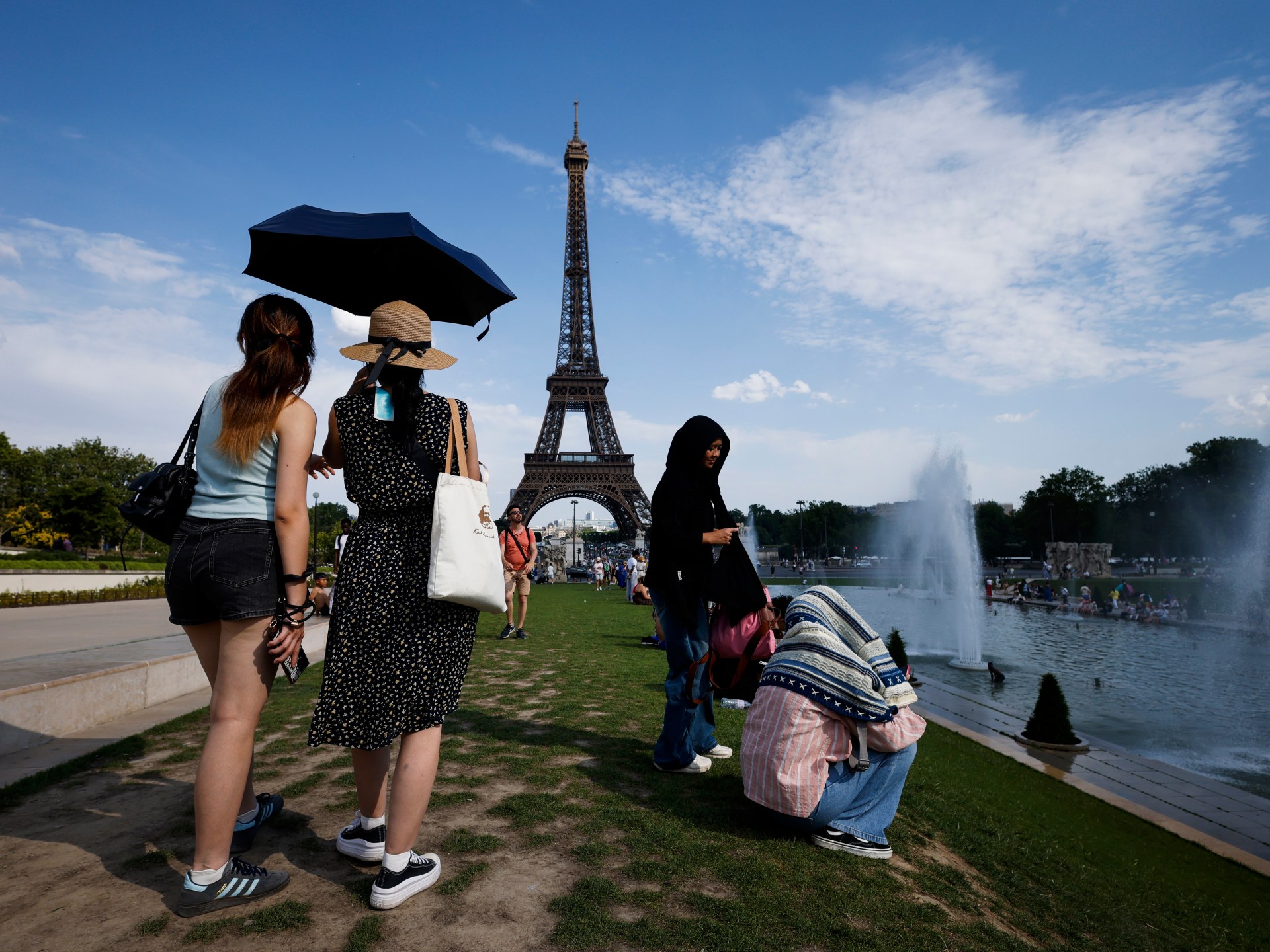

Temperatures in Europe have hit a new high this summer, with hotter early-summer heatwaves resulting in illness, excessive deaths and the collapse of infrastructure.
On Sunday, temperatures reached 40 degrees Celsius (104 degrees Fahrenheit) in some regions of the continent, including in Germany, the Czech Republic and Poland, impacting transport services.
- list 1 of 3Europe faces another day of extreme heat after more temperature records set
- list 2 of 3‘London cooking’: Why can’t the UK cope with the heat; when will it adapt?
- list 3 of 3Amid the heatwave, Europe needs a new urbanism
end of list
Meanwhile, in France, where 1,000 excess deaths – the number above what would normally be expected – have been reported as a result of the heatwave, storms hit areas of the country after days of temperatures averaging 29.8C (85.6F), but reaching as high as 44C (111.2F) in one town.
Overall, 1,300 excess deaths have been reported in Europe since June 21, according to World Health Organization chief Tedros Adhanom Ghebreyesus. In a post on X, he wrote that Europe is the fastest-warming continent on Earth, heating at twice the global average, and warned that the continent’s infrastructure has not been built to withstand high temperatures.
“Driven by climate change and global warming, the phenomenon of the ‘once-in-a-generation’ heatwave is now occurring nearly annual,” he said on Sunday.
While it is important to note that some excess deaths may be related to other issues and not directly caused by overheating, experts say heatwaves generally are the cause of more people dying than usual. So, what’s behind the excess heatwave-related deaths, and how should European countries be responding?
Here’s what we know:

Why are people dying due to heatwaves in Europe?
On Sunday, France’s public health agency reported 1,000 excess deaths due to the recent heatwave, which began on June 20. The country’s rate of deaths was about 900 per day before the heatwave began.
Advertisement
The agency added that most of the deaths had been of people aged 65 and above, though the extreme heat had affected the health of the entire population.
In Spain, a 90-year-old woman reportedly died near Bilbao after suffering heatstroke in her nursing home, and a 68-year-old man in Almeria was also said to have died from heatstroke last week.
In Germany, at least seven people died due to heatwave-related incidents.
At least two people died in separate swimming accidents in Berlin on Saturday, German police said. In another incident, a group in a rubber dinghy found an unresponsive man in Jungfernheideteich, a man-made lake in a public park in western Berlin. At least 40 people died by drowning in France.
Garyfallos Konstantinoudis, a lecturer at the Grantham Institute – Climate Change and the Environment, which carries out Imperial College London’s work on climate change, said: “Heatwaves pose serious health dangers, primarily by causing heat stress, which occurs when the body struggles to regulate its temperature. This can lead to dehydration, heat exhaustion, and in severe cases, heatstroke, a medical emergency,” he told Al Jazeera.
Heatstroke is a severe heat-related illness which causes the body’s core temperature to rise above 40C (104F), when it cannot cool down properly. “Heatstrokes cause symptoms like high body temperature, confusion, loss of consciousness, rapid heartbeat, rapid breathing, and can lead to organ failure or death if not treated urgently,” Konstantinoudis said.
Heat stress can trigger fatal events such as heart attacks, strokes and respiratory failure, particularly among high-risk groups including older adults, people with disabilities, and those without adequate access to cooling or hydration, he added.
What causes heatwaves?
Meteorologists say the extreme temperatures in Europe this month were caused by a heat dome – a vast area of high pressure – forming over a large area of Western Europe.
The phenomenon is sustained by what is known as an omega block, a weather pattern named after the Greek letter because of the shape it forms in the atmosphere.
Under normal conditions, the jet stream carries weather systems from west to east across the planet. During an omega block, however, that flow becomes distorted, trapping a ridge of high pressure between two low-pressure systems.
The result is that hot, stagnant air remains locked over the same region for days or even weeks.
Scientists say man-made climate change is making heatwaves substantially more frequent and more severe.
Advertisement
Global average temperatures are currently about 1.25C (2.25F) above pre-industrial levels. In 2024, temperatures reached 1.55C (2.79F) above those levels, Laurie Parsons, reader in Human Geography at Royal Holloway, University of London, told Al Jazeera.
“Heatwaves like we are seeing now are about 30 times more likely to happen than in the pre-climate change era,” he said. “Exceptional heatwaves like the current one would previously have been a once-in-a-300-year event but now occur more often than once a decade.”

How are countries responding?
Excess deaths during heatwaves have not historically been common in Europe, where temperatures, especially in the north and west, have usually remained temperate in the summer months. Thus, European homes have traditionally been designed and built primarily to retain heat, due to the cooler climate in the winter months.
But in recent years, with heatwaves becoming a common phenomenon, governments have been forced to address this issue.
In Paris and Denmark, initiatives to monitor the welfare of elderly people have gained momentum, while Barcelona has opened up more than 500 climate shelters where people can seek refuge from extreme heat.
Last week, the European Trade Union Confederation also called on the European Commission in Brussels to set a maximum working temperature law.
“Climate change is here and is profoundly affecting the world of work, threatening jobs and incomes in our sectors. It demands immediate action, through both mitigation and adaptation strategies,” Enrico Somaglia, the general secretary of the European Federation of Food, Agriculture, and Tourism Trade Union, said in a statement on June 25. “We can’t accept another summer where legislators come with too little, too late. A binding EU directive on occupational heat is essential to keep workers safe.”
The issue is being addressed by the European Union Employment, Social Policy, Health and Consumer Affairs Council in Luxembourg on Monday.
What should countries be doing?
Some politicians have been leveraging the situation to appeal to voters, such as France’s Marine Le Pen, leader of the far-right National Rally party, who has announced a “massive air conditioning plan” under which air conditioning units will be installed in areas with more vulnerable populations, should she be elected to power.
But scientists warn that while air conditioning offers temporary relief from extreme heat, it actually increases global warming as the electricity required to run them is still mostly generated by fossil fuels.
In the longer term, 10 per cent of all greenhouse gas emissions are expected to be generated by cooling by 2050, according to the United Nations Environment Programme (UNEP).
According to UNEP research, some types of cooling equipment, including fridges and air conditioners, run on hydrofluorocarbons, synthetic gases which pollute the atmosphere. Some warm the planet nearly 4,000 times more over a 20-year period than carbon dioxide, the agency said.
Advertisement
Martin Krause, director of the climate change division at UNEP, said: “Cooling is essential for the health and well-being of billions. The irony is that, right now, as current systems are highly polluting and energy-intensive, it’s making the problem with extreme heat worse, perpetuating a vicious cycle.”
Joeri Rogelj, director of research at the Grantham Institute – Climate Change and Environment, said responding to heat emergencies with reactive measures alone is therefore insufficient.
“The heatwaves we are experiencing are driven by rapidly rising global warming, which is in turn caused by greenhouse gas emissions from our economies. The response must therefore address both symptoms and causes,” he told Al Jazeera.
Referring to the excess deaths in France this month, he suggested that the country should take a longer-term view by designing cooler cities with more trees and shade, supporting cooler homes, and ensuring that vulnerable people are protected.
“But without tackling the underlying warming trend, such measures will become increasingly insufficient. The priority must therefore also be to reduce climate pollution to the absolute minimum,” he said.
UNEP recommends that countries promote “passive cooling” strategies, including those involving nature, such as tree planting; They can also implement urban planning standards so that roads, buildings and other infrastructure dissipate heat instead of concentrating it and they should ramp up efforts to phase out fossil fuels and quickly cut down on the use of refrigerants which warm the planet.
To reduce heat-related illnesses and deaths, it said, countries should establish early warning systems to alert residents of impending heat waves, strengthen healthcare systems and roll out action plans for countering the health-related risks of extreme heat.
They should also invest in sustainable cooling programmes, and enforce laws to protect workers such as outdoor labourers from high temperatures. It is also important to buttress critical infrastructure such as power plants, hospitals and schools against rising temperatures, UNEP said.
Related News

Over 5,500 children displaced by fighting in Sudan’s el-Obeid, charity says
Ecuador sentences ex-president Moreno to five years in jail in bribery case

Iran war live: Huge crowds mourn Khamenei, Trump vows calm during funeral