
Fighting in Sudan’s Kordofan region has intensified since late 2025, turning it into one of the main battlegrounds in the war between the Sudanese Armed Forces (SAF) and the paramilitary Rapid Support Forces (RSF), now in its fourth year.
The vast region, which comprises North, West and South Kordofan states, lies where the two sides’ areas of control meet, between the army-held central region and the RSF-controlled Darfur in the West. In recent months, the SAF has pushed the RSF out of much of North Kordofan.
The battle is increasingly being fought from the air. Drone strikes on towns in North Kordofan are growing more frequent and deadly, and civilian infrastructure has been hit across the region.
Since the war began in April 2023, one in five recorded attacks in Sudan has taken place in Kordofan.
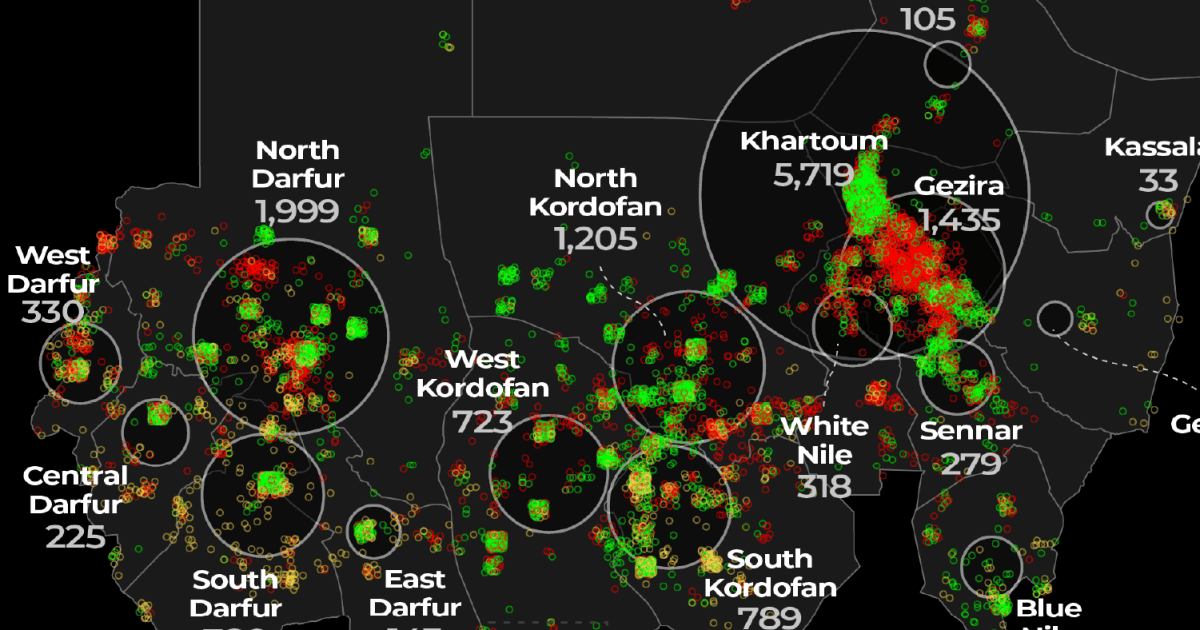
Al Jazeera maps where the fighting is concentrated in Kordofan and across Sudan, and the displacement that has followed.
Who controls what on the ground?
Sudan is broadly divided between the two sides. The SAF controls the capital, Khartoum, and most of the north, east and centre, while the RSF controls the west, including almost all of Darfur and parts of Kordofan. Smaller armed groups, including the RSF-allied Sudan People’s Liberation Movement-North (SPLM-N), hold pockets of territory in the south.
The army has the upper hand in the north, the RSF in the west, and South Kordofan remains contested.

Where have most attacks occurred?
According to an Al Jazeera analysis of data from the Armed Conflict Location and Event Data (ACLED), an independent conflict monitor, there were 14,648 recorded attacks between the start of the war on April 15, 2023, and September 19, 2026.
Advertisement
The four most affected states include:
- Khartoum: The capital region has seen the most, with 5,719 attacks, or 39 percent of the total, almost three times as many as North Darfur, the second-highest
- North Darfur has witnessed 1,999 attacks (13.7 percent)
- Gezira state has seen 1,435 attacks (9.8 percent)
- Kordofan emerged as a major centre for fighting. North, South and West Kordofan together recorded 2,876 attacks, or about 19.7 percent of all recorded attacks, putting the region behind only Khartoum when considered collectively.

Who has carried out the most attacks?
The SAF is associated with the largest share of recorded attacks between April 15, 2023 and September 19, 2026, accounting for just over half (52 percent), compared with just over a third (34.7 percent) for the RSF and 13.3 percent for other actors.

The balance of attacks has shifted over time. The SAF was associated with more recorded attacks than the RSF in the first year and a half of the war, before the RSF overtook it in number of attacks from late 2024 to mid-2025.
Since August 2025, the two sides’ monthly attack counts have been closer, with the SAF generally recording slightly more, even as the overall number of attacks has fallen sharply.

Where have attacks in Kordofan occurred?
After the fall of el-Fasher, the last major Darfur city held by the army and its allies, in October 2025, attention shifted to Kordofan. The region sits between RSF-held Darfur and the army-held centre, north and east, forming a corridor between the two sides’ heartlands.
Kordofan’s three states recorded 2,717 attacks: North Kordofan had 1,205 (44 percent), South Kordofan 789 and West Kordofan 723. Adding Abyei, a disputed oil-rich area on the Sudan-South Sudan border that was historically part of Kordofan, brings the total to 2,878.

The concentration of attacks differs from state to state. In North Kordofan, Sheikan locality alone accounted for 497 attacks, or 41 percent of the state’s total. Sheikan is home to the state capital, el-Obeid, a commercial and administrative hub linking central Sudan with the west. Taking the city would open a route east towards Khartoum for the RSF.

On September 9, a drone strike on a college in el-Obeid tore the roof off the building and killed a security guard, the college’s dean, Abdel Aziz al-Sheikh, told Reuters.
Advertisement
“As you can see, the entire faculty is destroyed and we feel that our dreams are destroyed, our future is destroyed,” Omnia Aboul Gassim, a student who had sat her exams at the el-Obeid college just one day before the attack, told Reuters.
In South Kordofan, Dilling locality was the main hotspot, with 242 attacks (31 percent), followed by Kadugli with 107 (14 percent) and Al Quoz with 94 (12 percent).
Attacks in West Kordofan were spread more evenly across localities. Babnusa recorded the most, with 142, followed by En Nuhud (119), Al Khiwai (112) and Abu Zabad (111).
ACLED has recorded at least 12,314 reported fatalities in Kordofan since April 2023.
The SAF was associated with 1,323 attacks (46 percent) across all three states in Kordofan, compared with 920 (32 percent) for the RSF and 633 (22 percent) for other actors.

How many people are displaced?
About 8.6 million people remain internally displaced across Sudan, according to the latest United Nations figures, down from a peak of 11.6 million in January 2025 as millions returned home to areas retaken by the army. New displacement continues in Kordofan, Darfur and Blue Nile.

Darfur hosts the largest concentrations of internally displaced people (IDPs), particularly South and North Darfur.
Returns have steadily increased since 2025, reaching about 5.1 million by August 2026. Khartoum has seen a major return of displaced people, with about 2.7 million returnees.

Despite the decline, millions remain displaced more than three years into the war. The International Organization for Migration (IOM) says the number of people newly displaced in Kordofan since fighting escalated in October 2025 has risen 65 percent in four months, from more than 132,000 in February to at least 219,000 by late June.
The agency has warned that el-Obeid, which shelters about 500,000 people, including more than 83,000 displaced, faces a looming threat of a full-scale invasion.
“The warning signs are impossible to ignore,” said IOM Director General Amy Pope earlier this month. “Across Sudan, families are fleeing violence, losing access to water, electricity and healthcare, and now facing the added burden of destructive floods.”

Related News
US arrests suspect in connection with Tumbler Ridge school shooting

Trump heads to South Carolina to boost Senator Darline Graham in race
Turkiye moves to ratify Mecca defence pact with Pakistan, Saudi Arabia