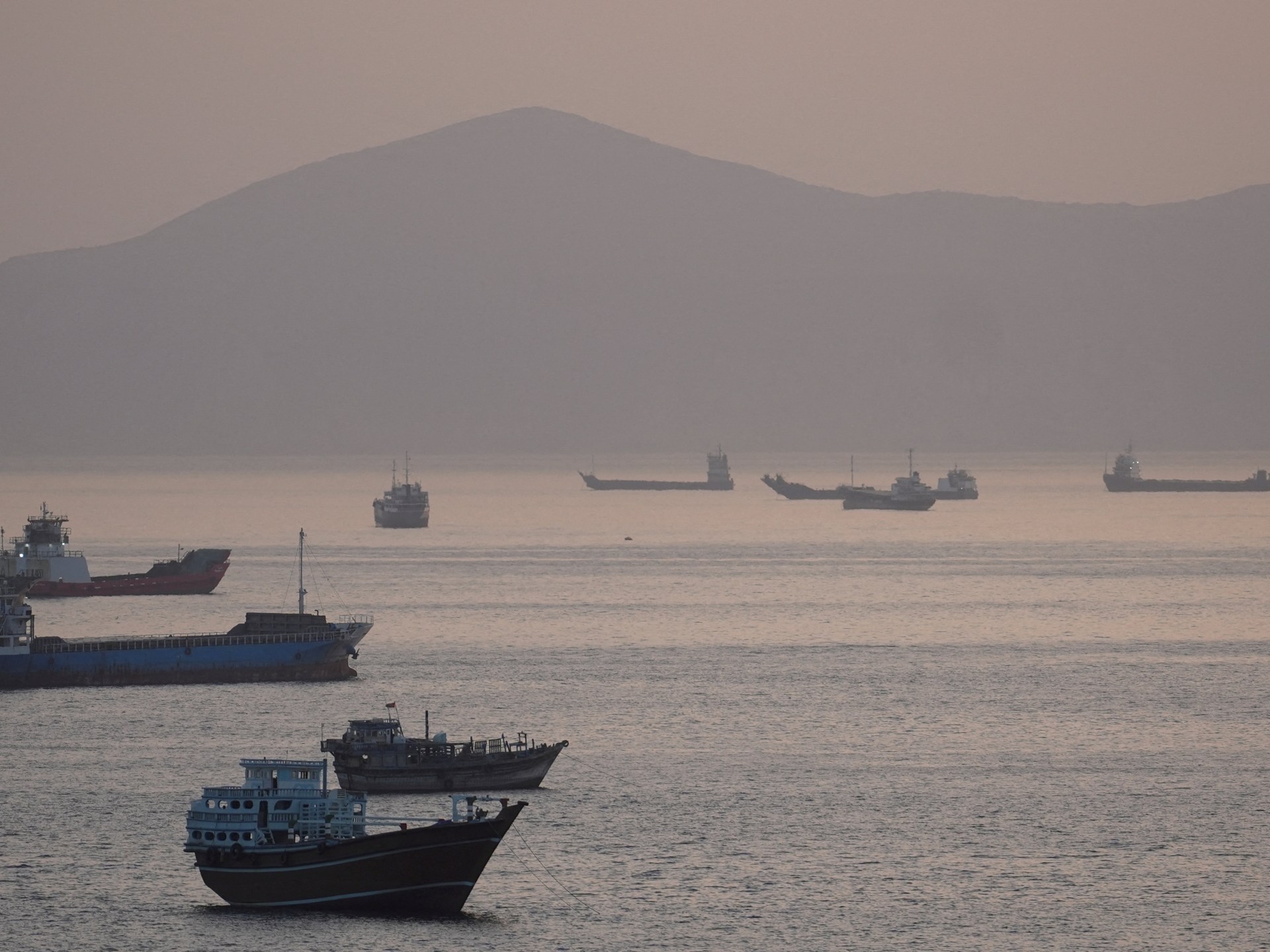

Safe transit through the Strait of Hormuz will be ensured as the United States threats end and with new procedures in place, the navy of Iran’s Islamic Revolutionary Guard Corps (IRGC) said, after the US said it was pausing operations to help stranded ships pass through the waterway.
The IRGC statement posted on X on Wednesday did not specify what the new procedures entailed. It thanked owners and captains of ships for respecting Iranian regulations when moving through the strait.
- list 1 of 4Miscalculation over Strait of Hormuz could ‘bring an all-out war’
- list 2 of 4Trump halts Hormuz operation, cites ‘great progress’ in Iran talks
- list 3 of 4US pauses plan to guide ships through the Strait of Hormuz
- list 4 of 4Airlines hike fares, cut millions of seats as Iran war drives up fuel costs
end of list
The announcement comes a day after US President Donald Trump halted the “Project Freedom” military operation to guide stranded vessels through the waterway.
On Tuesday, the US president said he would briefly pause the operation, citing “great progress” towards a comprehensive agreement with Iran, and saying it came at the request of mediator Pakistan. The US naval blockade of Hormuz, however, remains in effect, Trump said.
The Iranian ambassador to Pakistan, Reza Amiri Moghadam, said about the pause in Farsi: “He who tries what has already been tried will be filled with regret,” and in English: “Once Beaten, Twice Shy.”
Pakistan’s Prime Minister Shehbaz Sharif, mediating between Tehran and Washington, said he was “grateful” for Trump pausing the operation.
Sharif said on Wednesday that the pause will “go a long way towards advancing regional peace, stability and reconciliation during this sensitive period”.
Iran began to block the strait after the US and Israel launched their war on February 28, with Iranian forces attacking a number of ships, laying sea mines and charging fees for safe transit through the narrow channel.
Advertisement
Iran’s establishment of the “Persian Gulf Strait Authority” on Tuesday, a new body to regulate and organise the passage of vessels, whether military or commercial, seeks to permanently alter the status of the strait.
“Practically, what Iranians are saying is that this is not a temporary new maritime regime; they are talking about a permanent change in the status of the strait, and they say they are not going to give up on that,” said Al Jazeera’s Resul Serdar Atas, reporting from Tehran.
‘Project Freedom’ paused
The US operation in the strait had failed to bring about any significant resumption of traffic through the waterway, while provoking a new wave of Iranian strikes on ships in the strait and on targets in neighbouring countries.
In the latest attack, French shipping group CMA CGM said one of its vessels, the San Antonio, had been attacked while transiting the Strait of Hormuz, resulting in injuries among crew members and damage to the vessel.
The company said on Wednesday that the incident occurred a day earlier, with the injured crew now having been evacuated and given medical care.
The attack is the latest disruption in the crucial shipping route during the Middle East conflict. The war has blocked hundreds of vessels, stranded thousands of people and brought roughly 20 percent of global oil trade to a virtual standstill.
The incident shows that the situation remains dangerous in the Strait of Hormuz, but France was not specifically targeted by the attack, government spokesperson Maud Bregeon said .
“France was in no way the target,” Bregeon told reporters.
CMA CGM had reported last month that one of its vessels was the target of warning shots in the strait, although no crew members were injured.
The French firm, the world’s third-largest container shipping line, has indicated that 14 of its vessels were stranded in the Gulf at the start of the US-Israel war on Iran. One ship, the CMA CGM Kribi, exited the Strait of Hormuz at the start of April.
Lost revenues
The prolonged disruption in Hormuz is likely to drag the economies of the Gulf states.
“The Gulf economies are relatively strong. We’ve heard from countries like Saudi Arabia, the UAE and Qatar, which have large reserves. But even with the increase in oil and gas prices, you still need to ship your product out and it is having an impact,” said Al Jazeera’s Assed Baig, reporting from Doha, Qatar.
“According to Goldman Sachs, the Gulf Cooperation Council (GCC) states are losing roughly $700m daily by not being able to move oil.”
Advertisement
Related News
EU trade deal with South America’s Mercosur bloc takes provisional effect
Timeline: The highs and lows of the US-UK ‘special relationship’

Sudan refugees returning home face new ‘struggle for survival’: UN